


Jeremiah 33:19
Bible text: King James Version (1769 Blayney text) · Public domain
Bible text: Berean Standard Bible · Public domain
Bible text: American Standard Version (1901) · Public domain
Bible text: World English Bible, Messianic edition · Public domain
Bible text: Geneva Bible (1599) · Public domain
Bible text: Young's Literal Translation · Public domain
- וַיְהִיvay·Hiand it cameH1961Conj-w ¦ V-Qal-ConsecImperf-3msVerb Qal Consecutive Imperfect 3rd Singular Masculineוַandיְהִיit came
- דְּבַרde·var[the] word ofH1697N-mscNoun Singular Masculine Construct
- יְהוָהYah·wehYahwehH3068N-properNoun Proper Title
- אֶל'eltoH413PrepPreposition
- יִרְמְיָהוּyir·me·Ya·huJeremiahH3414N-proper-mNoun Proper Masculine
- לֵאמוֹרle·Mor<to> sayingH559Prep-l ¦ V-Qal-InfVerb Qal Infinitive Constructלֵ<to>אמוֹרsaying
English is a literal word-by-word gloss of the Hebrew, not the KJV's wording. Why?
This is the original text the KJV's translators worked from — each Hebrew word with its own literal English meaning in this verse, prepared by scholars at Tyndale House, Cambridge. The KJV translates whole sentences, not word by word, so its wording differs: one Hebrew word can become several English words, and the KJV may choose “the LORD” where the gloss reads “Yahweh”. Both are faithful — they answer different questions. For the KJV's own rendering, switch to the KJV text.
Details
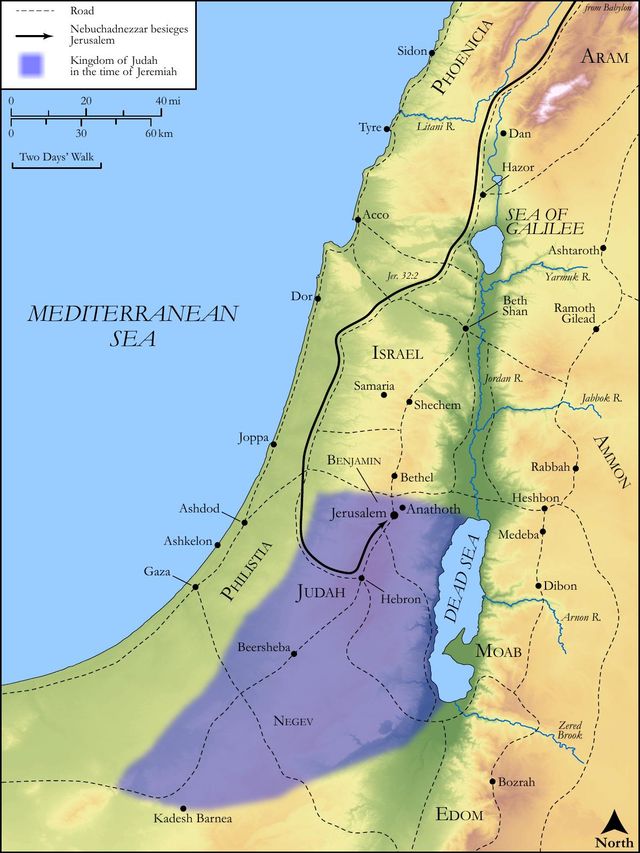
See on the biblical-era map
Study this verse
Public-domain commentary
Matthew Henry
From his Commentary on the Whole Bible. Henry comments on passages, not single verses — this entry covers Jeremiah 33:17–26. His two-level outline is real structure in the source text, so it is rendered as structure.
Three of God's covenants, that of royalty with David and his seed, that of the priesthood with Aaron and his seed, and that of Peculiarity with Abraham and his seed, seemed to be all broken and lost while the captivity lasted; but it is here promised that, notwithstanding that interruption and discontinuance for a time, they shall all three take place again, and the true intents and meaning of them all shall be abundantly answered in the New Testament blessings, typified by those conferred on the Jews after their return out of captivity.
I.The covenant of royalty shall be secured and the promises of it shall have their full accomplishment in the kingdom of Christ, the Son of David, Jer 33:17. The throne of Israel was overturned in the captivity; the crown had fallen from their head; there was not a man to sit on the throne of Israel; Jeconiah was written childless. After their return the house of David made a figure again; but it in the Messiah that this promise is performed that David shall never want a man to sit on the throne of Israel, and that David shall have always a son to reign upon his throne. For as long as the man Christ Jesus sits on the right hand of the throne of God, rules the world, and rules it for the good of the church, to which he is a quickening head, and glorified head over all things, as long as he is King upon the holy hill of Zion, David does not want a successor, nor is the covenant with him broken. When the first-begotten was brought into the world it was declared concerning him, The Lord God shall give him the throne of his father David and he shall reign over the house of Jacob for ever, Luk 1:32, Luk 1:33. For the confirmation of this it is promised,
1.That the covenant with David shall be as firm as the ordinances of heaven, to the stability of which that of God's promise is compared, Jer 31:35, Jer 31:36. There is a covenant of nature, by which the common course of providence is settled and on which it is founded, here called a covenant of the day and the night (Jer 33:20, Jer 33:25), because this is one of the articles of it, That there shall be day and night in their season, according to the distinction put between them in the creation, when God divided between the light and the darkness, and established their mutual succession, and a government to each, that the sun should rule by day and the moon and stars by night (Gen 1:4, Gen 1:5, Gen 1:16), which establishment was renewed after the flood (Gen 8:22), and has continued ever since, Psa 19:2. The morning and the evening have both of them their regular outgoings (Psa 65:8); the day-spring knows its place, knows its time, and keeps both, so do the shadows of the evening; and, while the world stands, this course shall not be altered, this covenant shall not be broken. The ordinances of heaven and earth (of this communication between heaven and earth, the dominion of these ordinances of heaven upon the earth), which God has appointed (Jer 33:25; compare Job 38:33), shall never be disappointed. Thus firm shall the covenant of redemption be with the Redeemer - God's servant, but David our King, Jer 33:21. This intimates that Christ shall have a church on earth to the world's end; he shall see a seed in which he shall prolong his days till time and day shall be no more. Christ's kingdom is an everlasting kingdom; and when the end cometh, and not till then, it shall be delivered up to God, even the Father. But it intimates that the condition of it in this world shall be intermixed and counterchanged, prosperity and adversity succeeding each other, as light and darkness, day and night. But this is plainly taught us, that, as sure as we may be that, though the sun will set tonight, it will rise again tomorrow morning, whether we live to see it or no, so sure we may be that, though the kingdom of the Redeemer in the world may for a time be clouded and eclipsed by corruptions and persecutions, yet it will shine forth again, and recover its lustre, in the time appointed.
2.That the seed of David shall be as numerous as the host of heaven, that is, the spiritual seed of the Messiah, that shall be born to him by the efficacy of his gospel and his Spirit working with it. From the womb of the morning he shall have the dew of their youth, to be his willing people, Psa 110:3. Christ's seed are not, as David's were, his successors, but his subjects; yet the day is coming when they also shall reign with him (Jer 33:22): As the host of heaven cannot be numbered, so will I multiply the seed of David, so that there shall be no danger of the kingdom's being extinct, or extirpated, for want of heirs. The children are numerous; and, if children, then heirs.
II.The covenant of priesthood shall be secured, and the promises of that also shall have their full accomplishment.
This seemed likewise to be forgotten during the captivity, when there was no altar, no temple service, for the priests to attend upon; but this also shall revive. It did so; immediately upon their coming back to Jerusalem there were priests and Levites ready to offer burnt-offerings and to do sacrifice continually (Ezr 3:2, Ezr 3:3), as is here promised, Jer 33:18. But that priesthood soon grew corrupt; the covenant of Levi was profaned (as appears Mal 2:8), and in the destruction of Jerusalem by the Romans it came to a final period. We must therefore look elsewhere for the performance of this word, that the covenant with the Levites, the priests, God's ministers, shall be as firm, and last as long, as the covenant with the day and the night. And we find it abundantly performed,
1.In the priesthood of Christ, which supersedes that of Aaron, and is the substance of that shadow. While that great high priest of our profession is always appearing in the presence of God for us, presenting the virtue of his blood by which he made atonement in the incense of his intercession, it may truly be said that the Levites do not want a man before God to offer continually, Heb 7:3, Heb 7:17. He is a priest for ever. The covenant of the priesthood is called a covenant of peace (Num 25:12), of life and peace, Mal 2:5. Now we are sure that this covenant is not broken, nor in the least weakened, while Jesus Christ is himself our life and our peace. This covenant of priesthood is here again and again joined with that of royalty, for Christ is a priest upon his throne, as Melchizedek.
2.In a settled gospel ministry. While there are faithful ministers to preside in religious assemblies, and to offer up the spiritual sacrifices of prayer and praise, the priests, the Levites, do not want successors, and such as have obtained a more excellent ministry. The apostle makes those that preach the gospel to come in the room of those that served at the altar, Co1 9:13, Co1 9:14.
3.In all true believers, who are a holy priesthood, a royal priesthood (Pe1 2:5, Pe1 2:9), who are made to our God kings and priests (Rev 1:6); they offer up spiritual sacrifices, acceptable to God, and themselves, in the first place, living sacrifices. Of these Levites this promise must be understood (Jer 33:22), that they shall be as numerous as the sand of the sea, the same that is promised concerning Israel in general (Gen 22:17); for all God's spiritual Israel are spiritual priests, Rev 5:9, Rev 5:10; Rev 7:9, Rev 7:15.
III.The covenant of peculiarity likewise shall be secured and the promises of that covenant shall have their full accomplishment in the gospel Israel. Observe,
1.How this covenant was looked upon as broken during the captivity, Jer 33:24. God asks the prophet, "Hast though not heard, and dost thou not consider, what this people have spoken?" either the enemies of Israel, who triumphed in the extirpation of a people that had made such a noise in the world, or the unbelieving Israelites themselves, "this people among whom thou dwellest;" they have broken covenant with God, and then quarrel with him as if he had not dealt faithfully with them. The two families which the Lord hath chosen, Israel and Judah, whereas they were but one when he chose them, he hath even cast them off. "Thus have they despised my people, that is, despised the privilege of being my people as if it were a privilege of no value at all." The neighbouring nations despised them as now no more a nation, but the ruins of a nation, and looked upon all their honour as laid in the dust; but,
2.See how firm the covenant stands notwithstanding, as firm as that with day and night; sooner will God suffer day and night to cease then he will cast away the seed of Jacob. This cannot refer to the seed of Jacob according to the flesh, for they are cast away, but to the Christian church, in which all these promises were to be lodged, as appears by the apostle's discourse, Rom 11:1, etc. Christ is that seed of David that is to be perpetual dictator to the seed of Abraham, Isaac, and Jacob; and, as this people shall never want such a king, so this king shall never want such a people. Christianity shall continue in the dominion of Christ, and the subjection of Christians to him, till day and night come to an end. And, as a pledge of this, that promise is again repeated, I will cause their captivity to return; and, having brought them back, I will have mercy on them. To whom this promise refers appears Gal 6:16, where all that walk according to the gospel rule are made to be the Israel of God, on whom peace and mercy shall be.
Historical interpretation
Historical reception
2 surviving comments on this verse. Each one is dated, so this reads as a timeline rather than a list.
Select a marker to jump to its quote. Markers stagger vertically where authors wrote within a few decades of each other.
We see the fulfillment of this prophecy as well. When the new covenant was given, in keeping with the divine promise, the priesthood was also given according to the order of Melchizedek, and those to whom it was promised offer the spiritual sacrifice to God continually. Then he says, as it is impossible for day to become night, so it is impossible for the Davidic monarchy to be destroyed. The fulfillment of this prophecy is also clear: Christ, who is of David according to the flesh, does not occupy the throne here below. He does, however, govern all things as he sits next to the Father. This is precisely what he also says about the priests and the Levites, noting that their line will be compared with the host of heaven and the sand of the sea. The facts confirm what is said: the whole land and sea are full of high priests and the deacons performing the liturgy of the Levites.
“But the counsel of the Lord stands forever. The thoughts of his heart are for all time.” Just as he said that the debased plans of people are to be made vain, so now he says that the dispositions of the Lord remain forever. While the sinner and the mortal person experience transient things, the eternal Lord established what will never be blameworthy. As Isaiah says, “All my counsel shall be enduring, and all that I meditated I shall achieve.” Jeremiah too says the same thing: “If my covenant were not under guard day and night, I should not have issued the laws of heaven and earth.”
Continue studying Jeremiah 33:19 across the web’s major study libraries — every link below opens this exact verse, chapter, or book on the destination site.
Read & Compare
 BibleGatewayThis verse in more than 200 translations and 70 languages.
 Bible.comThe YouVersion reader — hundreds of translations, reading plans, and highlights.
 ESV.orgCrossway's official English Standard Version reader.
 NET BibleThe NET translation with 60,000+ translators' notes on every rendering decision.
 STEP BibleTyndale House's free study tool — original text, vocabulary, and scholarly resources.
 BibliaLogos Bible Software's free web reader.
 USCCBThe New American Bible (Revised Edition) with the U.S. bishops' study notes.
Commentaries
 BibleHub CommentariesDozens of classic commentaries on this verse, gathered on one page.
 StudyLightMore than 100 commentary sets — the largest collection on the web.
 BibleRefPlain-English commentary on what this verse means, verse by verse.
 Enduring WordDavid Guzik's free commentary on this chapter, widely used by Bible teachers.
 Bible Study ToolsVerse commentary alongside Greek and Hebrew study aids.
Original Language & Research
- BibleHub InterlinearThe verse word by word — original language, transliteration, and English.
- BibleHub LexiconEvery word's original-language definition and Strong's entry.
 Blue Letter BibleDeep-study tools — Strong's numbers, concordance, and word studies.
 SefariaThe Hebrew text with Rashi and centuries of Jewish commentary.
Sermons, Hymns & Audio


TrulyRandomVerse is not affiliated with these sites and doesn’t control their content. They’re linked because they’re genuinely useful.
Summary
Jeremiah 33:19 serves as a foundational prophetic formula, introducing a divine oracle directly from the Lord to His prophet Jeremiah. This concise yet profoundly significant statement underscores the absolute divine origin and unimpeachable authority of the subsequent message, signaling that what follows is not human conjecture or mere opinion but an authoritative declaration from the sovereign, covenant-keeping God of Israel. It sets the stage with solemn gravity for the profound assurances of restoration, unwavering covenant faithfulness, and the ultimate fulfillment of God's promises that characterize the latter part of Jeremiah chapter 33.
Context
ShowHideLiterary Context
Jeremiah 33:19 is strategically placed within the "Book of Consolation" (chapters 30-33), a pivotal section of Jeremiah's prophecy that marks a dramatic shift from pronouncements of impending judgment and exile to glorious promises of future restoration and hope for Judah and Jerusalem. Immediately preceding this verse, Jeremiah 33:14-18 reaffirms God's unconditional covenants with David, promising a "righteous Branch" (the Messiah), and with the Levitical priests, ensuring their perpetual service. Verse 19 then acts as a crucial transitional marker, introducing the subsequent divine assurances in Jeremiah 33:20-26, which further ground God's covenant faithfulness in the immutable, observable order of creation—specifically, the covenant with day and night. This formulaic introduction emphasizes that the extraordinary promises of restoration, though seemingly impossible from a human perspective, are rooted in the unchanging character and infallible word of God.
Historical & Cultural Context
Jeremiah prophesied during one of the most tumultuous periods in Judah's history, marked by national decline, pervasive moral corruption, and the looming, then realized, threat of Babylonian invasion, culminating in the destruction of Jerusalem and the exile of its people. The Judahites were experiencing profound despair, questioning God's faithfulness and the validity of His ancient covenants in the face of national catastrophe. In such a desperate context, the prophetic word was absolutely vital for conveying God's perspective, His righteous judgment, and, crucially, His ultimate plan for redemption beyond the immediate devastation. The phrase "the word of the LORD came" was a culturally recognized and deeply significant marker of divine revelation, distinguishing true prophecy from human speculation, political maneuvering, or false prophecy, thereby lending immense authority and credibility to Jeremiah's message amidst widespread skepticism, suffering, and spiritual confusion.
Key Themes
ShowHideThis introductory phrase highlights several key themes central to the book of Jeremiah and indeed, to all prophetic literature. Firstly, Divine Communication is paramount; it underscores that God is not silent or aloof but actively intervenes in human history by revealing His will, purposes, and character to His chosen messengers. Secondly, it emphasizes God's Initiative and Authority, demonstrating His absolute sovereignty over all creation and human affairs, as He originates the message and dictates its content, not merely responding to human inquiry. Thirdly, the consistent use of this formula throughout prophetic books, and especially within a chapter focused on God's unwavering promises, reinforces the Reliability and Truthfulness of God's Word. It sets the theological foundation for the profound assurances that follow, particularly concerning the enduring nature of God's covenants, which are presented as being as sure as the covenant of day and night. This phrase implicitly calls the audience to listen attentively and trust implicitly, for the word is from the LORD, who made the heavens and the earth by His great power.
Exposition and Analysis
ShowHideKey Word Analysis
ShowHideFrom דָבַר; a word; by implication, a matter (as spoken of) or thing. In this context, "dâbâr" signifies far more than a mere utterance or sound; it carries the profound weight of divine decree, authoritative pronouncement, and the very essence of God's revealed will. It is the active, powerful expression of God's thought and intention, which, as seen throughout Scripture, inherently possesses the power to accomplish precisely what it declares.
From הָיָה; (the) self-Existent or Eternal; Jehovah, Jewish national name of God. This is the sacred, covenantal name of God (YHWH), emphasizing His eternal, unchanging nature, His absolute sovereignty, and His unwavering faithfulness to His promises. The use of "Yᵉhôvâh" here assures the audience that the message comes from the God who is utterly reliable, the one who was, and is, and is to come, and who remains steadfast in His covenant relationship with Israel, even in their darkest hour.
A primitive root; to say (used with great latitude). This verb indicates direct speech and intentional communication. In conjunction with "dâbâr" (word/decree) and "Yᵉhôvâh" (the covenant God), "ʼâmar" highlights the immediate, personal, and intentional nature of God's revelation to Jeremiah. It confirms that the subsequent prophecy is a direct, verbal message from God, not an interpretation, a vision alone, or a human deduction.
Verse Breakdown
ShowHide"And the word of the LORD"
This opening phrase unequivocally establishes the divine origin and supreme authority of the message about to be delivered. It is not Jeremiah's own thoughts, insights, or opinions, nor is it a product of human wisdom or political analysis. Instead, it is a direct, unadulterated communication from YHWH, the sovereign, covenant-keeping God of Israel. This immediately elevates the message above human fallibility and gives it ultimate weight, truthfulness, and binding power.
"came unto Jeremiah"
This clause precisely identifies the specific human recipient and channel of the divine word. Jeremiah is God's chosen messenger, the human conduit through whom God chooses to speak to His people. This highlights the prophetic office as one of mediation, where a human being is entrusted with the sacred duty of conveying God's unadulterated message to humanity, often at great personal cost. It underscores the personal nature of God's interaction with His prophets.
"saying,"
This final word serves as a direct introduction to the content of God's speech. It signals that what immediately follows is the precise oracle or pronouncement that God is about to reveal through Jeremiah. It emphasizes that the message is a verbal, articulate declaration, not merely an impression, a feeling, or a non-verbal sign, thereby demanding careful attention to the specific words that follow.
Literary Devices
ShowHideJeremiah 33:19 primarily employs the literary device of a Prophetic Formula. The phrase "And the word of the LORD came unto X, saying," is a standard, highly recognizable introductory formula used hundreds of times throughout the Old Testament prophetic books (e.g., Ezekiel 1:3, Hosea 1:1). This formula serves multiple critical functions: it immediately establishes the Divine Authority of the subsequent message, unequivocally distinguishing it from human wisdom, opinion, or speculation. It underscores the Divine Initiative, showing that God actively chooses to speak and reveal His will to humanity, rather than being sought out or compelled. Furthermore, its repetitive nature across prophetic texts creates a powerful sense of Consistency and Reliability in God's communication, reinforcing the idea that God is a speaking God whose word is trustworthy, unchanging, and true. This formula also functions as a Framing Device, solemnly signaling to the reader or listener that they are about to receive a direct divine oracle, thereby demanding their utmost attention, reverence, and faith.
Theological and Thematic Connections
ShowHideJeremiah 33:19, though concise, is profoundly significant as it affirms the very foundation of biblical revelation: God speaks. This verse underscores the active, personal, and authoritative nature of God's communication with humanity. It reminds us that the Bible is not merely a collection of human thoughts about God, but the very "word of the LORD," breathed out by Him and delivered through chosen vessels. This divine origin guarantees the truthfulness, reliability, and inherent power of Scripture. In a broader theological sense, it points to God's covenant faithfulness, as His word is the primary means by which He establishes, maintains, and ultimately fulfills His promises, even when human circumstances seem to contradict them. The stability and immutability of God's word are presented as the bedrock upon which all hope for restoration and future blessing rests.
Reflection and Application
ShowHideThe seemingly simple phrase "And the word of the LORD came unto Jeremiah, saying," carries profound implications for our faith and daily lives. It reminds us that the God of the universe is not silent or distant, but a God who actively communicates His will, character, and purposes. Just as He spoke directly to Jeremiah in a time of national crisis, despair, and exile, He continues to speak to us today primarily through His inspired written Word, the Bible. This calls us to approach Scripture with profound reverence and humility, recognizing that we are encountering the very voice of the Almighty, a living and active word that shapes reality. It instills immense hope, for if God has spoken, His promises are sure, and His plans will ultimately prevail, regardless of our present circumstances or the chaos of the world around us. Our sacred task is to listen attentively, to trust implicitly in the truthfulness and power of His declarations, and to obey diligently, knowing that His word is the unshakable foundation for our lives, providing infallible guidance, profound comfort, and unwavering hope in every season.
Questions for Reflection
ShowHideFAQ
ShowHideWhat is the significance of the phrase "the word of the LORD came"?
ShowHideThis phrase, a hallmark of prophetic literature, is profoundly significant because it unequivocally establishes the divine origin and absolute authority of the message that follows. It emphatically declares that the subsequent words are not Jeremiah's personal opinion, political commentary, or psychological insight, but a direct, undeniable revelation from God Himself. This formula (Hebrew: vayhi devar Yahweh 'el) ensures that the audience understands that the subsequent words are God's authoritative declaration, carrying divine weight and demanding a response of faith and obedience. It critically distinguishes true prophecy from human speculation or false claims, emphasizing that God is actively involved in human history and communicates His will to His chosen servants. This divine backing was crucial, especially in a book like Jeremiah, where the prophet's message often brought unpopular truths, challenging calls to repentance, and difficult pronouncements of judgment, making the divine endorsement essential for its credibility and reception. The phrase sets the stage for the powerful promises of restoration and hope found throughout Jeremiah 33.
Christ-Centered Fulfillment
ShowHideJeremiah 33:19, by emphasizing that "the word of the LORD came," profoundly foreshadows the ultimate and most complete revelation of God's Word in the person of Jesus Christ. While God spoke "at many times and in various ways through the prophets" (Hebrews 1:1), He has "in these last days spoken to us by his Son" (Hebrews 1:2). Jesus is not merely a messenger of God's word, nor just a prophet who receives it; He is the Word made flesh (John 1:14), the living, breathing, and perfect embodiment of divine revelation. Just as the word came to Jeremiah to declare God's unwavering covenants and promises of restoration for Israel, so too did the eternal Word, Jesus, come into the world to fulfill those very promises, establishing a new and better covenant, mediated by Himself (Hebrews 8:6). Through Christ, God's ultimate message of salvation, reconciliation, and eternal life is delivered, demonstrating the absolute faithfulness of the Lord to His people—a faithfulness as sure as the covenant with day and night that Jeremiah 33:19 introduces. In Jesus, the "word of the LORD" is not just heard from afar, but seen, touched, and experienced, bringing the promised "righteous Branch" (Jeremiah 33:15) to glorious fruition.