


Genesis 32:19
Bible text: King James Version (1769 Blayney text) · Public domain
Bible text: King James Version with Strong's numbers · Public domain
Bible text: Berean Standard Bible · Public domain
Bible text: American Standard Version (1901) · Public domain
Bible text: World English Bible, Messianic edition · Public domain
Bible text: Geneva Bible (1599) · Public domain
Bible text: Young's Literal Translation · Public domain
- וַיְצַוvay·Tzavand he commandedH6680Conj-w ¦ V-Piel-ConsecImperf-3msVerb Piel Consecutive Imperfect 3rd Singular Masculineוַandיְצַוhe commanded
- גַּםgambothH1571AdvAdverb
- אֶת'et<obj.>H853DirObjMParticle Object Indicator
- הַשֵּׁנִיha·she·Nithe secondH8145Art ¦ Adj-msAdjective Numerical Position Singular Masculine Absoluteהַtheשֵּׁנִיsecond
- גַּםgamas well asH1571AdvAdverb
- אֶת'et<obj.>H853DirObjMParticle Object Indicator
- הַשְּׁלִישִׁיha·she·li·Shithe thirdH7992Art ¦ Adj-msAdjective Numerical Position Singular Masculine Absoluteהַtheשְּׁלִישִׁיthird
- גַּםgamas well asH1571AdvAdverb
- אֶת'et<obj.>H853DirObjMParticle Object Indicator
- כָּלkolallH3605N-msNoun Singular Masculine Absolute
- הַהֹלְכִיםha·Ho·le·Khimwho were goingH1980Art ¦ V-Qal-Prtcpl-mpVerb Qal Participle Plural Masculine Absoluteהַwhoהֹלְכִיםwere going
- אַחֲרֵי'a·cha·ReibehindH310Adj-mpcAdjective Numerical Plural Masculine Construct
- הָעֲדָרִיםha·'a·da·Rimthe herdsH5739Art ¦ N-mpNoun Plural Masculine Absoluteהָtheעֲדָרִיםherds
- לֵאמֹרle·Mor<to> sayingH559Prep-l ¦ V-Qal-InfVerb Qal Infinitive Constructלֵ<to>אמֹרsaying
- כַּדָּבָרka·da·Varaccording to the mannerH1697Prep-k ¦ N-msNoun Singular Masculine Absoluteכַּaccording to theדָּבָרmanner
- הַזֶּהha·Zeh<the> thisH2088Art ¦ PrtParticle Demonstrativeהַ<the>זֶּהthis
- תְּדַבְּרוּןte·da·be·Runyou will speak !H1696V-Piel-Imperf-2mp ¦ SfxVerb Piel Imperfect 2nd Plural Masculineתְּדַבְּרוּyou will speakן!
- אֶל'eltoH413PrepPreposition
- עֵשָׂו'e·SavEsauH6215N-proper-mNoun Proper Masculine
- בְּמֹצַאֲכֶםbe·mo·tza·'a·Khemwhen find youH4672Prep-b ¦ V-Qal-Inf ¦ 2mpVerb Qal Infinitive Constructבְּwhenמֹצַאֲfindכֶםyou
- אֹתוֹ'o·To<obj.> himH853DirObjM ¦ 3msParticle Object Indicatorאֹת<obj.>וֹhim
English is a literal word-by-word gloss of the Hebrew, not the KJV's wording. Why?
This is the original text the KJV's translators worked from — each Hebrew word with its own literal English meaning in this verse, prepared by scholars at Tyndale House, Cambridge. The KJV translates whole sentences, not word by word, so its wording differs: one Hebrew word can become several English words, and the KJV may choose “the LORD” where the gloss reads “Yahweh”. Both are faithful — they answer different questions. For the KJV's own rendering, switch to the KJV text.
Details
See on the biblical-era maps


Study this verse
Public-domain commentary
Matthew Henry
From his Commentary on the Whole Bible. Henry comments on passages, not single verses — this entry covers Genesis 32:13–23. His two-level outline is real structure in the source text, so it is rendered as structure.
Jacob, having piously made God his friend by a prayer, is here prudently endeavouring to make Esau his friend by a present. He had prayed to God to deliver him from the had of Esau, for he feared him; but neither did his fear sink into such a despair as dispirits for the use of means, nor did his prayer make him presume upon God's mercy, without the use of means. Note, When we have prayed to God for any mercy, we must second our prayers with our endeavours; else, instead of trusting god, we tempt him; we must so depend upon God's providence as to make use of our own prudence. "Help thyself, and God will help thee;" God answers our prayers by teaching us to order our affairs with discretion. To pacify Esau,
I.Jacob sent him a very noble present, not of jewels or fine garments (he had them not), but of cattle, to the number of 580 in all, Gen 32:13-15. Now,
1.It was an evidence of the great increase with which God had blessed Jacob that he could spare such a number of cattle out of his stock.
2.It was an evidence of his wisdom that he would willingly part with some, to secure the rest; some men's covetousness loses them more than ever it gained them, and, by grudging a little damage; skin for skin, and all that a man has, if he be a wise man, he will give for his life.
3.It was a present that he thought would be acceptable to Esau, who had traded so much in hunting wild beasts that perhaps he was but ill furnished with tame cattle with which to stock his new conquests. And we may suppose that the mixed colours of Jacob's cattle, ring-straked, speckled, and spotted, would please Esau's fancy.
4.He promised himself that by this present he should gain Esau's favour; for a gift commonly prospers, which way soever it turns (Pro 17:8), and makes room for a man (Pro 18:16); nay, it pacifies anger and strong wrath, Pro 21:14. Note, [1.] We must not despair of reconciling ourselves even to those that have been most exasperated against us; we ought not to judge men unappeasable, till we have tried to appease them. [2.] Peace and love, though purchased dearly, will prove a good bargain to the purchaser. Many a morose ill-natured man would have said, in Jacob's case, "Esau has vowed my death without cause, and he shall never be a farthing the better for me; I will see him far enough before I will send him a present:" but Jacob forgives and forgets.
II.He sent him a very humble message, which he ordered his servants to deliver in the best manner, Gen 32:17, Gen 32:18.
They must call Esau their lord, and Jacob his servant; they must tell him the cattle they had was a small present which Jacob had sent him, as a specimen of his acquisitions while he was abroad. The cattle he sent were to be disposed of in several droves, and the servants that attended each drove were to deliver the same message, that the present might appear the more valuable, and his submission, so often repeated, might be the more likely to influence Esau. They must especially take care to tell him that Jacob was coming after (Gen 32:18-20), that he might not suspect he had fled through fear. Note, A friendly confidence in men's goodness may help to prevent the mischief designed us by their badness: if Jacob will seem not to be afraid of Esau, Esau, it may be hoped, will not be a terror to Jacob.
Continue studying Genesis 32:19 across the web’s major study libraries — every link below opens this exact verse, chapter, or book on the destination site.
Read & Compare
 BibleGatewayThis verse in more than 200 translations and 70 languages.
 Bible.comThe YouVersion reader — hundreds of translations, reading plans, and highlights.
 ESV.orgCrossway's official English Standard Version reader.
 NET BibleThe NET translation with 60,000+ translators' notes on every rendering decision.
 STEP BibleTyndale House's free study tool — original text, vocabulary, and scholarly resources.
 BibliaLogos Bible Software's free web reader.
 USCCBThe New American Bible (Revised Edition) with the U.S. bishops' study notes.
Commentaries
 BibleHub CommentariesDozens of classic commentaries on this verse, gathered on one page.
 StudyLightMore than 100 commentary sets — the largest collection on the web.
 BibleRefPlain-English commentary on what this verse means, verse by verse.
 Enduring WordDavid Guzik's free commentary on this chapter, widely used by Bible teachers.
 Bible Study ToolsVerse commentary alongside Greek and Hebrew study aids.
Original Language & Research
- BibleHub InterlinearThe verse word by word — original language, transliteration, and English.
- BibleHub LexiconEvery word's original-language definition and Strong's entry.
 Blue Letter BibleDeep-study tools — Strong's numbers, concordance, and word studies.
 SefariaThe Hebrew text with Rashi and centuries of Jewish commentary.
Sermons, Hymns & Audio


TrulyRandomVerse is not affiliated with these sites and doesn’t control their content. They’re linked because they’re genuinely useful.
Summary
Genesis 32:19 details Jacob's meticulous and repeated instructions to his servants, ensuring that the specific message intended for Esau was delivered consistently by each successive wave of gift-bearing droves. This command was an integral part of Jacob's elaborate strategy to appease his estranged brother, emphasizing humility and generosity, and carefully preparing Esau for their long-anticipated reunion after two decades of separation.
Context
ShowHideLiterary Context
Genesis 32 is a pivotal chapter in the Jacob narrative, marking his return to Canaan after twenty years with Laban. The immediate literary context shows Jacob grappling with profound fear and anxiety as he anticipates encountering his brother Esau, from whom he had fled after deceiving him out of his birthright and blessing. The chapter begins with a divine encounter at Mahanaim (Genesis 32:1-2), followed by Jacob sending messengers to Esau (Genesis 32:3-5). Upon hearing that Esau is approaching with 400 men, Jacob is "greatly afraid and distressed" (Genesis 32:7). In response, he divides his camp, prays fervently (Genesis 32:9-12), and then devises a comprehensive plan involving a series of costly gifts, or "droves," sent ahead of him. Verse 19 specifically reiterates the instructions for the latter groups, underscoring the systematic and persistent nature of Jacob's appeasement strategy.
Historical & Cultural Context
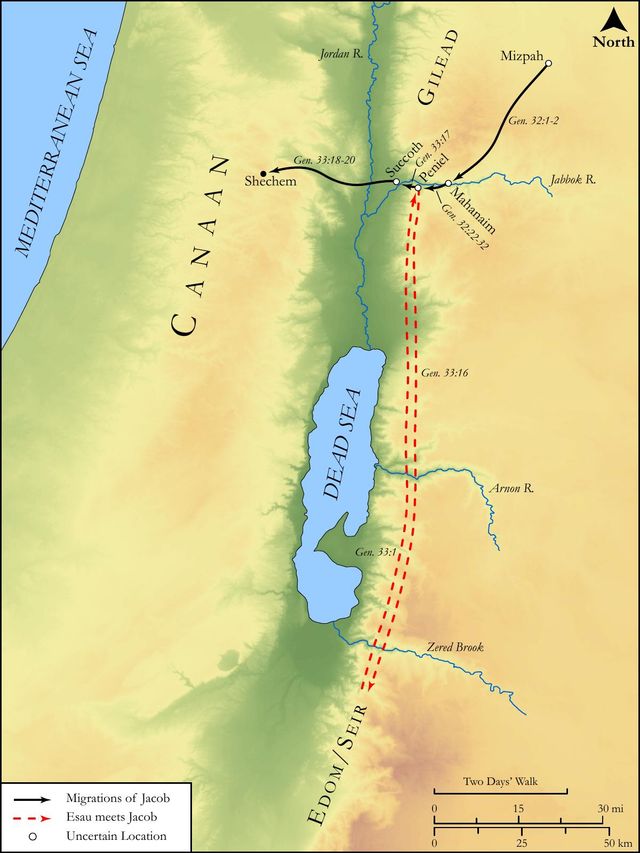
In the lands of the patriarchs, diplomatic encounters, especially between estranged family members or potential adversaries, often involved elaborate gift-giving as a means of reconciliation, tribute, or appeasement. Gifts were not merely tokens but carried significant symbolic weight, demonstrating respect, submission, or a desire for peace. The sending of multiple, staggered droves, each accompanied by a deferential message, was a highly sophisticated tactic. Furthermore, the concept of "face" and honor was paramount; Jacob's self-identification as "thy servant" to Esau, his elder brother, was a profound act of humility, effectively reversing their traditional roles and acknowledging Esau's superior status. This act was designed to disarm Esau's potential wrath, which was culturally understood as a legitimate response to Jacob's past deception. The geography of the region, as Jacob approached Edom (Esau's territory), also made a peaceful resolution critical for his safe passage and future settlement in Canaan.
Key Themes
ShowHideThis verse contributes to several overarching themes within Genesis and the broader biblical narrative. The primary theme is Reconciliation and Peacemaking, as Jacob actively seeks to mend a deeply fractured family relationship, demonstrating a proactive approach to conflict resolution. It also highlights Human Prudence and Divine Providence, illustrating how Jacob's earnest prayer for deliverance (Genesis 32:9-12) is immediately followed by meticulous human planning and strategic action. This interplay suggests that faith does not negate responsibility but often works in conjunction with wise and diligent effort. The theme of Humility and Deference is also prominent, as Jacob, despite his wealth and God's promises, adopts a subservient posture towards Esau, recognizing the need to humble himself to achieve peace. Finally, the narrative underscores the Consequences of Past Actions and the long shadow they cast, necessitating significant effort to overcome.
Exposition and Analysis
ShowHideKey Word Analysis
ShowHideThis primitive root means "to constitute, enjoin; appoint, (for-) bid, (give a) charge, (give a, give in, send with) command(-er, -ment)." Here, it emphasizes Jacob's authoritative and deliberate instruction. It's not a mere suggestion but a firm directive, highlighting the seriousness and precision of his plan. The verb implies a setting in order, a careful arrangement of his strategy.
Derived from the root "to speak," this noun signifies "a word; by implication, a matter (as spoken of) or thing." In this context, "on this manner" refers directly to the specific "word" or "message" that the servants were to deliver to Esau. It underscores the exactness required in their communication, ensuring that the verbal message accompanying the gifts was consistent and impactful, reinforcing Jacob's deferential posture.
This primitive root means "to come forth to, i.e. appear or exist; transitively, to attain, i.e. find or acquire; figuratively, to occur, meet or be present." The phrase "when ye find him" introduces a contingency, indicating that the instructions were to be carried out upon the actual encounter with Esau. It implies a search or a meeting, emphasizing the direct, personal delivery of the message and gifts, rather than leaving them for Esau to discover.
Verse Breakdown
ShowHide"And so commanded he the second, and the third, and all that followed the droves,"
This clause reveals the systematic and comprehensive nature of Jacob's strategy. Having given instructions to the first group, he reiterates the identical command to the subsequent groups of servants leading the various animal droves. The phrase "all that followed the droves" indicates that no group was exempt; every segment of his procession carrying gifts was to participate in this pre-emptive appeasement. This repetition underscores Jacob's thoroughness and his determination to ensure the message's consistent delivery and cumulative effect.
"saying,"
This simple participle introduces the direct speech that follows, indicating the content of Jacob's command. It links the act of commanding with the specific message to be conveyed.
"On this manner shall ye speak unto Esau,"
This is the core of the instruction. "On this manner" refers to the precise message detailed in the preceding verses (specifically Genesis 32:18 and Genesis 32:20), which involved identifying the gifts as from "thy servant Jacob" and informing Esau that Jacob himself was following behind. The command to "speak" highlights the verbal component of the appeasement strategy, emphasizing that the gifts were to be accompanied by a deferential and explanatory message.
"when ye find him."
This concluding phrase specifies the timing and condition for the delivery of the message. It's not a general broadcast but a direct, personal address to Esau upon encountering him. This contingency clause adds to the realism and practicality of Jacob's plan, ensuring the message's impact at the critical moment of meeting.
Literary Devices
ShowHideThe verse employs several literary devices to enhance its meaning and impact. Repetition is evident in Jacob's command being given not just to one group but to "the second, and the third, and all that followed the droves," emphasizing the meticulous and pervasive nature of his strategy. This highlights Jacob's anxiety and his desire to leave nothing to chance. The use of Foreshadowing is also present, as Jacob's careful preparation and the detailed instructions hint at the momentous and potentially dangerous encounter with Esau that is soon to unfold. The entire passage, including this verse, functions as Suspense-building, as the reader is kept in anticipation of Esau's reaction to Jacob's elaborate overtures. Finally, the phrase "On this manner shall ye speak" implies a Specific Protocol, indicating a carefully choreographed diplomatic maneuver rather than a casual encounter, underscoring the gravity of the situation and Jacob's strategic foresight.
Theological and Thematic Connections
ShowHideJacob's actions in Genesis 32:19 exemplify a profound theological truth: while divine promises are sovereign, human responsibility and diligent effort are often the means through which God works. Jacob had received a direct promise of protection and prosperity from God (Genesis 32:9-12), yet he did not passively await divine intervention. Instead, he engaged in meticulous planning, demonstrating wisdom and prudence in navigating a potentially life-threatening situation. This proactive approach to reconciliation, marked by humility and generosity, reflects a biblical principle that peace is often pursued through active, sometimes costly, measures. It underscores that true faith is not a substitute for wise action but often compels it, as we trust God while diligently working towards His purposes.
Reflection and Application
ShowHideGenesis 32:19, within the broader narrative of Jacob's encounter with Esau, offers profound lessons for contemporary believers navigating strained relationships and seeking reconciliation. Jacob's meticulous planning and repeated instructions underscore the importance of intentionality and perseverance in peacemaking. We are called not to merely hope for reconciliation, but to actively pursue it, even when it requires significant effort, humility, and vulnerability. Jacob, a wealthy man, willingly adopted a posture of deference, calling himself Esau's "servant" and sending costly gifts. This reminds us that genuine reconciliation often demands setting aside pride, acknowledging past wrongs (even implicitly), and approaching others with humility and generosity. His example encourages us to combine earnest prayer with practical, well-thought-out strategies, recognizing that faith and action are not mutually exclusive but complementary. Just as Jacob prepared the way for his encounter, we too should prepare our hearts and actions when seeking to mend broken bonds, trusting God's sovereignty while exercising our responsibility.
Questions for Reflection
ShowHideFAQ
ShowHideWhy did Jacob send multiple droves of gifts with repeated instructions?
ShowHideJacob's decision to send multiple droves, each with the same message, was a deliberate and sophisticated strategy to maximize the psychological impact of his gifts and message of humility. The staggered delivery was intended to gradually soften Esau's heart and "pacify" his anger before Jacob's personal arrival, as stated in Genesis 32:20. This repetition ensured the message was clearly understood and emphasized Jacob's deference, building anticipation and reducing the likelihood of a hostile reception. It was a calculated diplomatic maneuver designed to overwhelm Esau with generosity and humility, making it difficult for him to maintain his wrath.
Does Jacob's elaborate planning indicate a lack of faith in God's protection?
ShowHideNot at all. While Jacob had just prayed earnestly to God for deliverance and reminded God of His promises (Genesis 32:9-12), his meticulous planning demonstrates a biblical principle that faith often works in conjunction with prudent human action. Jacob's actions show responsibility, wisdom, and a sober assessment of the potential danger, rather than presuming upon God's intervention without any effort on his part. It is an example of praying as if everything depends on God, and working as if everything depends on you, illustrating the dynamic interplay between divine sovereignty and human responsibility.
Christ-Centered Fulfillment
ShowHideJacob's humble approach and strategic pursuit of reconciliation with Esau, involving a costly offering and deferential posture, profoundly foreshadows the ultimate act of reconciliation achieved through Jesus Christ. Just as Jacob sought to pacify Esau's wrath and restore relationship, Christ, the greater Son of Abraham and Isaac, offered the ultimate "gift" to God on behalf of humanity. Through His sacrificial death on the cross, He appeased divine wrath and made peace between a holy God and sinful humanity, becoming the perfect mediator. He did not merely send gifts but became the gift, humbling Himself to the point of death, even the death on a cross (Philippians 2:8). By His blood, He reconciled all things to God, whether on earth or in heaven (Colossians 1:20). Jacob's fear and desire for a peaceful encounter find their ultimate resolution in Christ, who has overcome the world and offers true peace and reconciliation to all who believe, bridging the chasm of sin and hostility that separates humanity from God (Ephesians 2:14-16).