


Ezekiel 42:19
Bible text: King James Version (1769 Blayney text) · Public domain
Bible text: Berean Standard Bible · Public domain
Bible text: American Standard Version (1901) · Public domain
Bible text: World English Bible, Messianic edition · Public domain
Bible text: Geneva Bible (1599) · Public domain
Bible text: Young's Literal Translation · Public domain
- סָבַבsa·Vavhe turnedH5437V-Qal-Perf-3msVerb Qal Perfect 3rd Singular Masculine
- אֶל'eltoH413PrepPreposition
- רוּחַRu·ach[the] side ofH7307N-fscNoun Singular Feminine Construct
- הַיָּםhai·Yamthe seaH3220Art ¦ N-msNoun Singular Masculine Absoluteהַtheיָּםsea
- מָדַדma·Dadhe measured [it]H4058V-Qal-Perf-3msVerb Qal Perfect 3rd Singular Masculine
- חֲמֵשׁcha·meshfiveH2568Adj-cscAdjective Numerical Singular common gender Construct
- מֵאוֹתme·'othundred<s>H3967Adj-fpcAdjective Numerical Plural Feminine Construct
- קָנִיםka·NimreedsH7070N-mpNoun Plural Masculine Absolute
- בִּקְנֵהbik·Nehby [the] reed ofH7070Prep-b ¦ N-mscNoun Singular Masculine Constructבִּbyקְנֵה[the] reed of
- הַמִּדָּהha·mi·Dah<the> measurementH4060Art ¦ N-fsNoun Singular Feminine Absoluteהַ<the>מִּדָּהmeasurement
English is a literal word-by-word gloss of the Hebrew, not the KJV's wording. Why?
This is the original text the KJV's translators worked from — each Hebrew word with its own literal English meaning in this verse, prepared by scholars at Tyndale House, Cambridge. The KJV translates whole sentences, not word by word, so its wording differs: one Hebrew word can become several English words, and the KJV may choose “the LORD” where the gloss reads “Yahweh”. Both are faithful — they answer different questions. For the KJV's own rendering, switch to the KJV text.
Details
See on the biblical-era map
Study this verse
Public-domain commentary
Matthew Henry
From his Commentary on the Whole Bible. Henry comments on passages, not single verses — this entry covers Ezekiel 42:15–20.
We have attended the measuring of this mystical temple and are now to see how far the holy ground on which we tread extends; and that also is here measured, and found to take in a great compass. Observe, 1. What the dimensions of it were. It extended each way 500 reeds (Eze 42:16-19), each reed above three yards and a half, so that it reached every way about an English measured mile, which, the ground lying square, was above four miles round. Thus large were the suburbs (as I may call them) of this mystical temple, signifying the great extent of the church in gospel-times, when all nations should be discipled and the kingdoms of the world made Christ's kingdoms. Room should be made in God's courts for the numerous forces of the Gentiles that shall flow into them, as was foretold, Isa 49:18; Isa 60:4. It is in part fulfilled already in the accession of the Gentiles to the church; and we trust it shall have a more full accomplishment when the fulness of the Gentiles shall come in and all Israel shall be saved. 2. Why the dimensions of it were made thus large. It was to make a separation, by putting a very large distance between the sanctuary and the profane place; and therefore there was a wall surrounding it, to keep off those that were unclean and to separate between the previous and the vile. Note, A difference is to be put between common and sacred things, between God's name and other names, between his day and other days, his book and other books, his institutions and other observances; and a distance is to be put between our worldly and religious actions, so as still to go about the worship of God with a solemn pause.
Historical interpretation
Historical reception
1 surviving comment on this verse from the historical church.
(Verse 15 onwards) When he had finished measuring the interior dimensions of the house, he led me along the way of the gate that faced east, and he measured it all around. (He measured the likeness of the house all around in order.) He measured the east side with the measuring rod; it was 500 rods long by the measuring rod all around. (He also measured the north side, south side, and west side.) And he measured against the north wind, five hundred cubits, measuring with a cubit in circumference. And he measured against the south wind, five hundred cubits, measuring with a cubit in circumference. And he measured against the west wind, five hundred cubits, measuring with a cubit. He measured on all four sides, the wall surrounding it, with a length of five hundred cubits and a width of five hundred cubits, dividing between the sanctuary and the common area. It should be known that after the East and North wind, the South and West wind has a reversed order among the Seventy. For they first set the West, that is the sea; and then the South, whereas among the Hebrews the South wind is first, and then the West. And what the Scripture now says: 'And when he had finished measuring the interior of the house, he led me through the gate that faces toward the East, and showed me all that has been mentioned, both inside and out, and the inner parts of the temple, that is, the Most Holy Place, properly belong to the building of the temple and the inner temple.' Now it follows: He led me through the gate, which looked towards the Eastern road, and measured it all around, like the likeness of a house. By this it is shown that it is not the house itself, but the likeness of the house that is seen: for now we see through a glass darkly; but then face to face: now I know in part; but then I shall know even as I am known (I Cor. XIII). Therefore, even Moses in the tabernacle, and Solomon in the building, made not the true tent of the temple, but the likeness and figure of it: that by these things which are lesser and earthly, we may understand those things which are heavenly, and in the spiritual building. But the man who had brought the prophet, went not into the outer courtyard, but through the gate which looked towards the eastern way, first measuring against the eastern wind, that is, the eastern quarter, five hundred reeds round about; second, towards the north; thirdly, towards the south; fourthly, towards the sea, that is, towards the west, on the four sides, a wall all around, as much in length as in breadth, that is, square, which wall had together with it two thousand reeds. But if the reed was six cubits long, and the wrestler one-sixth of a cubit, it is clear that the outer wall had a circumference of 2,000 reeds, which makes 12,333 cubits and a third of two thousand. Let the wise and diligent reader read the book of Joshua and he will find how this measure is preserved in the suburbs. Therefore, even the legion of demons chose this number in the suffocation of the pigs (Luke 8), so that he who was separated from the servants of God by the command of the Lord may be led to his own destruction, to the ruin of those who lead a life worthy of filth and squalor. But every exterior wall, which has a very spacious length and width in the form of a square, contains the number of the apostles, that is, twelve thousand: so that a thousand number is assigned to each apostle, and yet it does not reach the measure of the fullness of Christ and the perfect man, unless it is joined by the παλαιστὴ, which is three hundred and thirty-three cubits, and a third part of a cubit: through which the mystery of the holy and venerable Trinity is demonstrated, which encircles and protects everything, and provides the safest dwelling for the inhabitants of its temple. Where the ark of Noah has a length of three hundred cubits, and a height of thirty cubits, which is completed in one cubit (Gen. 5). But the fifty cubits that are added there in width signify the sacrament of remission (as we have often said). Hence the Lord came to baptism at the age of thirty, and this very prophet puts the thirtieth year at the beginning of his book: which is completed by adding three hundred and thirtieth, and the thirtieth number and a third part. However, in regard to the simplicity of the interpretation, while we pay little attention to the speed of dictation, both the Septuagint and our translation have its wall on all sides, with a length of five hundred cubits and a width of five hundred cubits. The Hebrew text, however, does not include the word 'wall', but simply the length of five hundred and the width of five hundred, with the understanding of 'reeds'. As mentioned earlier, towards the east wind, and towards the north, and towards the south, and towards the sea, the wall of each section was measured by the person holding the reed. But the number five hundred, which is close to fifty, concerning the remission of all sins, is indicated not only in the old Scripture (Lev. XXV), but also in the words of the Savior in the Gospel, saying: There were two debtors to a certain creditor: one owed five hundred denarii, and the other fifty (Luke VII, 41). And the wall divides between the sanctuary and the place of the common people. From this we understand that all the description above the temple, the priests, who are the sons of Zadok, were delegated to ministries. But this wall, which stretches over such a large space and surrounds everything, separates the sanctuary from the common area.
Continue studying Ezekiel 42:19 across the web’s major study libraries — every link below opens this exact verse, chapter, or book on the destination site.
Read & Compare
 BibleGatewayThis verse in more than 200 translations and 70 languages.
 Bible.comThe YouVersion reader — hundreds of translations, reading plans, and highlights.
 ESV.orgCrossway's official English Standard Version reader.
 NET BibleThe NET translation with 60,000+ translators' notes on every rendering decision.
 STEP BibleTyndale House's free study tool — original text, vocabulary, and scholarly resources.
 BibliaLogos Bible Software's free web reader.
 USCCBThe New American Bible (Revised Edition) with the U.S. bishops' study notes.
Commentaries
 BibleHub CommentariesDozens of classic commentaries on this verse, gathered on one page.
 StudyLightMore than 100 commentary sets — the largest collection on the web.
 BibleRefPlain-English commentary on what this verse means, verse by verse.
 Enduring WordDavid Guzik's free commentary on this chapter, widely used by Bible teachers.
 Bible Study ToolsVerse commentary alongside Greek and Hebrew study aids.
Original Language & Research
- BibleHub InterlinearThe verse word by word — original language, transliteration, and English.
- BibleHub LexiconEvery word's original-language definition and Strong's entry.
 Blue Letter BibleDeep-study tools — Strong's numbers, concordance, and word studies.
 SefariaThe Hebrew text with Rashi and centuries of Jewish commentary.
Sermons, Hymns & Audio


TrulyRandomVerse is not affiliated with these sites and doesn’t control their content. They’re linked because they’re genuinely useful.
Summary
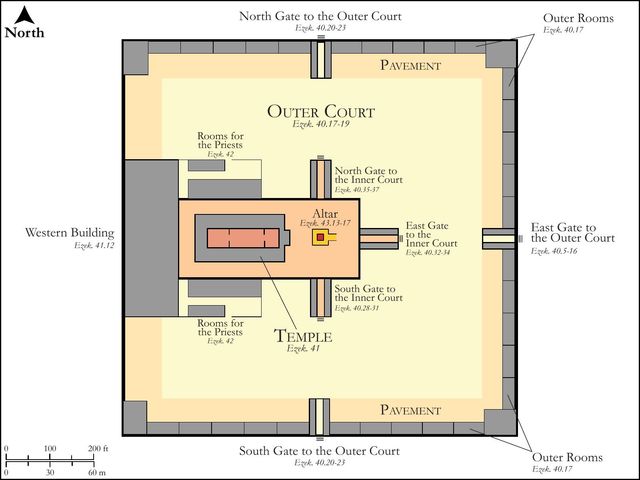
Ezekiel 42:19 meticulously records the final measurement of the western side of the outer precinct within the prophet Ezekiel's grand vision of a future temple complex. This verse specifies a dimension of five hundred reeds, thereby completing the square perimeter of the sacred area. It underscores the divine architect's commitment to absolute precision, order, and the immense scale of the holy space God intends to establish as a testament to His enduring presence and the restoration of His dwelling among His people.
Context
ShowHideLiterary Context
Ezekiel 42:19 is strategically positioned towards the conclusion of the highly detailed temple vision, which spans Ezekiel 40-48. This particular verse serves as the culminating measurement of the outer wall, providing the precise dimension for its western boundary and completing the description of the entire sacred perimeter. Chapters 40-42 are dedicated to an exhaustive architectural blueprint, detailing the layout, dimensions, and various chambers of the temple and its surrounding courts, all guided by a divine figure wielding a measuring reed. The preceding verses in chapter 42 focus on the priests' chambers on the north and south sides, and the overall structure of the sacred precinct. By completing the perimeter's measurement, this verse effectively sets the stage for the profound theological shift in Ezekiel 43, where the glory of the Lord returns to the temple. The repetitive and precise nature of these measurements throughout the vision is not merely architectural but serves to deeply impress upon the reader the divine origin, perfect order, and ultimate reality of this envisioned sanctuary.
Historical & Cultural Context
The vision of this magnificent temple was granted to Ezekiel during the Babylonian exile, a period marked by profound national despair and spiritual displacement for the Jewish people. The First Temple in Jerusalem had been utterly destroyed by Nebuchadnezzar in 586 BC, leaving the exiles cut off from their spiritual heartland. In this context of desolation, the detailed blueprint of a new, grand temple functioned as an incredibly powerful message of hope, restoration, and God's unwavering covenant faithfulness. It served as a divine assurance that God had not abandoned His people and that His presence would indeed return to dwell among them in a perfectly ordered and holy sanctuary. The use of a "measuring reed" was a standard practice in building in that day, symbolizing precision, authority, and adherence to a divine or royal standard. The sheer scale of the measurements, including the "five hundred reeds" recorded in Ezekiel 42:19, would have conveyed an overwhelming sense of grandeur, divine majesty, and the surpassing glory of this future temple compared to its predecessor.
Key Themes
ShowHideThe meticulous measurements detailed throughout Ezekiel 40-48, including the specific dimension in Ezekiel 42:19, contribute significantly to several overarching theological themes. Firstly, they powerfully highlight Divine Precision and Order, demonstrating that God's plans are not arbitrary or chaotic but are perfectly conceived, meticulously detailed, and flawlessly executed. Every single detail of His dwelling place is divinely ordained, reflecting His perfect character and sovereignty. Secondly, the clearly defined boundaries and vast dimensions emphasize Holiness and Separation, unequivocally demarcating the sacred from the common. The immense size of the precinct, measured in reeds, underscores the absolute purity and distinctness required for God's holy presence. This concept of separation is fundamental to understanding God's nature and His desire for a consecrated people and place. Finally, for a people suffering in exile, this vision offered profound Future Hope and Restoration. It represented a tangible divine promise of a new era, a new temple, and the glorious return of God's presence to His people, signifying a renewed relationship and the ultimate fulfillment of His covenant promises.
Exposition and Analysis
ShowHideKey Word Analysis
ShowHideThis verb (H5437) denotes a revolving, surrounding, or turning motion. In the context of Ezekiel 42:19, it describes the precise action of the angelic guide, who, having completed the measurements of the other sides of the temple complex, deliberately turned to face the western direction. This action emphasizes the methodical, thorough, and comprehensive nature of the survey, ensuring that every aspect of the sacred precinct was meticulously measured and accounted for. It conveys a systematic approach to defining the divinely appointed boundaries of God's holy space.
The primitive root (H4058) fundamentally means "to stretch," and by extension, "to measure" (as if by stretching a line). This is the central and recurring action throughout the entire temple vision in Ezekiel 40-48. The repeated use of this verb underscores the theme of divine precision and the tangible, blueprint-like reality of the envisioned structure. It signifies that this is not a vague or symbolic sketch but a detailed architectural plan, with every dimension precisely determined by God's perfect standard. The act of measuring here denotes divine ownership, the establishment of order, and the setting apart of a consecrated space.
This noun (H7070) refers to a reed, specifically functioning as a measuring rod. As established earlier in Ezekiel 40:5, this particular reed was six cubits long, with each cubit being a "cubit and a hand breadth" (approximately 20.6 inches or 52.3 cm). Therefore, one reed measured approximately 123.6 inches or 3.14 meters. The use of "reeds" as the unit of measurement highlights the immense scale of the temple complex. Five hundred reeds translates to roughly 1.57 kilometers (or just under a mile) on each side, forming a vast, perfect square precinct.
Verse Breakdown
ShowHide"He turned about to the west side"
This initial clause describes the specific orientation and movement of the angelic guide. Having systematically measured the eastern, northern, and southern boundaries of the outer precinct, the guide now directs his attention and physical presence to the western boundary. The "west side" (Hebrew: yâm H3220, literally "sea," commonly referring to the Mediterranean Sea which lay to the west of Israel, thus becoming the designation for the direction "west") indicates the final side of the square precinct to be measured, thereby completing the entire perimeter. This methodical progression reinforces the thoroughness and divine intentionality of the survey.
"and measured five hundred reeds with the measuring reed."
This concluding clause states the precise dimension of the western boundary. The act of "measured" (H4058) signifies the application of a divine standard to define and consecrate the sacred space. The quantity "five hundred reeds" specifies the exact length, utilizing the "measuring reed" (H4060, middâh, meaning "measure" or "standard," and H7070, qâneh, "reed") as the divinely sanctioned instrument. This exact numerical value, which is consistent across all four sides of the outer precinct (Ezekiel 42:15-19), establishes the perfect square shape of the entire temple complex's outer boundary. This symmetry, completeness, and precise dimension underscore its divine design, order, and the comprehensive holiness of the area.
Literary Devices
ShowHideEzekiel 42:19, like the broader temple vision it belongs to, is rich in Symbolism. The meticulous measurements themselves, particularly the consistent "five hundred reeds" on each side, are not merely architectural specifications but symbolize divine order, absolute perfection, and the expansive, all-encompassing nature of God's holy presence. The Precision and Detail with which these measurements are presented serve to underscore the divine origin and authority of the vision; it is not a vague, ethereal dream but a divinely inspired, tangible blueprint. This level of exactitude also highlights God's meticulous character and His unwavering commitment to establishing a perfectly ordered dwelling place. Furthermore, the entire passage functions as Visionary Literature, a prophetic revelation conveyed through an elaborate, symbolic architectural tour, designed to communicate profound theological truths about God's future plans for His people and the ultimate dwelling of His glory.
Theological and Thematic Connections
ShowHideEzekiel 42:19, by completing the measurement of the vast outer precinct, powerfully reinforces the profound theological truth that God is a God of absolute order, precision, and holiness. The immense, perfectly square dimensions of the temple complex symbolize the comprehensive and all-encompassing nature of God's presence and His sovereign control over all creation. This divinely ordained order stands in stark contrast to the chaos and destruction that had befallen Jerusalem and its former temple, offering a potent message of hope that God's ultimate plan is one of restoration, perfection, and the re-establishment of His holy dwelling among His people. The precise boundaries underscore the necessity of separation between the sacred and the profane, a foundational principle for approaching a holy God and entering His presence.
Reflection and Application
ShowHideEzekiel 42:19, with its profound emphasis on precise measurements and divine order, invites us to deeply reflect on the very nature of God and His expectations for our lives. Just as God meticulously designed every aspect of His dwelling place, He also possesses a perfect and intentional plan for His creation and for each individual within it. This verse serves as a powerful reminder that God is not a God of chaos or randomness, but of intentionality, purpose, and perfect design. For believers today, while we no longer worship in a physical temple of stone, we are called to be living temples of the Holy Spirit (1 Corinthians 6:19). The vast, precisely measured boundaries of Ezekiel's temple complex challenge us to consider the expansive extent of the holiness God desires in our own lives—not merely in one isolated area, but in every dimension of our being. It prompts us to consecrate ourselves fully to Him, allowing His divine order and standards to shape our thoughts, words, and actions, thereby setting us apart for His sacred purposes. Furthermore, the vision's inherent promise of a restored dwelling for God provides enduring hope that God's ultimate design for His people and creation will indeed come to fruition, culminating in the perfect, eternal dwelling of the New Jerusalem.
Questions for Reflection
ShowHideFAQ
ShowHideWhat is the significance of the "five hundred reeds" measurement in Ezekiel 42:19?
ShowHideThe "five hundred reeds" measurement is profoundly significant because it defines the exact dimensions of the outer wall of the entire temple complex, establishing a perfect square of 500 reeds on each of its four sides (as detailed in Ezekiel 42:15-19). This translates to an immense area, approximately 1.57 kilometers (just under a mile) per side. Its significance lies in symbolizing the vastness, perfection, and comprehensive holiness of God's dwelling place. It emphasizes that the entire precinct is set apart exclusively for God, demonstrating His absolute sovereignty and the meticulous nature of His divine design. This precise, symmetrical measurement also serves as a powerful foreshadowing of the perfectly measured New Jerusalem described in Revelation 21:16, which is similarly presented as a city of perfect, symmetrical dimensions.
Christ-Centered Fulfillment
ShowHideWhile Ezekiel 42:19 describes a literal, future temple with precise measurements, its profound emphasis on holiness, divine order, and God's dwelling finds its ultimate and glorious fulfillment in Jesus Christ and the New Covenant. The vast, perfectly measured temple precinct, envisioned as a dwelling for God's glory, points forward to Jesus Christ Himself, who is the true temple of God, the very embodiment of God's presence dwelling among humanity (John 2:19-21). He is the one through whom God's glory truly tabernacles with His people (John 1:14). Furthermore, the meticulous boundaries and the concept of separation inherent in the temple foreshadow the perfect holiness and purity achieved through Christ's atoning sacrifice, which makes it possible for believers, as living stones, to be built into a spiritual house, a holy priesthood (1 Peter 2:5), becoming a dwelling place for God by the Spirit (Ephesians 2:21-22). The "five hundred reeds" of perfect measure ultimately culminates in the New Jerusalem, described as a city of perfect dimensions, where God Himself dwells directly and eternally with His redeemed people, and there is no longer any need for a physical temple, "for the Lord God Almighty and the Lamb are its temple" (Revelation 21:22). Thus, the precision and promise of Ezekiel's vision find their ultimate spiritual reality and eternal perfection in Christ and His everlasting kingdom.