


Ezekiel 30:7
Bible text: King James Version (1769 Blayney text) · Public domain
Bible text: Berean Standard Bible · Public domain
Bible text: American Standard Version (1901) · Public domain
Bible text: World English Bible, Messianic edition · Public domain
Bible text: Geneva Bible (1599) · Public domain
Bible text: Young's Literal Translation · Public domain
- וְנָשַׁמּוּve·na·Sha·muand they will be desolateH8074Conj-w ¦ V-Niphal-ConsecPerf-3cpVerb Niphal Consecutive Perfect 3rd Plural common genderוְandנָשַׁמּוּthey will be desolate
- בְּתוֹךְbe·Tokhin midst ofH8432Prep-b ¦ N-mscNoun Singular Masculine Constructבְּinתוֹךְmidst of
- אֲרָצוֹת'a·ra·TzotlandsH776N-fpNoun Plural Feminine Absolute
- נְשַׁמּוֹתne·sha·Motmade desolateH8074V-Niphal-Prtcpl-fpVerb Niphal Participle Plural Feminine Absolute
- וְעָרָיוve·'a·Ravand its citiesH5892Conj-w ¦ N-mpc ¦ 3msNoun Plural Masculine Constructוְandעָרָיcitiesוits
- בְּתוֹךְbe·tokhin midst ofH8432Prep-b ¦ N-mscNoun Singular Masculine Constructבְּinתוֹךְmidst of
- עָרִים'a·RimcitiesH5892N-mpNoun Plural Masculine Absolute
- נַחֲרָבוֹתna·cha·ra·Votmade wasteH2717V-Niphal-Prtcpl-fpVerb Niphal Participle Plural Feminine Absolute
- תִּהְיֶינָהTih·Yei·nahthey will beH1961V-Qal-Imperf-3fpVerb Qal Imperfect 3rd Plural Feminine
English is a literal word-by-word gloss of the Hebrew, not the KJV's wording. Why?
This is the original text the KJV's translators worked from — each Hebrew word with its own literal English meaning in this verse, prepared by scholars at Tyndale House, Cambridge. The KJV translates whole sentences, not word by word, so its wording differs: one Hebrew word can become several English words, and the KJV may choose “the LORD” where the gloss reads “Yahweh”. Both are faithful — they answer different questions. For the KJV's own rendering, switch to the KJV text.
Details
See on the biblical-era map
Study this verse
Public-domain commentary
Matthew Henry
From his Commentary on the Whole Bible. Henry comments on passages, not single verses — this entry covers Ezekiel 30:1–19. His two-level outline is real structure in the source text, so it is rendered as structure.
The prophecy of the destruction of Egypt is here very full and particular, as well as, in the general, very frightful. What can protect a provoking people when the righteous God comes forth to contend with them?
I.It shall be a very lamentable destruction, and such as shall occasion great sorrow (Eze 30:2, Eze 30:3):
"Howl you; you may justly shriek now that it is coming, for you will be made to shriek and make hideous outcries when it comes. Cry out, Woe worth the day! or, Ah the day! alas because of the day! the terrible day! Woe and alas! For the day is near; the day we have so long dreaded, so long deserved. It is the day of the Lord, the day in which he will manifest himself as a God of vengeance. You have your day now, when you carry all before you, and trample on all about you, but God will have his day shortly, the day of the revelation of his righteous judgment," Psa 37:13. It will be a cloudy day, that is, dark and dismal, without the shining forth of any comfort; and it shall threaten a storm - fire, and brimstone, and a horrible tempest. It shall be the time of the heathen, of reckoning with the heathen for all their heathenish practices, that time which David spoke of when God would pour out his fury upon the heathen (Psa 79:6), when they should sink, Psa 9:15.
II.It shall be the destruction of Egypt, and of all the states and countries in confederacy with her and in her neighbourhood.
1.Egypt herself shall fall (Eze 30:4): The sword shall come upon Egypt, the sword of the Chaldeans, and it shall be a victorious sword, for the slain shall fall in Egypt, fall by it, fall before it. Is the country populous? They shall take away her multitude. Is it strong, and well-fixed? Her foundations shall be broken down, and then the fabric, though built ever so fine, ever so high, will fall of course.
2.Her neighbours and inmates shall fall with her. When the slain fall so thickly in Egypt great pain shall be in Ethiopia, both that in Africa, which is in the neighbourhood of Egypt on one side, and that in Asia, which is near to it on the other side. When their neighbour's house was on fire they could not but apprehend their own in danger; nor were their fears groundless, for they shall all fall with them by the sword, Eze 30:5. Ethiopia and Libya (Cush and Phut, so the Hebrew names are, two of the sons of Ham who are mentioned, and Mizraim, that is, Egypt, between them, Gen 10:6), and the Lydians (who were famous archers, and are spoken of as confederates with Egypt, Jer 46:9), these shall fall with Egypt and Chub (the Chaldeans, the inhabitants of the inner Libya); these and others were the mingled people; there were those of all these and other countries who upon some account or other resided in Egypt, as did also the men of the land that is in league, some of the remains of the people of Israel and Judah, the children of the covenant, or league, as they are called (Act 3:25), the children of the promise, Gal 4:28. These sojourned in Egypt contrary to God's command, and these shall fall with them. Note, Those that will take their lot with God's enemies shall have their lot with them, yea, though they be in profession the men of the land that is in league with God.
III.All that pretend to support the sinking interests of Egypt shall come down under her, shall come down with her (Eze 30:6):
Those that uphold Egypt shall fall, and then Egypt must fall of course. See the justice of God; Egypt pretended to uphold Jerusalem when that was tottering, but proved a deceitful reed; and now those that pretended to uphold Egypt shall prove no better. Those that deceive others are commonly paid in their own coin; they are themselves deceived.
1.Does Egypt think herself upheld by the absolute authority and dominion of her king? The pride of her power shall come down, Eze 30:6. The power of the king of Egypt was his pride; but that shall be broken, and humbled.
2.Is the multitude of her people her support? These shall fall by the sword, even from the tower of Syene, which is in the utmost corner of the land, from that side of it by which the enemy shall enter. Both the countries and the cities, the husbandmen and the merchants, shall be desolate, Eze 30:7, as before, Eze 29:12. Even the multitude of Egypt shall be made to cease, Eze 30:10. That populous country shall be depopulated. The land shall be even filled with the slain, Eze 30:11.
3.Is the river Nile her support, and are the several channels of it a defence to her? "I will make the rivers dry (Eze 30:12), so that those natural fortifications which were thought impregnable, because impassable, shall stand them in no stead." 4. Are her idols a support to her? They shall be destroyed; those imaginary upholders shall appear more than ever to be imaginary, for so images are when they pretend to be deliverers and strongholds (Eze 30:13): I will cause their images to cease out of Noph. 5. Is her royal family her support? There shall be no more a prince in the land of Egypt; the royal family shall be extirpated and extinguished, which had continued so long. 6. Is her courage her support, and does she think to uphold herself by the bravery of her men of war, who have now of late been inured to service? That shall fail: I will put a fear in the land of Egypt. 7. Is the rising generation her support? is she upheld by her children, and does she think herself happy because she has her quiver full of them? Alas! the young men shall fall by the sword (Eze 30:17) and the daughters shall go into captivity (Eze 30:18), and so she shall be robbed of all her hopes.
IV.God shall inflict these desolating judgments on Egypt (Eze 30:8):
They shall know that I am the Lord, and greater than all gods, than all their gods, when I have set a fire in Egypt. The fire that consumes nations is of God's kindling; and, when he sets fire to a people, all their helpers shall be destroyed. Those that go about to quench the fire shall themselves be devoured by it; for who can stand before him when he is angry? When he pours out his fury upon a place, when he sets fire to it (Eze 30:15, Eze 30:16), neither its strength nor its multitude can stand it in any stead.
V.The king of Babylon and his army shall be employed as instruments of this destruction:
The multitude of Egypt shall be made to cease and be quite cut off by the hand of the king of Babylon, Eze 30:10. Those that undertook to protect Israel from the king of Babylon shall not be able to protect themselves. It is said of the Chaldeans, who should destroy Egypt,
1.That they are strangers (Eze 30:12), who therefore shall show no compassion for old acquaintance-sake, but shall behave strangely towards them.
2.That they are the terrible of the nations (Eze 30:11), both in respect of force and in respect of fierceness; and, being terrible, they shall make terrible work. (3.) That they are the wicked, who will not be restrained by reason and conscience, the laws of nature or the laws of nations, for they are without law: I will sell the land into the hand of the wicked. They do violence unjustly, as they are wicked; yet, so far as they are instruments in God's hand of executing his judgments, it is on his part justly done. Note, God often makes one wicked man a scourge to another; and even wicked men acquire a title to prey, jure belli - by the laws of war, for God sells it into their hands.
VI.No place in the land of Egypt shall be exempted from the fury of the Chaldean army, not the strongest, not the remotest:
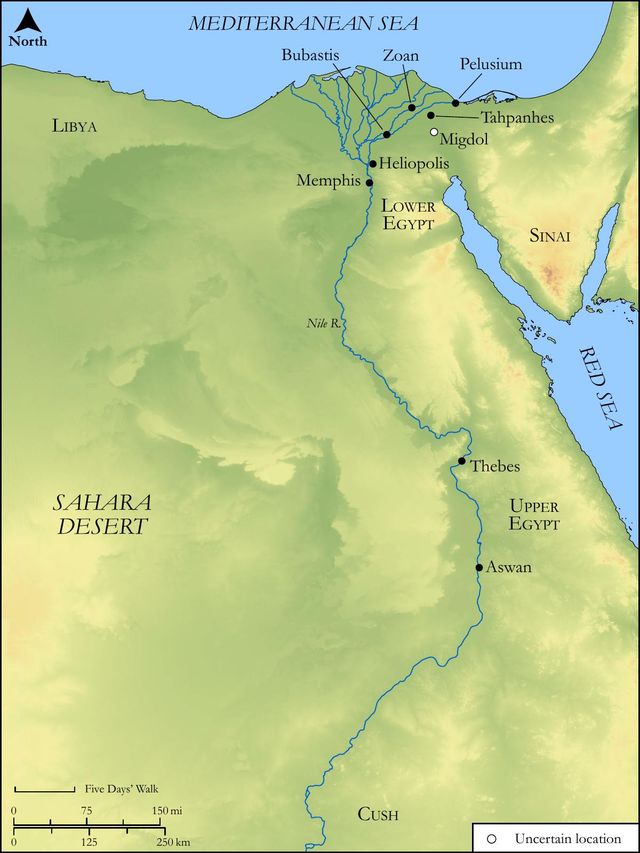
The sword shall go through the land. Various places are here named: Pathros, Zoan, and No (Eze 30:14), Sin and Noph (Eze 30:15, Eze 30:16), Aven and Pi-beseth (Eze 30:17), and Tehaphnehes, Eze 30:18. These shall be made desolate, shall be fired, and God's judgments shall be executed upon them, and his fury poured out upon them. Their strength and multitude shall be cut off; they shall have great pain, shall be rent asunder with fear, and shall have distresses daily. Their day shall be darkened; their honours, comforts, and hopes, shall be extinguished. Their yokes shall be broken, so that they shall no more oppress and tyrannize as they have done. The pomp of their strength shall cease, and a cloud shall cover them, a cloud so thick that through it they shall not see any hopes, nor shall their glory be seen, or shine further. And, lastly, the Ethiopians, who are at a distance from them, as well as those who are mingled with them, shall share in their pain and terror. God will by his providence spread the rumour, and the careless Ethiopians shall be made afraid, Eze 30:9. Note, God can strike a terror upon those that are most secure; fearfulness shall, when he pleases, surprise the most presumptuous hypocrites.
The close of this prediction leaves, 1. The land of Egypt mortified: Thus will I execute judgments on Egypt, Eze 30:19. The destruction of Egypt is the executing of judgments, which intimates not only that it is done justly, for its sins, but that it is done regularly and legally, by a judicial sentence. All the executions God does are according to his judgments. 2. The God of Israel herein glorified: They shall know that I am the Lord. The Egyptians shall be made to know it and the people of God shall be made to know it better. The Lord is known by the judgments which he executes.
Historical interpretation
Historical reception
2 surviving comments on this verse. Each one is dated, so this reads as a timeline rather than a list.
(Verse 35, 36, and following) And I will bring you into a desert of peoples, and there I will judge you face to face. Just as I contended with your fathers in the desert of the land of Egypt, so I will judge you, says the Lord. And I will subject you to my scepter, and I will bring you into the bonds of the covenant, and I will choose from among you the transgressors and the wicked: from their place of residence I will bring them out, and they will not enter the land of Israel, and you will know that I am the Lord. Thus says the Lord: I will do for you who are in Babylon, and now serve idols, what I did for your ancestors in Egypt. I will lead you into the desert of the peoples, and there I will judge you face to face, just as I contended with them in judgment when they came out of Egypt. And after I have judged you, I will subject you to my scepter and rule, and I will make a covenant with you and bring you into your land with the bonds of love, so that bound by my love, you will never be able to depart from me. But I will choose from among you the transgressors and the wicked, who persist in the hardness of their hearts in evil deeds, not for possession, but for rejection. And I will indeed bring them out of the land of their dwelling, so that when they are brought out, they will not enter the land of Israel; but they will perish in various regions. And by the distinction between good and evil, you shall know that I am the Lord, who judges all things. The rest of the discourse hastens, and we briefly go through each point, in order to provide only the meaning to the readers.
(Chapter 30, Verses 1 and following) And the word of the Lord came to me, saying: Son of man, prophesy and say: Thus saith the Lord God: Howl ye, woe, woe to the day: For the day is near, yea the day of the Lord is near, a day of cloud, the time of the nations shall be. And the sword shall come upon Egypt: and there shall be dread in Ethiopia, when the wounded shall fall in Egypt, and the multitude thereof shall be taken away, and the foundations thereof shall be destroyed. Ethiopia, and Libya, and Lydia, and all the rest of the people, and Chub, and the children of the land of the covenant, shall fall with them by the sword. Thus says the Lord God: The supports of Egypt shall fall, and the pride of her power shall come down; from Migdol to Syene they shall fall within her by the sword, says the Lord God. And they shall be desolate in the midst of the desolate countries, and her cities shall be in the midst of the cities that are laid waste. And they shall know that I am the Lord, when I have set a fire in Egypt, and all her helpers are destroyed. In that day shall messengers go forth from me in ships to make the confident Ethiopians afraid, and great pain shall come upon them, as in the day of Egypt: for, surely it is coming. Thus says the Lord God: I will make the multitude of Egypt cease by the hand of Nebuchadnezzar king of Babylon. He and his people with him, the most ruthless of nations, shall be brought to destroy the land. They shall draw their swords against Egypt and fill the land with the slain. I will make the rivers dry and sell the land into the hand of the wicked; I will make the land desolate and all that is in it, by the hand of foreigners. I, the Lord, have spoken. Thus says the Lord God: I will destroy the idols and put an end to the idols in Memphis. There will no longer be a ruler in the land of Egypt, and I will bring terror to the land of Egypt. I will destroy the land of Pathros and bring fire to Taphnis. I will bring judgment upon Alexandria and pour out my anger upon the stronghold of Egypt, Pelusium. I will kill the multitude of Alexandria and bring fire to Egypt. Pelusium will suffer like a woman in labor, and Alexandria will be laid waste, with daily distress in Memphis. The young men of Heliopolis and Bubastus (or Bugastus) will fall by the sword, and the captives themselves will be led away. And in Taphnis the day will darken, when I shatter the scepters of Egypt and the pride of its power fails in it. It will be covered by clouds, and its daughters will be led into captivity. And I will execute judgments on Egypt, and they will know that I am the Lord. LXX: And the word of the Lord came to me, saying: Son of man, prophesy and say: Thus says the Lord God: Woe to the day! For the day is near, the day of the Lord is near; it will be a day of clouds, the end of the nations. And the sword shall come upon the Egyptians, and there will be turmoil in Ethiopia. And those wounded shall fall in Egypt, and they shall take away its multitude, and its foundations shall be destroyed. Persians, and Cretans, and Lydians, and Libyans, and all the mixed peoples, and from the sons of my covenant they shall fall by the sword. Thus says the Lord God. And the supports of Egypt shall be cut down, and the pride of its strength shall come down from Migdol to Syene. They shall fall by the sword in it, says the Lord God. And it shall be desolated in the midst of the desolated regions, and its cities shall be in the midst of deserted cities, and they shall know that I am the Lord, when I bring fire upon Egypt, and all who support it are destroyed. In that day, messengers shall go forth from my presence, hastening to destroy the hope of Ethiopia, and there shall be great turmoil among them on the day of Egypt, for behold, it is coming. Thus says the Lord God. And I will destroy the multitude of Egyptians by the hand of Nebuchadnezzar, king of Babylon himself, and his people with him, sent from the nations to destroy the land. And they will unsheath all their swords against Egypt, and the land will be filled with the wounded. And I will make their rivers desolate, and I will deliver the land into the hands of the wicked, and I will destroy the land and its abundance in the hands of foreigners. I, the Lord, have spoken. For thus says the Lord God: And I will destroy the abominations, and I will cause the officials of Memphis to fail, and the princes of the land of Egypt, and they will exist no longer. And I will bring terror to the land of Egypt, and I will destroy the land of Pathros, and I will bring fire upon Tahpanhes, and I will execute vengeance in Diospolis, and I will pour out my fury upon Sin, the stronghold of Egypt, and I will destroy the multitude of Memphis. And I will set fire to Egypt, and there will be a great commotion in Sais, and there will be a division in Diospolis, and the waters will be scattered. The young men of Heliopolis and Bubastis will fall by the sword, and the women will be taken captive, and in Taphnis the day will become dark when I break the scepters of Egypt there, and the strength of its power will be destroyed, and a cloud will cover it, and its daughters will be taken captive, and I will bring judgment on Egypt, and they will know that I am the Lord. After the twenty-seventh year of the captivity of King Joachim, we return to the present time when he began to prophesy against Egypt, that is, in the tenth year and the tenth month, on the eleventh day of the month. And the Lord commanded him to speak to all nations, and especially to Egypt. So what is it that he speaks? Howl, woe, woe to the day, for the day is near and the day of the Lord is approaching. It is not a bright shining sun, but a day covered with clouds, bringing a storm upon Babylon. And when the sword begins to devastate Egypt, there will be fear in Ethiopia, which is near Egypt, lest the Babylonian blade reach her even to herself. For the wounded will fall in Egypt, and its multitude will be taken away, and all its foundations will be destroyed, so that if someone from Ethiopia, and Libya, and Lydia, and from other various peoples is found in Egypt, and Chub, which Symmachus translates as Arabia, and from the sons of the covenant with the land, that is, from the people of the Jews, let them fall with that sword. For which nations, seventy were appointed: the Persians, and the Cretans, and the Lydians, and the Libyans, and all the mixed peoples, and the children of my covenant with the sword they will fall. And in order that we may know that all these nations were in aid of Egypt, the following speech demonstrates: And those supporting Egypt will collapse, that is, its allies, and all the pride of its empire, or the insult of its strength will be destroyed and deposed from the tower of Syene, which we said was located at the farthest borders of Egypt, or from Magdalo to Syene, as the seventy translated: all the cities of Egypt will be deserted, so that they may know the Lord, when the fire of the Chaldeans has devastated everything, and all his helpers have been worn down, and messengers have arrived near Aquila and Theodotion Siim, which Symmachus translated, hastening: we turn to the ships; for this is how we have received it from the Hebrews: so that all of Ethiopia's confidence may be crushed, and when the neighboring province has been laid waste, fear may grip the nearest. But in order that we may know who that sword is, which devastates Egypt and terrifies Ethiopia, it follows more clearly: And I will cause the multitude of Egypt to cease in the hand of Nebuchadnezzar king of Babylon, who shall not only come, but shall come with many accompanying nations, so that all of Egypt shall be filled with the blood of the slain, and the wrath of the Lord shall be so great that the channels of the rivers, that is, the canals of the Nile, shall be dried up to the ground, and the land shall be deserted in the hand of the pestilence, or the multitude of the worst men of Egypt. For my words cannot be in vain, and there will be such indignation that the images of Egypt will be dispersed and the idols of Memphis, which is still the capital of Egyptian superstition, will cease to exist, whether it be the nobles and leaders of Memphis or the whole land of Egypt. But such terror will possess all of Egypt that the whole land of Phatures will perish and fire will devastate Taphnis, or as the Septuagint translates it, Tanin. And he said, 'I will establish law courts in Alexandria, which is called so today. But it had the former name 'No', which Aquila, Symmachus, and Theodotion translated as it is in Hebrew. For this, I do not know why, the Seventy, wishing something, said 'Diospolis', which is a small city of Egypt. But we have placed 'No' for Alexandria, by anticipation, which is called 'prolepsis' in Greek, according to that Virgilian phrase (Aeneid, book IV):
And I will pour out my indignation upon Sais, which we have turned into Pelusium, and it is called the strength of Egypt, because it has the safest harbor, and the sea trade is exercised there to the greatest extent. Hence the poet calls it 'lentil of Pelusium' (Virgil, Georgics I), not because this type of legume is produced there, or primarily there; but because it is brought from Thebes and all of Egypt through the Nile river to that place in large quantities. And he said, 'I will destroy the multitude of Alexandria, which is again situated in Hebrew No, not in Diospolis, but in Memphis, they transferred it to LXX. And to show that the city was populous at that time, he said, 'I will destroy the multitude of No (); and I will give fire, that is, the king of Babylon in Egypt, who will lay waste everything like fire. Sain, that is, Pelusium, will groan like a woman in labor: or it will be disturbed by turmoil; and in Alexandria, that is, in No, there will be a rupture, and the waters will be dispersed, for which they transferred it back to LXX Diospolis. However, it is the custom of the Egyptians, because of the flooding of the Nile, to build high embankments along the banks of the Nile. If these embankments are breached due to the negligence of the caretakers or the excessive magnitude of the water, the surrounding fields are not irrigated by water, but are instead overwhelmed and ravaged. This signifies that Egypt should be occupied by the Chaldean army in the same way that it is usually covered and corrupted by the overflowing waters of the Nile. Because of the flooding of the waters, and the breaking and breaching of the dikes, it is written in Hebrew: 'And there shall be daily distress in Memphis, where the Nile is divided, and where the temple of Apis is, and the oracles give their answers, there let daily distresses occur. The young men of Heliopolis, which in Hebrew is called On, and of Bubastis, another city, shall fall by the sword, so that the cities themselves, that is, their inhabitants or women, shall be taken into captivity, who are of the sex that is subject to harm.' But in Taphnis, which is the royal city, the scepters of Egypt, that is, the entire royal race, will be destroyed. And when its power, with the killing of the princes, is ended, then the day will darken, and all things will be filled with darkness and shadows, so that the city itself is covered in a cloud of sorrow and mourning, and its daughters, that is, the remaining towns, will be led into captivity. After I have executed judgments in Egypt and demonstrated that I am the judge of all, then the Egyptians will know that I am the Lord. We have described these elements as if for little children, so that they may be able to reach the reading of prose or poetry through letters, syllables, names, and the context of words. Now let us undertake anthropology and demonstrate, in a short like a painted picture, the very wide sea of discussion. The Word of the Lord, who was always in the Father, became a prophet, and He calls him not by his own name but the Son of Man. This is always understood in a good sense in the Holy Scriptures, specifically in the singular number, as in this same prophet, and in Daniel, and in the Gospel. Furthermore, the plural number is read in the opposite sense, as in this example: Sons of men, their teeth are weapons and arrows, and their tongue is a sharp sword (Psalm 56:5). And again: Sons of men, how long will you have heavy hearts? (Psalm 4:3). For the lion roars, and who will not be afraid? The Lord has spoken, and who will not prophesy? (Amos 3:8). Woe, woe to the day, says the Lord. For the day is near, and it approaches, says the Lord. It will be a day of clouds, a time or end of nations. Duplex consummatio est, aut generaliter omnium, quando finis advenerit, aut specialiter singulorum, quando tempus mortis institerit. Juxta autem dicitur, quia aeternitati comparatum, omne tempus breve est. Unde et Jacob centum et triginta annos quibus dixerat: pauci, inquit, et pessimi sunt dies mei (Gen. XLVII, 9) . Et Psalmista de universi generis humani fragilitate disputans, ait: Dies nostri quasi umbra pertransierunt (Ps. CXLIII, 4) . Considering this, we will not be lifted up by power, nor will we be incubating with wealth, nor will we rejoice in happiness, knowing that all things must quickly be taken away. And the beautiful day of the Lord is said to be when the conversation of the entire world will be destroyed, and with error removed, the truth will appear as one, and the days of clouds and mist. For no one, fearless and uncertain, awaits the judge without fear of judgment. And the time or end of the nations will not only be of the Egyptian nation, but of all nations, so that it may be made clear that prophesy applies to all nations. Following, a flaming sword will come to Egypt, a versatile sword, divine word, that will divide the good from the evil and consume the wicked with its fire. But in Egypt of this age, there will be fear in Ethiopia, those who stray through Egypt in the night of error and dwell in darkness, and whose darkness does not easily or at all turn to light. And those who have stood in wickedness will fall wounded in Egypt. And the multitude of Egypt will be taken away. For wide and spacious is the path that leads to death (Matthew 7:13). And its foundations will be destroyed, so that nothing of Egypt's former firmness remains: but with the desolate and worse foundations, let the foundation of Christ be laid, on which the Church will be built. For every plant that the heavenly Father has not planted will be uprooted (Matthew 7). Hence Jeremiah is commanded to destroy what has been built, in order to build better things (Jeremiah 1). The Ethiopians, Libyans, and Lydians, or according to the Seventy, the Persians, Cretans, Lydians, Libyans, and Chub, that is, the Arabs, and all the remaining common people, whom the Seventy translated as hybrids and mixtures. All of these, due to the diversity of vices and the interpretation of names that we have placed in the vision of Tyre, we can understand as different nations. Hence, the Apostle says: You, he says, who are called Uncircumcision, Gentiles in the flesh (Ephesians 2:11). For never would He have said that the nations are flesh and that others are spirit, as in another place: 'Behold Israel according to the flesh.' Hence it must be provided with special care that we do not turn back in our hearts to Egypt, from which we once have come forth, and that we do not find ourselves among the other nations and perish by the sword. As it is said in what follows: 'The young men of Heliopolis and Bubastus shall fall by the sword.' This will happen especially when the sons of the earth of the covenant or Testament of Mine are struck with the sword, of whom it is written: 'Woe to those who go down to Egypt for help, who trust in horses and chariots.' (Isa. 31:1) But if the people of other nations are slaughtered in Egypt, how much more will the sons of the earth, the covenant and Testament of God, be contemptuous of the bread of Angels, the pumpkins, onions, garlic, and cucumbers of Egypt (Num. XI) . Then the supports and props of Egypt, which sustained it in wickedness, will fall, along with the clever arguments of dialecticians and the tricks of philosophers. Also, the contemptuous and proud empire will be destroyed, those who speak arrogantly and consider Ecclesiastical simplicity meaningless. For indeed, from the tower of Syene to those things which are at the furthest boundaries of Egypt, adjoining Ethiopia and the Blemmys: where the Nile is unnavigable and the clamor of cataracts, and everything is impassable and full of serpents and poisonous animals. But if, as we said above, 'Magdala' sounds forth magnificence and 'Syene' a circle, it is clear that the riches of Egypt and its insolent power and magnificence, that is, boasting and exaltation, perish by force even to the circle of Egypt, where nothing is stable; rather, it turns in an uncertain course and reaches ruin. Then the cities of Egypt will be scattered, and the land will be deserted, and no assembly will remain, having any firmness, so that at the end of things they may know that He Himself is the Lord, when He sends fire into Egypt, which the Lord desires to burn, like hay, wood, and straw, which have been built upon the foundation of Christ, and all helpers of perverse doctrines will be crushed. From this it is to be understood that the knowledge of a false name, and those of whom it is written: Scatter the nations that desire war (Ps. LXVII, 32), are called partners and helpers of Egypt. On that day, they say, those messengers will go forth from the face of God, of whom it is written in the Gospel: Their angels always see the face of my Father who is in heaven (Matthew 18:20). And in the parable of the sower, the reapers are angels, that is, those who are messengers, are sent to gather all scandals and throw them into the furnace of fire, where there will be weeping and gnashing of teeth (Ibid. 13). And they will hasten to fulfill the command in order to deter or crush the confidence of Ethiopia, who have reached the highest peak of wickedness, so that Ethiopia may be crushed in the overthrow of Egypt, and may fear, because it is the day of the Lord's vengeance and vindication, when the darkness of sinners will flee and the light of virtues will remain. And he says, 'I will make the multitude of Egypt cease in the hand of Nebuchadnezzar king of Babylon, to whom they were delivered to be punished. For he is the enemy and avenger who also received a reward, because he served in the conquest of Tyre, the multitude of Egypt, so that many in Egypt may cease who have always been there. But if anyone opposes, how can it be said in Deuteronomy: Your fathers descended to Egypt with seventy souls, but now you have become as numerous as the stars of heaven (Deut. X, 22): it is easily solved.' For He did not establish an example of the earthly multitude, but of the heavenly, which shines with virtues and is full of light, above which the bravest of nations, bring brought by the Lord, are proclaimed, so that they may scatter the earth, on behalf of whom the Seventy interpreters of plagues were sent. Which I do not know how it is consistent with those who are brought by the Lord, unless perhaps according to that example, the sending in of the very worst angels (Psalm 77:19): who will unsheath their swords upon Egypt, and will fill the land with the slain or the wounded, so that they may feel themselves to have been killed and wounded, and to such an extent Egypt is destroyed and has fallen into nothingness, that all the rivers of eloquence by which the errors of the Egyptians were washed away, with reeds and a pen, should dry up and be handed over into the hands of the worst, who may torment them, and the fullness of the land of Egypt, which had grown in evil, may be blotted out in the hands of foreign gods. For neither good, but wicked angels are put in charge of torments. It is necessary for them to know that the Lord has spoken. This is frequently assumed so that those who hear may know that these are not the words of prophets, but of the Lord, whose commandments cannot be nullified. It follows: And I will destroy the idols, which are abominations. The Seventy translated it: And I will cause the idols or the chief men of Memphis to cease, and the leader or prince in the land of Egypt will no longer exist. For it is the very character of the most merciful Lord to overthrow what is falsely constructed, so that no likeness which feigns the image of truth may remain in Egypt. Let the nobles of Memphis also perish, which is interpreted from the mouth; concerning which all the idols have been set up, so that with their heads cut off and the masters of the idols destroyed, there may be no ruler in Egypt, and all Egypt may be filled with terror and destruction. Concerning its cities, it is said: And I will destroy the land of Pathros, and I will bring fire upon Taphnehes, or upon Tanis, and I will execute judgments in No, which the Seventy translated as Diospolis; and I will pour out my indignation upon Zoan, the stronghold of Egypt. Phatures is interpreted as the crushing of bread; Taphnis, a humble command; Diospolis, for which the name Noah is given in Hebrew, is rest. Sain, temptation: by these names, the various gatherings of heretics and all forms of lies are revealed: those who trample upon the bread of the Church and despise it, and follow a humble commandment that does not lead to heavenly things, and indulge in pleasures, and are at rest; such as the rich purple-clad man we read about in the Gospel (Luke 16); and they serve the tempters: one of whom sought from the Lord the power to tempt Job. The Lord will destroy and burn all these things, and He will pour out His indignation over them, and He will scatter the strength of Egypt, so that they are reduced to nothing and no longer trouble the people of God, and make them rely on their own help; so that, having forsaken the truth, they may seek falsehood, and be wounded by their own support, just as one is injured by a reed staff. After this, it is said: 'And I will kill or destroy the multitude of Memphis, for which in Hebrew is called No, which the same Seventy translators have rendered as Diospolis, which means 'rest'.' For there are many who seek rest, and desire to lie on ivory beds, and to eat suckling lambs. Or, according to the Seventy, who are translated as Mempheos, there are many who talk in riddles: Take the splinter out of your eye, when they themselves have a beam in their own. And there is fire given in Egypt, which consumes verbosity and luxuries with its ardor. All temptation will grieve, and in Diospolis, which is again not put in Hebrew as No, there will be a tearing apart; so that waters may be poured out and every wicked assembly may be scattered, and may perish here and there. And according to the Hebrew in Memphis, there will be daily distress, as they will give an account for every idle word, so that they may understand that nothing of their Lord's judgment will pass by. The young men of Heliopolis and Bubastus will also fall by the sword. Heliopolis is called On in Hebrew, which means sorrow. But Bubastus, according to the Egyptian language, is an experience of the mouth. All of these who were unable to bear the pain of the world, but sought after the delights of Diospolis, and trusted in their flowery words and debated against other doctrines, will have the victories of their speech cut down by the sword of God's word; and those who are not young men, but are called women due to the weakness of their minds, will be led captive. Whether the cities themselves, with their boastful sorrows and jaws, will be led into captivity. And in Taphnis, he says, the day will turn black. Taphnae, according to interpretation, means yielding to the jaw, and it is understood to refer to the devil: those who yield to him will lose the light of truth, and they will transform day into night, and they will feel that the scepters of Egypt and all authority have been shattered in Taphnis, so that its contemptible strength or the pride of its power may fail, and the rays of the sun's justice may be blinded in a cloud, and not women, but daughters will be led into captivity; and the Lord will bring about not one judgment, but many judgments in Egypt. For just as there are many dwelling places for the righteous with the Father, so too there are different judgments for the punishments of Egypt, so that when all these things have been done, the Egyptians may recognize that He Himself is the Lord, whose true judgments are justified in themselves.
Continue studying Ezekiel 30:7 across the web’s major study libraries — every link below opens this exact verse, chapter, or book on the destination site.
Read & Compare
 BibleGatewayThis verse in more than 200 translations and 70 languages.
 Bible.comThe YouVersion reader — hundreds of translations, reading plans, and highlights.
 ESV.orgCrossway's official English Standard Version reader.
 NET BibleThe NET translation with 60,000+ translators' notes on every rendering decision.
 STEP BibleTyndale House's free study tool — original text, vocabulary, and scholarly resources.
 BibliaLogos Bible Software's free web reader.
 USCCBThe New American Bible (Revised Edition) with the U.S. bishops' study notes.
Commentaries
 BibleHub CommentariesDozens of classic commentaries on this verse, gathered on one page.
 StudyLightMore than 100 commentary sets — the largest collection on the web.
 BibleRefPlain-English commentary on what this verse means, verse by verse.
 Enduring WordDavid Guzik's free commentary on this chapter, widely used by Bible teachers.
 Bible Study ToolsVerse commentary alongside Greek and Hebrew study aids.
Original Language & Research
- BibleHub InterlinearThe verse word by word — original language, transliteration, and English.
- BibleHub LexiconEvery word's original-language definition and Strong's entry.
 Blue Letter BibleDeep-study tools — Strong's numbers, concordance, and word studies.
 SefariaThe Hebrew text with Rashi and centuries of Jewish commentary.
Sermons, Hymns & Audio


TrulyRandomVerse is not affiliated with these sites and doesn’t control their content. They’re linked because they’re genuinely useful.
Summary
Ezekiel 30:7 delivers a chilling prophecy foretelling the utter devastation of Egypt, declaring that its once-proud cities and fertile lands will be reduced to a wasteland, mirroring the desolation already suffered by other ruined nations. This verse powerfully underscores the comprehensive nature of divine judgment, portraying Egypt's downfall as a stark testament to God's absolute sovereignty over all earthly powers and the inevitable fate of those who defy His will.
Context
ShowHideLiterary Context
This verse is strategically placed within a series of divine oracles specifically directed against Egypt, spanning Ezekiel chapters 29-32. These prophecies meticulously detail the impending destruction of Egypt, primarily at the hands of Nebuchadnezzar, the king of Babylon, whom God explicitly identifies as His chosen instrument for executing this judgment, as revealed in Ezekiel 29:19-20. The immediate preceding verses in Ezekiel 30 vividly describe the "day of the Lord" descending upon Egypt, bringing with it widespread slaughter, the shattering of its idols, and the collapse of its economic and military might. Verse 7, therefore, serves to intensify this prophetic picture by emphasizing the resulting, profound desolation, explicitly linking Egypt's future ruin to the state of other nations already laid waste, thereby highlighting the universal reach of God's judgment and the inescapable consequences of national pride and idolatry.
Historical & Cultural Context
Ezekiel's prophecies against Egypt were delivered during the tumultuous early 6th century BC, a period marked by significant geopolitical shifts. Judah, having already fallen under Babylonian dominion, frequently looked to Egypt as a formidable, albeit often unreliable, potential ally against the burgeoning Babylonian empire. However, the biblical prophets consistently portrayed Egypt's alliance as a deceptive and ultimately futile hope (e.g., Isaiah 30:1-7 and Jeremiah 37:5-7). Egypt, with its long history, immense wealth, and formidable military, was widely regarded as a regional superpower, and its pharaohs often claimed divine status. This prophecy, therefore, served a crucial purpose: to dismantle any false hope placed in Egypt's strength and to unequivocally demonstrate Yahweh's supreme authority over even the mightiest nations, revealing that their perceived power was utterly insignificant before His divine decree. The prophesied desolation would have been a shocking and profoundly humiliating reversal for a nation accustomed to centuries of prosperity, dominance, and self-proclaimed divine favor.
Key Themes
ShowHideThe broader themes woven throughout the Book of Ezekiel include God's absolute sovereignty over all nations, the unyielding inevitability of divine judgment against sin and rebellion, and the concept of desolation as a direct and severe consequence of national pride, idolatry, and unfaithfulness. This particular verse powerfully contributes to these themes by demonstrating that even a nation as powerful and ancient as Egypt is not exempt from God's righteous wrath. The repeated and emphatic imagery of "desolate" and "wasted" underscores the comprehensive nature of God's judgment, signifying not merely a temporary setback but a profound, lasting, and irreversible ruin. Furthermore, the striking idea of Egypt being "in the midst of the countries that are desolate" highlights a significant theme of shared fate, where nations that defy God ultimately experience a common downfall, serving as a stark and universal warning to all who might place their trust in human might rather than in divine power.
Exposition and Analysis
ShowHideKey Word Analysis
ShowHideThis primitive root signifies "to stun (or intransitively, grow numb), i.e., devastate or (figuratively) stupefy." It conveys a profound sense of utter emptiness, ruin, and the emotional impact of astonishment or horror at such destruction. In Ezekiel 30:7, it speaks to the shocking and profound state of abandonment and ruin that will befall Egypt, leaving its lands utterly uninhabited and unproductive, a place of utter waste.
This term refers to "the earth (at large, or partitively a land)." Here, it specifically denotes the various territories, lands, or nations that have already experienced God's judgment and have been laid waste. By stating Egypt will be "in the midst of the countries that are desolate," the prophecy emphasizes that Egypt's fate is not unique but rather a participation in a universal pattern of divine retribution against rebellious nations, underscoring a shared destiny of ruin.
This primitive root means "to parch (through drought) i.e. (by analogy,) to desolate, destroy, kill." It speaks to a state of being dried up, ruined, or annihilated. Its use alongside "desolate" (shâmêm') intensifies the imagery of complete and irreversible destruction, suggesting a land and its cities rendered barren, uninhabitable, and stripped of all life, prosperity, and former glory.
Verse Breakdown
ShowHide"And they shall be desolate in the midst of the countries that are desolate"
This clause pronounces a severe and certain judgment upon Egypt, with "they" referring to the Egyptians or, more broadly, their land and people. The emphatic repetition of "desolate" underscores the certainty and comprehensiveness of this state of ruin. Crucially, it places Egypt's future ruin not in isolation, but "in the midst of" other nations that have already experienced similar divine judgment and have been reduced to desolation. This implies a shared, universal fate for all who oppose God, emphasizing that Egypt, despite its former glory and perceived invincibility, will join the ranks of the utterly ruined.
"and her cities shall be in the midst of the cities that are wasted"
This second clause powerfully reiterates and amplifies the first, focusing specifically on the urban centers of Egypt. "Her cities" refers to the once-mighty, populous, and wealthy cities of Egypt, which will now be reduced to rubble and ruin. They will stand "in the midst of the cities that are wasted," meaning they will become indistinguishable from other urban ruins that bear witness to past destructions. This highlights the total collapse of Egypt's infrastructure, economy, and societal organization, leaving behind only desolate monuments to its former grandeur and current, profound devastation.
Literary Devices
ShowHideEzekiel 30:7 employs several powerful literary devices to convey its message of impending and comprehensive judgment. Repetition is a primary device, with the terms "desolate" and "wasted" (or variations thereof) appearing multiple times. This repetition serves to emphasize the absolute, comprehensive, and inescapable nature of the destruction, leaving no doubt about the severity of Egypt's fate. The parallel structure of the two clauses—"And they shall be desolate in the midst of the countries that are desolate, and her cities shall be in the midst of the cities that are wasted"—utilizes Synonymous Parallelism. This technique reinforces the meaning of the first clause with the second, adding depth, intensity, and a sense of inevitability to the prophecy. This also creates a strong sense of Irony, as Egypt, a nation once proud, powerful, and self-sufficient, is reduced to the same state as those it may have once dominated or considered inferior, thereby stripping it of its perceived uniqueness and superiority. Furthermore, the verse employs Hyperbole to underscore the extreme nature of the desolation; while some inhabitants might remain, the prophetic language paints a picture of complete and utter ruin, conveying the severity of God's judgment in the strongest possible terms.
Theological and Thematic Connections
ShowHideEzekiel 30:7 stands as a profound theological statement on God's absolute sovereignty over all nations and His unwavering commitment to justice. It demonstrates that no earthly power, however mighty, ancient, or self-reliant, is beyond the reach of His righteous judgment. The desolation of Egypt, a nation long associated with pride, idolatry, and oppression (particularly against Israel), vividly illustrates the severe consequences of national rebellion against divine authority. This prophecy serves as a powerful reminder that God's overarching plan for history encompasses the rise and fall of empires, all orchestrated to bring about His ultimate purposes and to demonstrate His glory to all the earth. It underscores the universal principle that sin, particularly corporate sin like idolatry, pride, and injustice, inevitably leads to ruin, whether for individuals or for entire civilizations.
Reflection and Application
ShowHideEzekiel 30:7 stands as a timeless and sobering reminder of the transient nature of earthly power and the enduring reality of divine judgment. In a world where nations still rise and fall, and where human pride often asserts itself against divine wisdom, this verse calls us to profound humility and a sober recognition of God's ultimate authority over all creation and history. It challenges us to critically examine where our trust truly lies: in the fleeting strength of human systems, alliances, and economies, or in the unchanging power, faithfulness, and righteousness of the Almighty God. For believers, this prophecy reinforces the call to live as citizens of an eternal kingdom, urging us not to place ultimate hope or security in any earthly government, economy, or cultural achievement, but rather to seek first God's kingdom and His righteousness. Furthermore, this prophecy serves as a potent warning against the dangers of national idolatry and self-sufficiency, compelling us to seek justice, righteousness, and humble submission to God's ways within our own societies and spheres of influence.
Questions for Reflection
ShowHideFAQ
ShowHideWhat was the specific historical fulfillment of this prophecy against Egypt?
ShowHideThe prophecy found its primary historical fulfillment through the invasion of Egypt by Nebuchadnezzar, King of Babylon, around 568-567 BC. While the destruction may not have been as absolute as the hyperbolic prophetic language suggests in every minute detail (prophetic language often uses hyperbole to convey severity and certainty), historical records and archaeological findings confirm significant Babylonian incursions and periods of Egyptian subjugation, leading to a demonstrable decline in its regional power and influence. Ezekiel 29:19-20 specifically names Nebuchadnezzar as God's instrument for this judgment, indicating the precision and divine origin of the prophecy.
Does this verse imply that God desires the destruction of nations?
ShowHideThis verse, like many judgment prophecies in the Old Testament, primarily highlights God's perfect justice and His absolute intolerance for sin, particularly national pride, idolatry, and oppression. While the outcome described is indeed destruction, the underlying divine desire is always for repentance, turning from evil, and recognition of His sovereignty. God's ultimate desire is for all nations to acknowledge Him and turn to Him (Psalm 22:27). However, when nations persistently defy Him, reject His warnings, and oppress His people, judgment becomes a necessary demonstration of His righteousness, a means to uphold His holy character, and a way to clear the path for His redemptive purposes to unfold.
Christ-Centered Fulfillment
ShowHideWhile Ezekiel 30:7 speaks of the physical desolation of Egypt, its deeper theological resonance points powerfully to the ultimate judgment that falls upon all who reject God, and conversely, the profound and eternal restoration found exclusively in Christ. The "desolation" described here serves as a stark foreshadowing of the spiritual desolation that sin brings, separating humanity from its Creator and leaving souls "wasted" by their rebellion and alienation from divine life. However, the Gospel reveals that Christ willingly entered into this desolate human condition. He Himself became "desolate" on the cross, experiencing the ultimate separation from God the Father as He bore the weight of humanity's sin (Matthew 27:46). Through His perfect sacrifice, Jesus transforms the desolate places of our hearts and lives, bringing spiritual flourishing where there was once only barrenness. The judgment against Egypt, like all Old Testament judgments, serves as a stark reminder of God's holiness and the gravity of sin, but it also points forward to the Lamb of God who takes away the sin of the world (John 1:29), offering a path to reconciliation, spiritual life, and eternal hope. For all who believe in Him, the promise is not of desolation, but of abundant life (John 10:10), a new creation where all things are made new (Revelation 21:5), and an escape from the ultimate and eternal desolation that awaits those who reject God's gracious offer of salvation (Romans 6:23).