


Ezekiel 23:34
Bible text: King James Version (1769 Blayney text) · Public domain
Bible text: King James Version with Strong's numbers · Public domain
Bible text: Berean Standard Bible · Public domain
Bible text: American Standard Version (1901) · Public domain
Bible text: World English Bible, Messianic edition · Public domain
Bible text: Geneva Bible (1599) · Public domain
Bible text: Young's Literal Translation · Public domain
- וְשָׁתִיתve·sha·Titand you will drinkH8354Conj-w ¦ V-Qal-ConsecPerf-2fsVerb Qal Consecutive Perfect 2nd Singular Feminineוְandשָׁתִיתyou will drink
- אוֹתָהּ'o·Tah<obj.> itH853DirObjM ¦ 3fsParticle Object Indicatorאוֹתָ<obj.>הּit
- וּמָצִיתu·ma·Tzitand you will drain [it]H4680Conj-w ¦ V-Qal-ConsecPerf-2fsVerb Qal Consecutive Perfect 2nd Singular Feminineוּandמָצִיתyou will drain [it]
- וְאֶתve·'Etand <obj.>H853Conj-w ¦ DirObjMParticle Object Indicatorוְandאֶת<obj.>
- חֲרָשֶׂיהָcha·ra·Sei·haits fragmentsH2789N-mpc ¦ 3fsNoun Plural Masculine Constructחֲרָשֶׂיfragmentsהָits
- תְּגָרֵמִיte·ga·Re·miyou will breakH1633V-Piel-Imperf-2fsVerb Piel Imperfect 2nd Singular Feminine
- וְשָׁדַיִךְve·sha·Da·yikhand your breastsH7699Conj-w ¦ N-mdc ¦ 2fsNoun Dual Masculine Constructוְandשָׁדַיִbreastsךְyour
- תְּנַתֵּקִיte·na·Te·kiyou will tear outH5423V-Piel-Imperf-2fsVerb Piel Imperfect 2nd Singular Feminine
- כִּיkiforH3588PrtParticle Conditional
- אֲנִי'a·NiIH589Pro-1csPronoun Personal 1st Singular common gender
- דִבַּרְתִּיdi·Bar·tiI have spokenH1696V-Piel-Perf-1csVerb Piel Perfect 1st Singular common gender
- נְאֻםne·'Um[the] utterance ofH5002N-mscNoun Singular Masculine Construct
- אֲדֹנָי'a·do·Nai[the] LordH136N-properNoun Proper Title
- יְהוִהYah·wehYahwehH3069N-properNoun Proper Title
English is a literal word-by-word gloss of the Hebrew, not the KJV's wording. Why?
This is the original text the KJV's translators worked from — each Hebrew word with its own literal English meaning in this verse, prepared by scholars at Tyndale House, Cambridge. The KJV translates whole sentences, not word by word, so its wording differs: one Hebrew word can become several English words, and the KJV may choose “the LORD” where the gloss reads “Yahweh”. Both are faithful — they answer different questions. For the KJV's own rendering, switch to the KJV text.
Details
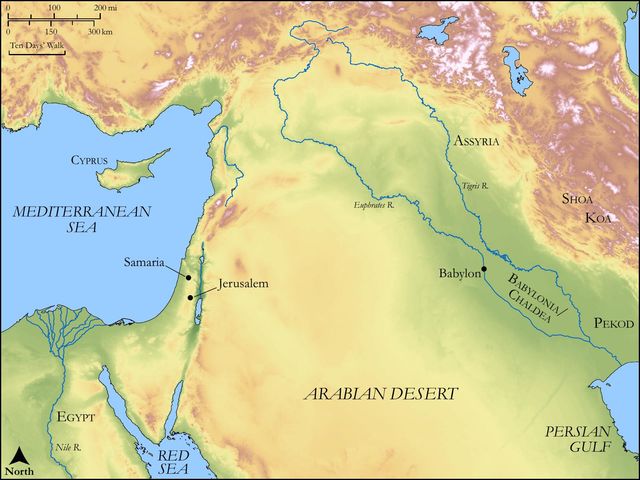
See on the biblical-era map
Study this verse
Public-domain commentary
Matthew Henry
From his Commentary on the Whole Bible. Henry comments on passages, not single verses — this entry covers Ezekiel 23:22–49. His three-level outline is real structure in the source text, so it is rendered as structure.
Jerusalem stands indicted by the name of Aholibah, for that she, as a false traitor to her sovereign Lord the God of heaven, not having his fear before her eyes, but moved by the instigation of the devil, had revolted from her allegiance to him, had compassed and imagined to shake off his government, had kept up a correspondence had joined in confederacy with his enemies, and the pretenders to a deity, in contempt of his crown and dignity. To this indictment she has pleaded, Not guilty: I am not polluted; I have not gone after Baalim. But it is found against her by the notorious evidence of the fact, and she stands convicted of it, nor has any thing material to offer why judgment should not be given and execution awarded according to law. In these verses, therefore, we have the sentence.
I.Her old confederates must be her executioners; and those whom she had courted to be her leaders in sin are now to be employed as instruments of her punishment (Eze 23:22): "I will raise up thy lovers against thee, the Chaldeans, whom formerly thou didst so much admire and covet an acquaintance with, but from whom thy mind is since alienated and with whom thou hast perfidiously broken covenant." They are called thy lovers (Eze 23:22) and yet (Eze 23:28) those whom thou hatest. Note, It is common for sinful love soon to turn into hatred; as Amnon's to Tamar. Those of headstrong and unreasonable passions are often very hot against those persons and things that a little before they were as hot for. Fools run into extremes; nay, and wise men may see cause to change their sentiments. And therefore, as we should rejoice and weep as if we rejoiced not and wept not, so we should love and hate as if we loved not and hated not. Ita ama tanquam osurus - Love as one who may have cause to feel aversion.
II.The execution to be done upon her is very terrible.
1.Her enemies shall come against her on every side (Eze 23:22), those of the several nations that constituted the Chaldean army (Eze 23:23), all of them great lords and renowned, whose pomp, and grandeur, and splendid appearance made them look the more amiable when they came as friends to protect and patronise Jerusalem, but the more formidable when they came to chastise its treachery and aimed at no less than its ruin.
(1.)They shall come with a great deal of military force (Eze 23:24), with chariots and wagons furnished with all necessary provisions for a camp, with arms and ammunition, bag and baggage, with a vast army, and well armed.
(2.)They shall have justice on their side: "I will set judgment before them" (they shall have right with them as well as might; for the king of Babylon had just cause to make war upon the king of Judah, because he had broken his league with him), "and therefore they shall judge thee, not only according to God's judgments, as the instruments of his justice, to punish thee for the indignities done to him, but according to their judgments, according to the law of nations, to punish thee for thy perfidious dealings with them." (3.) They shall prosecute the war with a great deal of fury and resentment. It being a war of revenge, they shall deal with thee hatefully, Eze 23:29. This will make the execution the more severe that their swords will be dipped in poison. Thou hatest them, and they shall deal hatefully with thee; those that hate will be hated and will be hatefully dealt with. (4.) God himself will lead them on, and his anger shall be mingled with theirs (Eze 23:25): I will set my jealousy against thee; that shall kindle this fire, and then they shall deal furiously with thee. If men deal ever so hatefully, ever so furiously, with us, yet, if we have God on our side, we need not fear them; they can do us no real hurt. But if men deal furiously with us, and God set his jealousy against us too, what will become of us?
2.The particulars of the sentence here passed upon this notorious adulteress are,
(1.)That all she has shall be seized on. The clothes and the fair jewels, with which she had endeavoured to recommend herself to her lovers, these she shall be stripped of, Eze 23:26. All those things that were the ornaments of their state shall be taken away: "They shall take away all thy labour, all that thou hast gotten by thy labour, and shall leave thee naked and bare," Eze 23:29. Both city and country shall be impoverished and all the wealth of both swept away.
(2.)That her children shall go into captivity. "They shall take thy sons and thy daughters, and make slaves of them (Eze 23:25); for they are children of whoredoms, unworthy the dignities and privileges of Israelites," Hos 2:4.
(3.)That she shall be stigmatized and deformed: "They shall take away thy nose and thy ears, shall mark thee for a harlot, and render thee for ever odious," Eze 23:25. This intimates the many cruelties of the Chaldean soldiers towards the Jews that fell into their hands, whom, it is probable, they used barbarously. Some will have this to be understood figuratively; and by the nose they think is meant the kingly dignity, and by the ears that of the priesthood.
(4.)That she shall be exposed to shame: Thy lewdness and thy whoredoms shall be discovered (Eze 23:29), as, when a malefactor is punished, all his crimes are ripped up, and repeated to his disgrace; what was secret then comes to light, and what was done long since is then called to mind.
(5.)That she shall be quite cut off and ruined: "The remnant of thy people that have escaped the famine and pestilence shall fall by the sword; and the residue of thy houses that have not been battered down about thy ears shall be devoured by the fire," Eze 23:25. And this shall be the end of Jerusalem.
III.Because she has trod in the steps of Samaria's sins, she must expect no other than Samaria's fate.
It is common, in giving judgment, to have an eye to precedents; so has God in passing this sentence on Jerusalem (Eze 23:31, etc.): "Thou hast walked in the way of thy sister, notwithstanding the warning thou hast had given thee, by the fatal consequences of her wickedness; and therefore I will give her cup, her portion of miseries, into thy hand, the cup of the Lord's fury, which will be to thee a cup of trembling." Now,
1.This cup is said to be deep and large, and to contain much (Eze 23:32), abundance of God's wrath and abundance of miseries, the fruits of that wrath. It is such a cup as that which we read of, Jer 25:15, Jer 25:16. The cup of divine vengeance holds a great deal, and so those will find into whose hand it shall be put.
2.They shall be made to drink the very dregs of this cup, as the wicked are said to do (Psa 75:8): "Thou shalt drink it and suck it out, not because it is pleasant, but because it is forced upon thee (Eze 23:34); thou shalt break the shreds thereof, and pluck off thy own breasts, for indignation at the extreme bitterness of this cup, being full of the fury of the Lord (Isa 51:20), as men in great anguish tear their hair, and throw every thing from them. Finding there is no remedy, but it must be drank (for I have spoken it, saith the Lord God), thou shalt have no manner of patience in the drinking of it." 3. They shall be intoxicated by it, made sick, and be at their wits' end, as men in drink are, staggering, and stumbling, and ready to fall (Eze 23:33): Thou shalt be filled with drunkenness and sorrow. Note, Drunkenness has sorrow attending it, to such a degree that the utmost confusion and astonishment are here represented by it. Who would think that that which is such a force upon nature, such a scandal to it, which deprives men of their reason, disorders them to the last degree, and is therefore expressive of the greatest misery, should yet be with many a beloved sin, that they should damn their own souls to distemper their own bodies? Who has woe and sorrow like them? Pro 23:29. 4. Being so intoxicated, they shall become, as drunkards deserve to be, a laughing-stock to all about them (Eze 23:32): Thou shalt be laughed to scorn and had in derision, as acting ridiculously in every thing thou goest about. When God is about to ruin a people he makes their judges fools and pours contempt on their princes, Job 12:17, Job 12:21.
IV.In all this God will be justified, and by all this they will be reformed; and so the issue even of this will be God's glory and their good.
1.They have been bad, very bad, and that justifies God in all that is brought upon them (Eze 23:30): I will do these things unto thee because thou hast gone a whoring after the heathen, and (Eze 23:35) because thou hast forgotten me and cast me behind thy back. Note, Forgetfulness of God, and a contempt of him, of his eye upon us and authority over us, are at the bottom of all our treacherous adulterous departures from him. Therefore men wander after idols, because they forget God, and their obligations to him; nor could they look with so much desire and delight upon the baits of sin if they did not first cast God behind their back, as not worthy to be regarded. And those who put such an affront upon God, how can they think but that it should turn upon themselves at last? Therefore bear thou also thy lewdness and thy whoredoms; that is, thou shalt suffer the punishment of them, and thou alone must bear the blame. Men need no more to sink them than the weight of their own sins; and those who will not part with their lewdness and their whoredoms must bear them.
2.They shall be better, much better, and this fire, though consuming to many, shall be refining to a remnant (Eze 23:27): Thus will I make thy lewdness to cease from thee. The judgments which were brought upon them by their sins parted between them and their sins, and taught them at length to say, What have we to do any more with idols? Observe,
(1.)How inveterate the disease was: Thy whoredoms were brought from the land of Egypt. Their disposition to idolatry was early and innate, their practice of it was ancient, and had gained a sort of prescription by long usage.
(2.)How complete the cure was notwithstanding: "Though it has taken root, yet it shall be made to cease, so that thou shalt not so much as lift up thy eyes to the idols again, nor remember Egypt with pleasure any more." They shall avoid the occasions of this sin, for they shall not so much as look upon an idol, lest their hearts should unawares walk after their eyes. And they shall abandon all inclinations to it: "They shall not remember Egypt; they shall not retain any of that affection for idols which they had from the very infancy of their nation." They got it, through the corruption of nature, in their bondage in Egypt, and lost it, through the grace of God, in their captivity in Babylon, which this was the blessed fruit of, even the taking away of sin, of that sin; so that whereas, before the captivity, no nation (all things considered) was more impetuously bent upon idols and idolatry than they were, after that captivity no nation was more vehemently set against idols and idolatry than they were, insomuch that at this day the image-worship which is practised in the church of Rome confirms the Jews as much as any thing in their prejudices against the Christian religion.
Historical interpretation
Historical reception
4 surviving comments on this verse. Each one is dated, so this reads as a timeline rather than a list.
(Verse 35, 36, and following) And I will bring you into a desert of peoples, and there I will judge you face to face. Just as I contended with your fathers in the desert of the land of Egypt, so I will judge you, says the Lord. And I will subject you to my scepter, and I will bring you into the bonds of the covenant, and I will choose from among you the transgressors and the wicked: from their place of residence I will bring them out, and they will not enter the land of Israel, and you will know that I am the Lord. Thus says the Lord: I will do for you who are in Babylon, and now serve idols, what I did for your ancestors in Egypt. I will lead you into the desert of the peoples, and there I will judge you face to face, just as I contended with them in judgment when they came out of Egypt. And after I have judged you, I will subject you to my scepter and rule, and I will make a covenant with you and bring you into your land with the bonds of love, so that bound by my love, you will never be able to depart from me. But I will choose from among you the transgressors and the wicked, who persist in the hardness of their hearts in evil deeds, not for possession, but for rejection. And I will indeed bring them out of the land of their dwelling, so that when they are brought out, they will not enter the land of Israel; but they will perish in various regions. And by the distinction between good and evil, you shall know that I am the Lord, who judges all things. The rest of the discourse hastens, and we briefly go through each point, in order to provide only the meaning to the readers.
(Ver. 23, 24 onwards) Again, I raised my hand against them in the wilderness, to scatter them among the nations and disperse them in the lands, because they had not performed my judgments, and had rejected my commandments, and had violated my Sabbaths, and their eyes had been after the idols (or thoughts) of their fathers. Therefore, I also gave them statutes that were not good, and judgments in which they would not live, and I defiled them in their offerings (or transgressions), as they offered (or led astray) everything that opens the womb because of their sins (for which the Septuagint translated, to destroy them and what they had overlooked): and they will know that I am the Lord. Where in the Old Testament, against their children, who fell in the wilderness, the Lord lifted up His hand to scatter them among the nations, Scripture does not say; but it is to be believed that this was done in accordance with what is reported here. Or he signifies by this, that after they entered the promised land, they were given over at various times, for many sins, to different nations and kings, and at that time the commandments of the Lord, which were good according to their nature, and the judgments by which believers could live, were made not good for them, since they were in no way able to keep the precepts of the law in captivity, and to do what the divine word commanded. He did not say, 'I gave them evil commandments,' but, 'not good commandments.' For it does not immediately follow that what is not good is evil, as the Apostle teaches, it is good for a man not to touch a woman; but because of incontinence, let each possess his own vessel in sanctification and honor (I Cor. VII). And if he does not do this, it is neither good nor evil. Therefore, God gave them, dispersed among the nations, not good commandments, that is, he allowed them to follow their own thoughts and desires, to do what is not appropriate. And he defiled them in his gifts: just as a Priest separates lepers from the people, and shows that they are defiled; while they offer to idols what they should offer to God. And they pass everything that opens the womb through the fire of Baal, that is, the firstborn; so that after they have deserted God and been handed over to the worship of idols, then they may understand that He is the Lord whom they have provoked to anger by their own fault. Symmachus interpreted this passage more explicitly, treating the future as past. Therefore, I will also give them bad precepts and judgments for which they will not live, and I will defile them because of their gifts, as they consecrate and offer everything that opens the womb, so that I may destroy them, and they will know that I am the Lord. And the meaning is this: because I have seen the sons of the fathers equaling the wickedness of their ancestors and doing the same things for which they offended God, I wanted to divide them into nations and disperse them throughout the whole world, and give them bad precepts and judgments in which they would not live, so that I may defile them with their gifts, for they consecrated everything that opens the womb to idols, and I may destroy them forever, and they will know that I am the Lord. Through which he showed that he had not given them good commandments who dwelt in the wilderness, but to those whom he wanted to scatter among the nations, and to make foreigners in the whole world, he gave them a desire for things that he did not give: so that there they would do good commandments of God, not good because of their own fault, while they exhibited to idols what God had commanded to be exhibited. This can also be said, that before the offense, they received only the Ten Commandments; but after idolatry and blasphemy, they received multiple ceremonies of the law, so that they would offer victims to God rather than to demons, and by comparison with sacrilege, what was not good in itself became lighter, and by no means evil, because it was offered to God, and yet not good, because they offended the author of good.
(Verse 27, 29 onwards) Therefore speak to the house of Israel, son of man, and tell them: Thus says the Lord God: Moreover, your fathers have blasphemed against me and have treated me with contempt, even as they spurned me. And I brought them into the land that I had lifted my hand to give them ((Vulgate adds: that land)): they saw every high hill and every leafy tree, and there they offered their sacrifices and presented there the irritation of their offerings, and they placed there the fragrance of their sweetness, and they poured out their ((Vulgate is silent on this)) libations there. And I said to them, 'What is the high place to which you are going?' And its name was called the High Place until this day. Therefore speak to the house of Israel, son of man, and say to them, 'Thus says the Lord God: As for your fathers, they have provoked Me to anger by their iniquities, by the fact that they have fallen away from Me. So I brought them into the land that I had lifted My hand in an oath to give them.' They saw every high hill and every leafy tree, and there they offered their sacrifices. They also presented there the provocation of their gifts, and they set there their pleasing aroma, and they poured out there their drink offerings. And I said to them: What is abbana, because you enter there? And they called its name abbana until this day. I wanted, he said, to scatter them in the wilderness, and to give them not good precepts, so that they would sacrifice to idols what they should have offered to me, and consecrate all their first-fruits to them by fire, so that I might kill them and destroy them. But when he says, I wanted, he shows that he did not do what he wanted. And that which follows: 'And they shall know that I am the Lord,' is not found in the Septuagint. For it did not seem fitting to them to know after their destruction that he himself is the Lord. But you, son of man, speak again to them, that is, to the elders of the house of Israel, who have come to inquire of you: Your fathers, from whom you have descended, have also blasphemed against me and held me in contempt; after I brought them into the land which I had given them to possess, they turned against me to provoke me. For when they saw every high hill and leafy tree, they would sacrifice on the mountains and in the groves and thickets, and offer victims to the idols, and pour out libations. And when I saw this, I said to them: What is this, Bama? for it is called high: or why do you enter into such a place which you have chosen for yourselves in all the hills, so that even today these places are called Bamoth, and the ancient error retains its original name? Regarding Bama, which we translate as excelsum, there is an error in the Septuagint edition, where it is written as ἀββανὰ, which does not resonate in the Hebrew language. Bama can mean 'in which' if the two syllables are divided into two words, but in the present context, that sense does not fit. However, wherever it is written in the Books of Kings and Chronicles: 'The people still sacrificed and offered incense on the high places,' Bama in the singular and Bamoth in the plural mean 'high places.'
(Verse 28 and following) For thus says the Lord God: Behold, I will deliver you into the hands of those whom you hate, into the hands of those from whom your soul is sated. And they will deal with you in hatred, and they will take away all your labors, and they will leave you naked and full of shame, and the shame of your fornications will be revealed. Your wickedness and your fornications have done this to you, because you have prostituted yourself to the nations, among whom you have defiled yourself with their idols. You have walked in the way of your sister, and I will give her cup into your hand. Thus says the Lord God: You shall drink the deep and wide cup of your sister. You shall be a laughingstock and a mockery, a very large mock. You will be filled with drunkenness and sorrow, with the cup of mourning and sadness, the cup of your sister Samaria. And you will drink it and gulp it down to the dregs, and you will devour its fragments, and you will tear your breasts (or as the Septuagint translated: I will take away her feasts and new moons); for I have spoken, says the Lord God (Vulgate adds God). Therefore, thus says the Lord God: Because you have forgotten me and cast me behind your back, you yourself also bear your wickedness and your adulteries. It is profitable for Jerusalem to have enmity against the Assyrians and the Chaldeans, and to not remember Egypt; but rather, to be delivered into their hands for punishment, those who hated her: to whom it is not given before, unless their souls are satisfied with them, so that after repenting of their old sins, then they may be cleansed with punishments, and may destroy all the works which she acquired by her harlotry: and may see her nakedness and shame; and may know that the Lord did not do all these things for her, but rather her adulteries, by which she committed adultery among the nations whom she enumerated above, so that she would worship their idols. In the streets, she says, you have walked with your sister Samaria: therefore you must drink the cup of her sins, which you have followed. However, there are many examples of the cup, which is often received for punishments and torments, among which is this: The cup in the hand of the Lord is full of mixed wine, and He poured from this into that: but its dregs were not emptied, all the sinners of the earth will drink from it (Psalm 75:8, 9). And in Isaiah it is called the cup of ruin and the goblet of fury (Isaiah 51:17). And God spoke to Jeremiah, saying: Take the cup of wine from my hand, and you shall drink to all the nations, to whom I will send you. And they shall drink, and vomit, and become mad (Jerem. XXV, 15). Just as certain purgatives are given, so that the harmful humor that is in the body may be expelled: so the Lord also gives the most bitter cup of torments, so that he may take away from sinners whatever is of gall and bitterness, and restore them to their former health. And the cup itself will be deep and wide. Deep, in the magnitude of punishment; wide, in the length of captivity. But when, he says, you have become drunk and been seized by pain, and you drink the cup even to the dregs, and you have drunk so much that you devour even the fragments of the cup itself: then you will be disgusted by your former fornication, and you will tear the breasts that were broken in Egypt, and those that were subdued and bruised by your lovers: whether I take away all your feasts and new moons, so that instead of celebration and joy, you will have eternal lamentation and sorrow. Since you have done these things, and have forgotten about me, and have cast me behind your body, or backwards, because of the sins of the body, or behind the genitals, which indicate the filthiness of shame: Therefore, you are the gate of your own wickedness and impiety, namely the punishments that you have deserved because of your impiety and wickedness. This can be understood significantly in regard to Jerusalem, which drinks the cup of her sister Samaria to the last drop, and has drunk the dregs of her torments to the very bottom.
Continue studying Ezekiel 23:34 across the web’s major study libraries — every link below opens this exact verse, chapter, or book on the destination site.
Read & Compare
 BibleGatewayThis verse in more than 200 translations and 70 languages.
 Bible.comThe YouVersion reader — hundreds of translations, reading plans, and highlights.
 ESV.orgCrossway's official English Standard Version reader.
 NET BibleThe NET translation with 60,000+ translators' notes on every rendering decision.
 STEP BibleTyndale House's free study tool — original text, vocabulary, and scholarly resources.
 BibliaLogos Bible Software's free web reader.
 USCCBThe New American Bible (Revised Edition) with the U.S. bishops' study notes.
Commentaries
 BibleHub CommentariesDozens of classic commentaries on this verse, gathered on one page.
 StudyLightMore than 100 commentary sets — the largest collection on the web.
 BibleRefPlain-English commentary on what this verse means, verse by verse.
 Enduring WordDavid Guzik's free commentary on this chapter, widely used by Bible teachers.
 Bible Study ToolsVerse commentary alongside Greek and Hebrew study aids.
Original Language & Research
- BibleHub InterlinearThe verse word by word — original language, transliteration, and English.
- BibleHub LexiconEvery word's original-language definition and Strong's entry.
 Blue Letter BibleDeep-study tools — Strong's numbers, concordance, and word studies.
 SefariaThe Hebrew text with Rashi and centuries of Jewish commentary.
Sermons, Hymns & Audio


TrulyRandomVerse is not affiliated with these sites and doesn’t control their content. They’re linked because they’re genuinely useful.
Summary
Ezekiel 23:34 delivers a profoundly stark pronouncement of divine judgment upon Aholibah, representing Jerusalem, for her egregious spiritual harlotry and idolatry. Through vivid and disturbing imagery, the verse declares that Jerusalem will be forced to fully consume the bitter cup of God's wrath, experiencing complete desolation, utter humiliation, and self-inflicted shame, all sealed by the unchangeable and sovereign word of the Lord GOD.
Context
ShowHideLiterary Context
Ezekiel 23 continues the prophet's extended and graphic allegory of two sisters, Aholah (Samaria, the Northern Kingdom) and Aholibah (Jerusalem, the Southern Kingdom), introduced in Ezekiel 23:1-4. Both sisters are depicted as engaging in spiritual prostitution, symbolizing their idolatry and illicit political alliances with foreign nations, which constituted a profound betrayal of their covenant with Yahweh. Aholah's judgment, detailed in Ezekiel 23:5-10, serves as a dire warning, yet Aholibah, despite witnessing her sister's downfall, plunged into even deeper and more perverse depravity, as described in Ezekiel 23:11-21. The verses immediately preceding Ezekiel 23:34 detail the specific instruments of God's judgment—the very "lovers" she pursued, the Babylonians, would turn against her to execute divine wrath. The "cup" imagery, first introduced in Ezekiel 23:31, is central, symbolizing the full measure of inescapable punishment.
Historical & Cultural Context
The historical backdrop for Ezekiel 23:34 is the turbulent late monarchical period of Judah, leading up to and including the Babylonian exile (586 BCE). Jerusalem (Aholibah) had repeatedly turned away from Yahweh, the covenant God of Israel, forming strategic but faithless alliances with powerful foreign empires like Assyria, Egypt, and Babylon. These political pacts were often accompanied by the adoption of their pagan religious practices and idols, a direct violation of the Mosaic covenant. The vivid imagery of a woman's public shame and exposure was a deeply powerful cultural motif in Israel, well understood as a representation of national humiliation, defeat, and utter disgrace. The act of "plucking off breasts" would have been perceived as a profoundly shocking and graphic representation of extreme self-mutilation, the loss of all that was once a source of pride, beauty, and sustenance, signifying complete desolation and public shaming. The "cup of wrath" was a common prophetic metaphor for divine judgment, found throughout Israelite prophecy, signifying the inescapable and bitter experience of punishment.
Key Themes
ShowHideThis verse powerfully contributes to several overarching themes prevalent in Ezekiel and the broader prophetic literature. Firstly, it underscores the seriousness of spiritual idolatry and unfaithfulness, portraying it not merely as a transgression but as a heinous act of harlotry against God that demands severe and certain judgment. Secondly, it highlights the unwavering justice and absolute sovereignty of God, emphasizing that His declared word of judgment will come to pass with absolute certainty, regardless of human resistance or denial. The concluding phrase, "for I have spoken it, saith the Lord GOD," reinforces divine immutability and authority, echoing similar declarations of God's faithfulness and power found throughout Scripture, such as in Numbers 23:19. Finally, the graphic imagery vividly illustrates the self-destructive nature of sin, where the very actions chosen by the unfaithful ultimately lead to their own profound suffering, shame, and ruin, stripping away all dignity, comfort, and former glory. This theme resonates with the consequences of sin seen from the fall in Genesis onward.
Exposition and Analysis
ShowHideKey Word Analysis
ShowHideA primitive root; to suck out; by implication, to drain, to squeeze out. In this context, applied to the "cup" of judgment, it emphasizes the complete and exhaustive consumption of its contents. Jerusalem will not merely sip but will drain every last drop, experiencing the full bitterness and exhaustion of God's wrath without any residue or possibility of escape or partial judgment.
A primitive root; to be spare or skeleton-like; used only as a denominative from גֶּרֶם; (causative) to bone, i.e. denude (by extensive, craunch) the bones; gnaw the bones, break. When applied to the "sherds" (pieces of pottery) of the cup, it signifies a violent and thorough shattering, leaving nothing whole or usable. This denotes the utter destruction and ruin that would befall Jerusalem, reducing it to fragmented, irreparable pieces, symbolizing complete desolation.
A primitive root; to tear off; break (off), burst, draw (away), lift up, pluck (away, off), pull (out), root out. In this deeply disturbing context, applied to "breasts," it conveys an act of extreme self-mutilation and profound public disgrace. It symbolizes the violent stripping away of dignity, beauty, and all sources of comfort or pride, leaving behind only raw pain, abject shame, and utter desolation.
Verse Breakdown
ShowHide"Thou shalt even drink it and suck [it] out"
This initial clause emphasizes the inescapable and complete nature of the divine judgment. The "it" refers to the "cup" of God's fury and punishment, a metaphor established in preceding verses. Jerusalem is compelled to consume this cup to its absolute fullest, draining every last drop of the bitter consequences of her spiritual infidelity and rebellion. There will be no partial judgment or opportunity for evasion; the punishment will be exhaustive and fully experienced, leaving no room for reprieve.
"and thou shalt break the sherds thereof"
Following the complete consumption of the cup, this phrase signifies the utter destruction and ruin that will ensue. The "sherds" are the broken pieces of the pottery cup after its contents have been consumed. The act of breaking them further emphasizes that nothing of the vessel (symbolizing Jerusalem's former state, dignity, or integrity) will remain intact or useful. It points to a violent, irreversible desolation, reducing the once-proud city to mere fragments of what it once was.
"and pluck off thine own breasts"
This is a deeply graphic, shocking, and culturally resonant image. "Breasts" (Hebrew, shad) symbolize beauty, nurture, pride, and perhaps even the source of life or comfort. The act of "plucking off" one's own breasts represents extreme self-inflicted pain, profound shame, and the violent stripping away of all dignity and cherished aspects. It powerfully illustrates the self-destructive nature of Jerusalem's sin, where her choices ultimately lead to her own abject humiliation, public disgrace, and the loss of all that she held dear or that defined her former glory and identity.
"for I have spoken [it], saith the Lord GOD"
This concluding declaration serves as a divine seal and immutable guarantee on the prophecy. It underscores the absolute certainty and unchangeable nature of God's word. The judgment is not a mere threat or possibility but a decreed reality, guaranteed by the sovereign authority of Yahweh, the covenant-keeping God (Lord GOD, Adonai YHWH). His word is final and will inevitably come to pass, signifying the unyielding nature of His justice and His absolute control over historical events.
Literary Devices
ShowHideEzekiel 23:34 is richly woven with powerful Metaphor and Graphic Imagery, which are hallmarks of prophetic literature, particularly Ezekiel's style. The "cup" is a central Metaphor for divine wrath and judgment, a recurring motif throughout the Old Testament. The actions of "drinking it and sucking it out" extend this metaphor, emphasizing the complete and exhaustive experience of this judgment. The subsequent acts of "breaking the sherds" and especially "plucking off thine own breasts" employ vivid Graphic Imagery and Hyperbole to convey the extreme shame, desolation, and self-inflicted pain that Jerusalem would endure. The entire chapter functions as an Allegory, with the two sisters, Aholah and Aholibah, personifying the Northern and Southern Kingdoms, respectively. This Personification allows the prophet to convey complex theological truths about national sin and divine retribution through a relatable, albeit shocking, human narrative. The concluding phrase, "for I have spoken it, saith the Lord GOD," acts as a divine Seal or Attestation, lending ultimate authority and certainty to the prophetic pronouncement, reinforcing the immutability of God's word.
Theological and Thematic Connections
ShowHideEzekiel 23:34 powerfully articulates the severity of God's judgment against spiritual unfaithfulness and idolatry. It reveals a God who, though patient and merciful, will ultimately bring His righteous indignation to bear upon persistent rebellion and covenant breaking. The imagery of the "cup of wrath" is a profound theological concept, signifying the full measure of divine justice that must be consumed by those who defiantly reject His covenant and pursue spiritual harlotry. This passage serves as a stark reminder that sin, particularly the betrayal of God through idolatry, is not a trivial matter to God; its consequences are both certain and devastating, often leading to self-inflicted pain, public shame, and utter ruin. The concluding affirmation, "I have spoken it, saith the Lord GOD," reinforces the absolute sovereignty and immutability of God's word, ensuring that His declarations of both blessing and judgment will inevitably come to pass.
Reflection and Application
ShowHideEzekiel 23:34 serves as a sobering and enduring warning for all generations, highlighting the profound seriousness of spiritual idolatry and unfaithfulness to God. In a world constantly vying for our allegiance, this verse challenges us to examine what truly occupies the throne of our hearts. Any pursuit, pleasure, or possession that takes precedence over our singular devotion to God becomes an idol, leading us down a path of spiritual harlotry that, though initially alluring, ultimately results in profound self-inflicted pain, shame, and desolation. The "cup of wrath" reminds us that God's justice is not to be trifled with, and His warnings are as certain and unavoidable as His promises. For believers, this passage calls for a renewed commitment to singular devotion, recognizing that true flourishing, dignity, and peace are found only in unwavering faithfulness to the One who truly sustains and defines us. It prompts us to consider the subtle forms of idolatry in our own lives—whether it be career, reputation, comfort, or even good causes—and to repent, turning back to the Lord before we are forced to drink the bitter consequences of our own making.
Questions for Reflection
ShowHideFAQ
ShowHideWhat does the "cup" symbolize in Ezekiel 23:34 and other biblical passages?
ShowHideIn Ezekiel 23:34 and throughout the Bible, the "cup" is a powerful and recurring symbol of divine judgment, wrath, and suffering. It represents the full measure of punishment that God pours out upon those who have sinned against Him. To "drink" or "suck out" the cup signifies experiencing this judgment completely and exhaustively, with no escape or alleviation. Examples include Isaiah 51:17, where Jerusalem is commanded to drink the "cup of staggering," and Jeremiah 25:15, where God gives the "wine cup of this fury" to all nations. This imagery underscores the bitterness, pain, and inescapable nature of God's righteous indignation against sin, emphasizing that His justice will be fully served.
Why is the imagery of "plucking off thine own breasts" so graphic and disturbing?
ShowHideThe imagery of "plucking off thine own breasts" (Hebrew: natak shadayikh) is intentionally graphic and disturbing, designed to convey the extreme depth of shame, humiliation, and self-inflicted pain that Jerusalem would experience as a consequence of her spiritual harlotry. In Israel, breasts symbolized beauty, dignity, and a source of nurture and pride, often associated with a woman's honor and identity. To violently tear them off oneself would represent the ultimate act of self-mutilation and public disgrace, stripping away all that was once cherished or a source of honor and leaving one utterly exposed and defiled. It powerfully highlights the self-destructive nature of sin, where the very actions that promised pleasure or gain ultimately lead to profound loss, defilement, and a complete stripping away of dignity, leaving behind only pain and desolation. This vivid imagery underscores the horrific consequences of spiritual infidelity.
Christ-Centered Fulfillment
ShowHideWhile Ezekiel 23:34 vividly portrays the bitter cup of God's wrath poured out upon unfaithful Jerusalem, its ultimate Christ-centered fulfillment lies in the person and redemptive work of Jesus Christ. Humanity, in its pervasive spiritual harlotry and rebellion against God, justly deserved to drink this cup of divine judgment to its fullest, experiencing utter desolation and eternal shame. However, in an act of unparalleled love and substitutionary atonement, Jesus Christ, the spotless Lamb of God, willingly drank this terrifying cup on our behalf. In the Garden of Gethsemane, He agonized, praying, "My Father, if it be possible, let this cup pass from me; nevertheless, not as I will, but as you will" (Matthew 26:39). This "cup" was not merely physical suffering but the full, concentrated wrath of God against the sin of the entire world. By drinking it to its dregs on the cross, Christ bore the judgment that was due to us, effectively "breaking the sherds" of divine fury so that we might be spared. His perfect sacrifice means that those who are in Him will never have to "pluck off their own breasts" in shame, for He has taken our shame and given us His righteousness (2 Corinthians 5:21). Through His atoning work, the judgment pronounced in Ezekiel 23:34 is fulfilled in Him, offering redemption, reconciliation, and eternal life instead of desolation for all who believe, ushering in a new covenant sealed by His precious blood (Luke 22:20).