


1 Samuel 20:34
Bible text: King James Version (1769 Blayney text) · Public domain
Bible text: King James Version with Strong's numbers · Public domain
Bible text: Berean Standard Bible · Public domain
Bible text: American Standard Version (1901) · Public domain
Bible text: World English Bible, Messianic edition · Public domain
Bible text: Geneva Bible (1599) · Public domain
Bible text: Young's Literal Translation · Public domain
- וַיָּקָםvai·Ya·komand he aroseH6965Conj-w ¦ V-Qal-ConsecImperf-3msVerb Qal Consecutive Imperfect 3rd Singular Masculineוַandיָּקָםhe arose
- יְהוֹנָתָןye·ho·na·TanJonathanH3083N-proper-mNoun Proper Masculine
- מֵעִםme·'Imfrom withH5973Prep-m ¦ PrepPrepositionמֵfromעִםwith
- הַשֻּׁלְחָןha·shul·Chanthe tableH7979Art ¦ N-msNoun Singular Masculine Absoluteהַtheשֻּׁלְחָןtable
- בָּחֳרִיbo·cho·riin [the] heat ofH2750Prep-b ¦ N-mscNoun Singular Masculine Constructבָּinחֳרִי[the] heat of
- אָף'AfangerH639N-msNoun Singular Masculine Absolute
- וְלֹאve·lo'and notH3808Conj-w ¦ NegParticle Negativeוְandלֹאnot
- אָכַל'a·Khalhe ateH398V-Qal-Perf-3msVerb Qal Perfect 3rd Singular Masculine
- בְּיוֹםbe·yomon [the] day ofH3117Prep-b ¦ N-mscNoun Singular Masculine Constructבְּonיוֹם[the] day of
- הַחֹדֶשׁha·Cho·deshthe new moonH2320Art ¦ N-msNoun Singular Masculine Absoluteהַtheחֹדֶשׁnew moon
- הַשֵּׁנִיha·she·Ni<the> secondH8145Art ¦ Adj-msAdjective Numerical Position Singular Masculine Absoluteהַ<the>שֵּׁנִיsecond
- לֶחֶםLe·chemfoodH3899N-msNoun Singular Masculine Absolute
- כִּיkiforH3588PrtParticle Conditional
- נֶעְצַבne'·Tzavhe was grievedH6087V-Niphal-Perf-3msVerb Niphal Perfect 3rd Singular Masculine
- אֶל'elconcerningH413PrepPreposition
- דָּוִדda·VidDavidH1732N-proper-mNoun Proper Masculine
- כִּיkiforH3588PrtParticle Conditional
- הִכְלִמוֹhikh·li·Mohe had put to shame himH3637V-Hiphil-Perf-3ms ¦ 3msVerb Hiphil Perfect 3rd Singular Masculineהִכְלִמhe had put to shameוֹhim
- אָבִיו'a·Vivhis fatherH1N-msc ¦ 3msNoun Singular Masculine Constructאָבִיfatherוhis
English is a literal word-by-word gloss of the Hebrew, not the KJV's wording. Why?
This is the original text the KJV's translators worked from — each Hebrew word with its own literal English meaning in this verse, prepared by scholars at Tyndale House, Cambridge. The KJV translates whole sentences, not word by word, so its wording differs: one Hebrew word can become several English words, and the KJV may choose “the LORD” where the gloss reads “Yahweh”. Both are faithful — they answer different questions. For the KJV's own rendering, switch to the KJV text.
Details
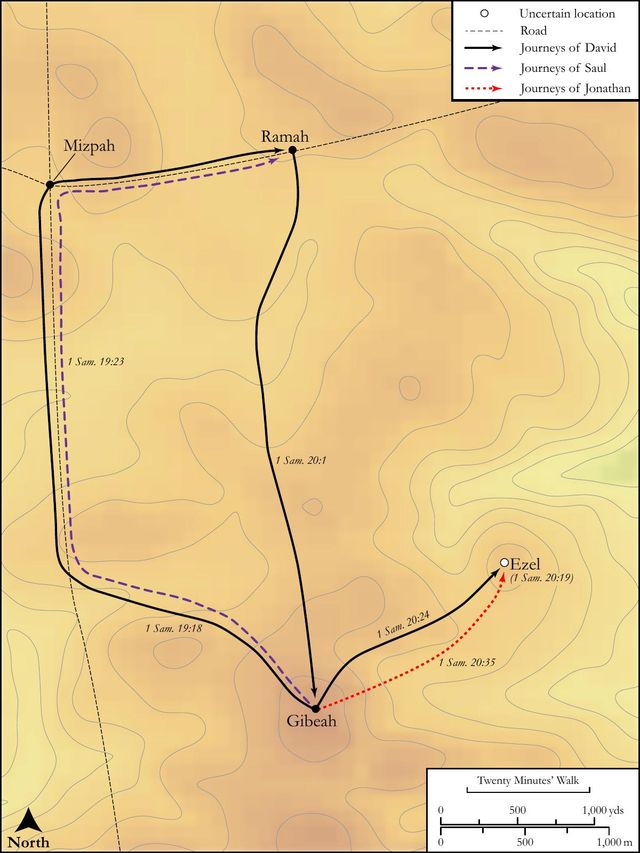
See on the biblical-era map
Study this verse
Public-domain commentary
Matthew Henry
From his Commentary on the Whole Bible. Henry comments on passages, not single verses — this entry covers 1 Samuel 20:24–34. His two-level outline is real structure in the source text, so it is rendered as structure.
Jonathan is here effectually convinced of that which he was so loth to believe, that his father had an implacable enmity to David, and would certainly be the death of him if it were in his power; and he had like to have paid very dearly himself for the conviction.
I.David is missed from the feast on the first day, but nothing is said of him.
The king sat upon his seat, to feast upon the peace-offerings as at other times (Sa1 20:25), and yet had his heart as full of envy and malice against David as it could hold. He should first have been reconciled to him, and then have come and offered his gift; but, instead of that, he hoped, at this feast, to drink the blood of David. What an abomination was that sacrifice which was brought with such a wicked mind as this! Pro 21:27. When the king came to take his seat Jonathan arose, in reverence to him both as a father and as his sovereign; every one knew his place, but David's was empty. It did not use to be so. None more content than he in attending holy duties; nor had he been absent now but that he must have come at the peril of his life; self-preservation obliged him to withdraw. In imminent peril present opportunities may be waived, nay, we ought not to throw ourselves into the mouth of danger. Christ himself absconded often, till he knew that his hour had come. But that day Saul took no notice that he missed David, but said within himself, "Surely he is not clean, Sa1 20:26. Some ceremonial pollution has befallen him, which forbids him to eat of the holy things till he has washed his clothes, and bathed his flesh in water, and been unclean until the evening." Saul knew what conscience David made of the law, and that he would rather keep away from the holy feast than come in his uncleanness. Blessed be God, no uncleanness is now a restraint upon us, but what we may by faith and repentance be washed from in the fountain opened, Psa 26:6.
II.He is enquired for the second day, Sa1 20:27.
Saul asked Jonathan, who he knew was his confidant, Wherefore cometh not the son of Jesse to meat? He was his own son by marriage, but he calls him in disdain, the son of Jesse. He asks for him as if he were not pleased that he should be absent from a religious feast; and so it should be example to masters of families to see to it that those under their charge be not absent from the worship of God, either in public or in the family. It is a bad thing for us, except in case of necessity, to omit an opportunity of statedly attending on God in solemn ordinances. Thomas lost a sight of Christ by being once absent from a meeting of the disciples. But that which displeased Saul was that hereby he missed the opportunity he expected of doing David a mischief.
III.Jonathan makes his excuse, Sa1 20:28, Sa1 20:29.
1.That he was absent upon a good occasion, keeping the feast in another place, though not here, sent for by his elder brother, who was now more respectful to him than he had been (Sa1 17:28), and that he had gone to pay his respects to his relations, for the keeping up of brotherly love; and no master would deny a servant liberty to do that in due time. He pleads,
2.That he did not go without leave humbly asked and obtained from Jonathan, who, as his superior officer, was proper to be applied to for it. Thus he represents David as not wanting in any instance of respect and duty to the government.
IV.Saul hereupon breaks out into a most extravagant passion, and rages like a lion disappointed of his prey.
David was out of his reach, but he falls upon Jonathan for his sake (Sa1 20:30, Sa1 20:31), gives him base language, not fit for a gentleman, a prince, to give to any man, especially his own son, heir apparent to his crown, a son that served him, the greatest stay and ornament of his family, before a great deal of company, at a feast, when all should be in good humour, at a sacred feast, by which all irregular passions should be mortified and subdued; yet he does in effect call him,
1.A bastard: Thou son of the perverse rebellious woman; that is, according to the foolish filthy language of men's brutish passion now a day, "Thou son of a whore." He tells him he was born to the confusion of his mother, that is, he had given the world cause to suspect that he was not the legitimate son of Saul, because he loved him whom Saul hated and supported him who would be the destruction of their family.
2.A traitor: Thou son of a perverse rebellion (so the word is), that is, "thou perverse rebel." At other times he reckoned no counsellor or commander that he had more trusty and well-beloved than Jonathan; yet now in this passion he represents him as dangerous to his crown and life.
3.A fool: Thou hast chosen the son of Jesse for thy friend to thy own confusion, for while he lives thou shalt never be established. Jonathan indeed did wisely and well for himself and family to secure an interest in David, whom Heaven had destined to the throne, yet, for this, he is branded as most impolitic. It is good taking God's people for our people and going with those that have him with them. It will prove to our advantage at last, however for the present it may be thought a disparagement, and a prejudice to our secular interest. It is probable Saul knew that David was anointed to the kingdom by the same hand that anointed him, and then not Jonathan, but himself, was the fool, to think to defeat the counsels of God. Yet nothing will serve him but David must die, and Jonathan must fetch him to execution. See how ill Saul's passion looks, and let it warn us against the indulgence of any thing like it in ourselves. Anger is madness, and he that hates his brother is a murderer.
V.Jonathan is sorely grieved and put into disorder by his father's barbarous passion, and the more because he had hoped better things, Sa1 20:2. He was troubled for his father, that he should be such a brute, troubled for his friend, whom he knew to be a friend of God, that he should be so basely abused; he was grieved for David (Sa1 20:34), and troubled for himself too, because his father had done him shame, and, though most unjustly, yet he must submit to it. One would pity Jonathan to see how he was put,
1.Into the peril of sin. Much ado that wise and good man had to keep his temper, upon such a provocation as this. His father's reflections upon himself made no return to; it becomes inferiors to bear with meekness and silence the contempts put upon them in wrath and passion. When thou art the anvil lie thou still. But his dooming David to die he could not bear: to that he replied with some heat (Sa1 20:32), Wherefore shall he be slain? What has he done? Generous spirits can much more easily bear to be abused themselves than to hear their friends abused.
2.Into the peril of death. Saul was now so outrageous that he threw his javelin at Jonathan, Sa1 20:33. He seemed to be in great care (Sa1 20:31) than Jonathan should be established in his kingdom, and yet now he himself aims at his life. What fools, what savage beasts and worse does anger make men! How necessary it is to put a hook in its nose and a bridle in its jaws! Jonathan was fully satisfied that evil was determined against David, which put him out of frame exceedingly: he rose from table, thinking it high time when his life was struck at, and would eat no meat, for they were not to eat of the holy things in their mourning. All the guests, we may suppose, were discomposed, and the mirth of the feast was spoiled. He that is cruel troubles his own flesh, Pro 11:17.
Historical interpretation
Three Centuries of Reception
4 surviving comments on this verse. Each one is dated, so this reads as a timeline rather than a list.
Select a marker to jump to its quote. Markers stagger vertically where authors wrote within a few decades of each other.
For that commendable friendship which maintains virtue is to be preferred most certainly to wealth or honors or power. It is not apt to be preferred to virtue indeed, but to follow after it. So it was with Jonathan, who for his affection’s sake avoided neither his father’s displeasure nor the danger to his own safety.
Who would not have loved him [David], when they saw how dear he was to his friends? For as he truly loved his friends, so he thought that he was loved as much in return by his own friends. No, parents put him even before their own children, and children loved him more than their parents. Therefore Saul was very angry and strove to strike Jonathan his son with a spear because he thought that David’s friendship held a higher place in his esteem than either filial piety or a father’s authority.
For love “does nothing unseemly,” but as it were with certain golden wings covers up all the offenses of the beloved. Thus also Jonathan loved David and heard the scorn of his father as one … “who has nothing of a man, but lives to the shame of himself and the mother who bore you.” What then? Did he grieve at these things, and hide his face and turn away from his beloved [David]? No, quite the contrary; he displayed his fondness as an ornament. And yet the one was at that time a king, and a king’s son, even Jonathan; the other a fugitive and a wanderer, David. But not even in this circumstance was he ashamed of his friendship. “For love does not act inappropriately.” This is its remarkable quality that it not only does not suffer the injured to grieve and feel irritated but even disposes him to rejoice. Accordingly, the one of whom we are speaking, after all these things, just as though he had a crown put on him, went away and fell on David’s neck. For love does not know what sort of thing shame is. Therefore it glories in those things for which another hides his face. The shame is in “not knowing how to love” rather than “incurring danger and enduring all for the beloved” when you do love.
Therefore Jonathan rose from the table in a fit of anger, etc. When persecution arose because of the word, the apostles and the foremost teachers of the Church gradually withdrew from the very custom of Judaizing, which they had maintained for some time to avoid scandalizing the persecutors, as both the Epistle to the Galatians and the Acts of the Apostles bear fuller witness. And to those who did not refuse to listen to the words of the law that sounded carnally (which is, as we have explained above, the beginning of intellectual new moon), they neither wished to agree nor be absent in observing these things carnally. For there was great sorrow and continuous grief over Christ in their hearts, because their brothers and kinsmen, who did not believe in Him, did not listen to them when they taught. He, who was blessed God over all forever, had been born among them according to the flesh and had deigned to become a curse for the good of others, in order to rescue us from the curse of the law.
Continue studying 1 Samuel 20:34 across the web’s major study libraries — every link below opens this exact verse, chapter, or book on the destination site.
Read & Compare
 BibleGatewayThis verse in more than 200 translations and 70 languages.
 Bible.comThe YouVersion reader — hundreds of translations, reading plans, and highlights.
 ESV.orgCrossway's official English Standard Version reader.
 NET BibleThe NET translation with 60,000+ translators' notes on every rendering decision.
 STEP BibleTyndale House's free study tool — original text, vocabulary, and scholarly resources.
 BibliaLogos Bible Software's free web reader.
 USCCBThe New American Bible (Revised Edition) with the U.S. bishops' study notes.
Commentaries
 BibleHub CommentariesDozens of classic commentaries on this verse, gathered on one page.
 StudyLightMore than 100 commentary sets — the largest collection on the web.
 BibleRefPlain-English commentary on what this verse means, verse by verse.
 Enduring WordDavid Guzik's free commentary on this chapter, widely used by Bible teachers.
 Bible Study ToolsVerse commentary alongside Greek and Hebrew study aids.
Original Language & Research
- BibleHub InterlinearThe verse word by word — original language, transliteration, and English.
- BibleHub LexiconEvery word's original-language definition and Strong's entry.
 Blue Letter BibleDeep-study tools — Strong's numbers, concordance, and word studies.
 SefariaThe Hebrew text with Rashi and centuries of Jewish commentary.
Sermons, Hymns & Audio


TrulyRandomVerse is not affiliated with these sites and doesn’t control their content. They’re linked because they’re genuinely useful.
Summary
1 Samuel 20:34 vividly portrays Jonathan's profound emotional and moral reaction to King Saul's escalating and murderous rage against David during the new moon feast. This pivotal moment underscores Jonathan's unwavering loyalty to David, his deep grief over David's unjust persecution, and his overwhelming shame at Saul's public display of tyrannical and ungodly behavior, which ultimately confirms David's need to flee and solidifies the tragic trajectory of Saul's reign, leading to the inevitable separation of David from the royal court.
Context
ShowHideLiterary Context
This verse serves as the dramatic culmination of a carefully orchestrated plan by David and Jonathan to ascertain King Saul's true intentions toward David. Following Saul's repeated attempts on David's life, David had sought Jonathan's counsel, and together they devised a test involving David's absence from the royal table during the new moon feast. The preceding narrative details Saul's volatile reaction to David's absence, his direct confrontation with Jonathan, and his shocking attempt to kill his own son by casting a javelin at him, as described in 1 Samuel 20:33. Jonathan's response in verse 34 is the immediate and decisive consequence of witnessing his father's unhinged and murderous intent, confirming David's worst fears and irrevocably sealing their separation. It marks the point of no return for Saul's relationship with David and highlights the depth of Jonathan's commitment to his friend.
Historical & Cultural Context
The new moon feast was a significant monthly religious and social observance in ancient Israel, typically involving a communal meal at the king's table, as indicated in 1 Samuel 20:5. David's expected presence and Saul's furious reaction to his absence underscore the public nature of the royal court and the king's absolute authority. Saul's act of casting a javelin at his own son, especially in such a public setting, was an extreme violation of patriarchal norms and a shocking display of uncontrolled fury, indicative of his severe mental and spiritual deterioration. Jonathan's subsequent refusal to eat was a culturally recognized and powerful sign of deep distress, mourning, protest, or spiritual anguish, conveying the profound severity of his emotional and moral condemnation of his father's actions.
Key Themes
ShowHideThis verse powerfully contributes to several overarching themes within the book of 1 Samuel. It profoundly illustrates the theme of unwavering loyalty and covenant friendship, as Jonathan prioritizes his sacred bond with David over his own dynastic ambitions and familial ties, demonstrating a commitment to righteousness that transcends political expediency and personal gain. It further accentuates the tragic degeneration of King Saul, whose "fierce anger" and willingness to harm his own son reveal a mind consumed by jealousy, paranoia, and a profound rejection of God's will, a trajectory first clearly seen in 1 Samuel 15:23. Finally, it emphasizes the cost of sin and injustice, as Jonathan experiences profound grief for David's suffering and intense shame for his father's actions, which brought public disgrace upon the royal house and exposed the moral corruption at the heart of Saul's kingship.
Exposition and Analysis
ShowHideKey Word Analysis
ShowHideThis word describes "a burning (i.e. intense) anger." In this context, it conveys Jonathan's intense, hot, and uncontrolled righteous indignation. His anger is not a petty outburst but a deep moral outrage stemming from the profound injustice and moral depravity displayed by his father. It signifies the depth of his conviction regarding Saul's sin and the imminent danger David faced.
This term means "to worry, pain or anger; displease, grieve, hurt, make, be sorry, vex." Jonathan's grief is a deep emotional sorrow, not merely for David's immediate plight, but also for the profound brokenness of his family and the tragic state of the kingdom under Saul's increasingly unstable rule. It speaks to a profound empathy for David's suffering and a sense of loss for what should have been a harmonious royal household.
This word signifies "to taunt or insult; be (make) ashamed, blush, be confounded, be put to confusion, hurt, reproach, (do, put to) shame." Jonathan felt a deep personal and public dishonor because of his father's actions. Saul's unkingly and ungodly behavior brought immense disgrace upon himself, his family, and the very institution of the monarchy, causing Jonathan profound personal embarrassment and moral distress in front of the court.
Verse Breakdown
ShowHide"So Jonathan arose from the table in fierce anger"
Jonathan's immediate and decisive action of leaving the feast signifies his strong disapproval and moral outrage. His "fierce anger" is a righteous response to the injustice and the public display of Saul's murderous intent, not a childish tantrum. It marks a definitive break with the pretense of normalcy at the royal table, a public act of disassociation from his father's sin.
"and did eat no meat the second day of the month"
This act of fasting or refusing to eat was a culturally significant gesture. It symbolized deep mourning, protest, or spiritual distress. Jonathan's hunger strike underscores the severity of his emotional turmoil and his profound grief, not only for David but also for the tragic state of affairs within his own family and the kingdom. It was a public declaration of his inner turmoil and condemnation of Saul's behavior.
"for he was grieved for David, because his father had done him shame"
This clause provides the dual motivation for Jonathan's extreme reaction. His primary concern was his deep sorrow and empathy for David, who was being unjustly persecuted and whose life was in immediate danger. Simultaneously, he felt immense personal and familial shame due to Saul's unhinged, unkingly, and disgraceful behavior. Saul's actions brought dishonor upon Jonathan and the royal house, revealing the king's moral corruption to all present.
Literary Devices
ShowHideThe verse employs several powerful literary devices to convey its profound meaning. Symbolism is evident in Jonathan's refusal to eat, which is not merely a physical act but a potent symbolic expression of deep grief, protest, and moral condemnation. This act communicates his inner turmoil and his definitive break from complicity with his father's evil. The narrative also utilizes Contrast, starkly juxtaposing Jonathan's unwavering loyalty, integrity, and selflessness against Saul's escalating paranoia, jealousy, and tyrannical behavior. This contrast highlights the moral chasm that has opened between father and son, emphasizing Jonathan's righteous character. Furthermore, the description of Saul's "fierce anger" and Jonathan's "grief" and "shame" relies on vivid Emotional Language to convey the intense psychological and relational stakes of the moment, drawing the reader into the profound human drama unfolding within the royal court.
Theological and Thematic Connections
ShowHideJonathan's righteous anger and profound grief in this verse are deeply theological. They reflect a heart aligned with God's justice, mourning the injustice inflicted upon God's chosen one, David, and lamenting the spiritual decay of Saul, God's rejected king. Jonathan's loyalty to David, even at the cost of his own inheritance, foreshadows the ultimate divine loyalty of God to His chosen king, and the eventual establishment of David's eternal dynasty. His willingness to suffer with David, and to bear the shame of his father's sin, speaks to the sacrificial nature of true love and covenant faithfulness, echoing themes of redemptive suffering and the cost of discipleship.
Reflection and Application
ShowHideJonathan's response in 1 Samuel 20:34 offers a profound lesson in integrity, loyalty, and the righteous response to injustice. His anger was not a selfish outburst but a holy indignation against the sin and cruelty displayed by his father. His grief was not self-pity but deep empathy for his friend and sorrow over the moral decay of his own family and the kingdom. In a world often characterized by self-preservation, political expediency, and moral compromise, Jonathan stands as a beacon of unwavering faithfulness. He demonstrates that true friendship demands costly commitment and that righteous anger, properly directed, can be a catalyst for moral clarity and courageous action. We are called to cultivate such loyalty, to mourn over injustice, and to stand against evil, even when it comes from unexpected or powerful sources. His actions challenge us to consider where our ultimate loyalties truly lie and whether we are willing to bear personal cost for the sake of truth and righteousness, prioritizing God's will above all else.
Questions for Reflection
ShowHideFAQ
ShowHideWhat is the significance of Jonathan's refusal to eat ("did eat no meat") in this context?
ShowHideJonathan's refusal to eat meat, particularly on the second day of the new moon feast, is highly significant. In Israel, fasting or abstaining from food was a common and powerful expression of deep emotional distress, mourning, protest, or spiritual anguish. It was not merely a physical act but a public and symbolic declaration of one's inner state. In this instance, it signifies Jonathan's profound grief for David's plight, his moral outrage at his father Saul's unhinged and murderous behavior, and the immense shame he felt for the disgrace Saul brought upon their family and the royal house. By refusing to partake in the communal meal, Jonathan publicly disassociated himself from Saul's actions and expressed his solidarity with David, underscoring the severity of the situation and the depth of his emotional and moral condemnation. This act was a clear signal to all present that something fundamentally broken had occurred at the king's table, demonstrating a moral conviction that transcended social obligation.
Christ-Centered Fulfillment
ShowHideJonathan's self-sacrificial loyalty and righteous indignation in 1 Samuel 20:34 powerfully foreshadow the ultimate friend and deliverer, Jesus Christ. Jonathan, the rightful heir to the throne of Israel, willingly relinquishes his claim and endangers his own life to protect David, God's anointed king. This mirrors Christ, who, though eternally King and heir of all things (Hebrews 1:2), "made himself nothing by taking the very nature of a servant" (Philippians 2:7), laying down His life for His friends (John 15:13) and indeed for His enemies (Romans 5:8). Jonathan's grief for David's unjust suffering resonates with Christ's empathy for humanity's suffering and His own bearing of our griefs and sorrows, becoming a "man of sorrows" (Isaiah 53:3-4). Furthermore, Jonathan's shame over his father's sin finds its ultimate resolution in Christ, who, though sinless, bore our shame and disgrace on the cross (Hebrews 12:2), becoming a curse for us to redeem us from the curse of the law (Galatians 3:13). Jonathan's unwavering commitment to David, the type of the coming King, points us to the perfect, unfailing covenant love of God manifested in Jesus, who secures an eternal kingdom not through human might or inheritance, but through His perfect obedience and ultimate sacrifice, establishing a spiritual lineage that transcends earthly dynasties.