


1 Chronicles 6:9
Bible text: King James Version (1769 Blayney text) · Public domain
Bible text: Berean Standard Bible · Public domain
Bible text: American Standard Version (1901) · Public domain
Bible text: World English Bible, Messianic edition · Public domain
Bible text: Geneva Bible (1599) · Public domain
Bible text: Young's Literal Translation · Public domain
- וַאֲחִימַעַץva·'a·chi·Ma·'atzand AhimaazH290Conj-w ¦ N-proper-mNoun Proper MasculineוַandאֲחִימַעַץAhimaaz
- הוֹלִידho·Lidhe fatheredH3205V-Hiphil-Perf-3msVerb Hiphil Perfect 3rd Singular Masculine
- אֶת'et<obj.>H853DirObjMParticle Object Indicator
- עֲזַרְיָה'a·zar·YahAzariahH5838N-proper-mNoun Proper Masculine
- וַעֲזַרְיָהva·'a·zar·Yahand AzariahH5838Conj-w ¦ N-proper-mNoun Proper MasculineוַandעֲזַרְיָהAzariah
- הוֹלִידho·Lidhe fatheredH3205V-Hiphil-Perf-3msVerb Hiphil Perfect 3rd Singular Masculine
- אֶת'et<obj.>H853DirObjMParticle Object Indicator
- יוֹחָנָןyo·cha·NanJohananH3110N-proper-mNoun Proper Masculine
English is a literal word-by-word gloss of the Hebrew, not the KJV's wording. Why?
This is the original text the KJV's translators worked from — each Hebrew word with its own literal English meaning in this verse, prepared by scholars at Tyndale House, Cambridge. The KJV translates whole sentences, not word by word, so its wording differs: one Hebrew word can become several English words, and the KJV may choose “the LORD” where the gloss reads “Yahweh”. Both are faithful — they answer different questions. For the KJV's own rendering, switch to the KJV text.
Details
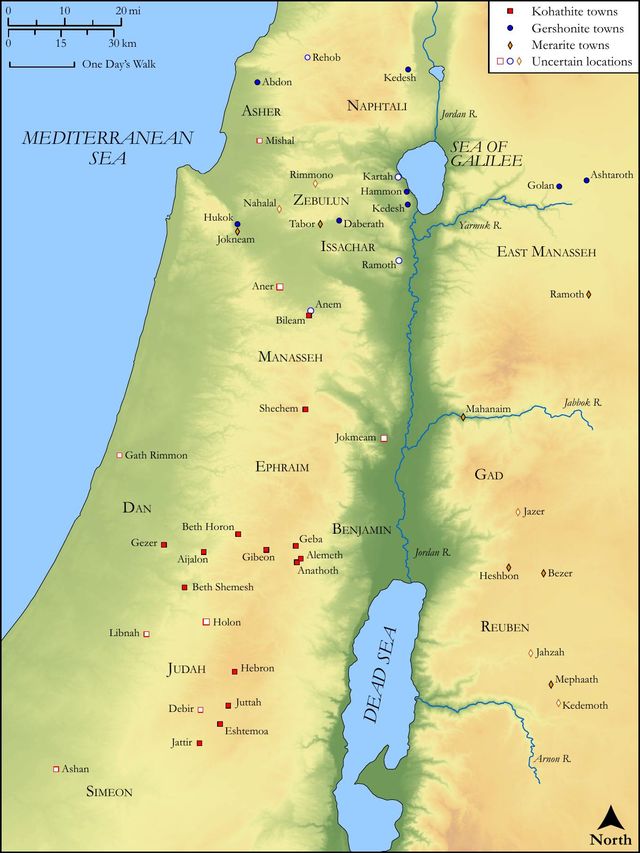
See on the biblical-era map
Study this verse
Public-domain commentary
Matthew Henry
From his Commentary on the Whole Bible. Henry comments on passages, not single verses — this entry covers 1 Chronicles 6:1–30.
The priests and Levites were more concerned than any other Israelites to preserve their pedigree clear and to be able to prove it, because all the honours and privileges of their office depended upon their descent. And we read of those who, though perhaps they really were children of the priests, yet, because they could not find the register of their genealogies, nor make out their descent by any authentic record, were, as polluted, put from the priesthood, and forbidden to eat of the holy things, Ezr 2:62, Ezr 2:63. It is but very little that is here recorded of the genealogies of this sacred tribe. I. The first fathers of it are here named twice, Ch1 6:1, Ch1 6:16. Gershom, Kohath, and Merari, are three names which we were very conversant with in the book of Numbers, when the families of the Levites were marshalled and had their work assigned to them. Aaron, and Moses, and Miriam, we have known much more of than their names, and cannot pass them over here without remembering that this was that Moses and Aaron whom God honoured in making them instruments of Israel's deliverance and settlement and figures of him that was to come, Moses as a prophet and Aaron as a priest. And the mention of Nadab and Abihu (though, having no children, there was no occasion to bring them into the genealogy) cannot but remind us of the terrors of that divine justice which they were made monuments of for offering strange fire, that we may always fear before him. 2. The line of Eleazar, the successor of Aaron, is here drawn down to the time of the captivity, Ch1 6:4-15. It begins with Eleazar, who came out of the house of bondage in Egypt, and ends with Jehozadak, who went into the house of bondage in Babylon. Thus, for their sins, they were left as they were found, which might also intimate that the Levitical priesthood did not make anything perfect, but this was to be done by the bringing in of a better hope. All these here named were not high priests; for, in the time of the judges, that dignity was, upon some occasion or other, brought into the family of Ithamar, of which Eli was; but in Zadok it returned again to the right line. Of Azariah it is here said (v. 10), He it is that executed the priest's office in the temple that Solomon built. It is supposed that this was that Azariah who bravely opposed the presumption of king Uzziah when he invaded the priest's office (Ch2 26:17, Ch2 26:18), though he ventured his neck by so doing. This was done like a priest, like one that was truly zealous for his God. He that thus boldly maintained and defended the priest's office, and made good its barriers against such a daring insult, might well be said to execute it; and this honour is put upon him for it; while Urijah, one of his successors, for a base compliance with King Ahaz, in building him an idolatrous altar, has the disgrace put upon him of being left out of this genealogy, as perhaps some others are. But some think that this remark upon this Azariah should have been added to his grandfather of the same name (Ch1 6:9), who was the son of Ahimaaz, and that he was the priest who first officiated in Solomon's temple. 3. Some other of the families of the Levites are here accounted for. One of the families of Gershom (that of Libni) is here drawn down as far as Samuel, who had the honour of a prophet added to that of a Levite. One of the families of Merari (that of Mahli) is likewise drawn down for several descents, Ch1 6:29, Ch1 6:30.
Historical interpretation
Historical reception
3 surviving comments on this verse. Each one is dated, so this reads as a timeline rather than a list.
The Chronicles also speak about the tabernacle because a temple of the Lord had not yet been built by either Samuel or David. The text also adds that that the holy services were held in the tabernacle. Worship was observed at that time according to the number of the days of the week. For it also says, “and their kindred who were in their villages were obliged to come in every seven days, in turn, to be with them.” With regard to the holy utensils it says, “Some of them had charge of the utensils of service, for they were required to count them when they were brought in and taken out. Others of them were appointed over the furniture, and over all the holy utensils, also over the choice flour, the wine, the oil, the incense and the spices.” And about the priests it says, “Others, of the sons of the priests, prepared the mixing of the spices.” With regard to the tomb of Saul the Chronicles gives us much information, and in the Book of Kings itself we read that his bones were gathered and buried in the land of Jabesh.
There is abundant information in the books of Chronicles which were written to continue the books of the Kings and to preserve the memory of such important events. The first book begins with a genealogy that sets out to demonstrate how the human race came from a single man. Since it focuses only on the single kingdom of Judah, it can tell us about its cities and the villages, and from where they took their names. Here we come to know Nathan, from whom the blessed Luke constructed the beginning of his genealogy of our Lord and Savior, Son of David and Solomon’s brother4 on his mother’s side: “The following children were born to him in Jerusalem: Shimeah, Shobab, Nathan and Solomon, that is, the four children he fathered with Bersabea, daughter of Ammiel.” And Rechab6 herself, who is mentioned in many books of Scripture, is said to have come from the tribe of Judah.It also clearly explains why Reuben lost his birthright and Joseph gained it and also, finally, the reason why the tribe of Judah obtained the highest honor: “The sons of Reuben the firstborn of Israel. He was the firstborn, but because he defiled his father’s bed his birthright was given to the sons of Joseph son of Israel, so that he is not enrolled in the genealogy according to the birthright; though Judah became prominent among his brothers and a ruler came from him, yet the birthright belonged to Joseph.” It also explains the reason why such a great honor was conceded to Joseph. By the will of God Judah had the dignity of receiving the Lord who was born from him according to the flesh. This is the sense tacitly expressed with the words “a leader from him.” Indeed the passage seems to assert that not only the kings of the earth derived from Judah, but also the eternal king himself who had no beginning and will never end.
It also describes the situation of the tribes beyond the Jordan, those of Reuben and Gad, and even the tribes of Manasseh which later were received into those of the Hagarites and the Itureans, and talks about the tribes of the Naphiseans, and all those peoples who entered into conflict with them. In addition the text relates how they fought and won, and made the Hagarites flee. And it also reports the reason for the victory: “When they received help against them, the Hagarites and all who were with them were given into their hands, for they cried to God in the battle, and he granted their entreaty because they trusted in him.” It also describes the amount of the spoils of war: “They captured their livestock: 50, of their camels, 250, sheep, 2, donkeys and 100, captives. Many were slain because the war was from God. And they lived in their territory until the exile.”
The genealogy of the priests and the Levites comes after this. It relates that Zadok, who was high priest at the time of David, had been the eleventh from Aaron; that Azariah, nephew of Zadok, had been the first to receive the priestly anointing in the temple built by Solomon. Among them there was also Jehozadak, who was brought to Babylon as a war prisoner. Jesus9 was his son, a high priest as well, who delivered the people from bondage together with Zerubbabel, and built a temple for the Lord. Here we also learn that Korah, who revolted against the great Moses, was a nephew of Isaar, son of Caath and brother of Amram, Aaron’s and Moses’ father. According to this lineage he was related to the first legislator. But he himself paid in the desert for his errors, although his children did not share the punishment of their father. From here Samuel13 came and then Aeman, who intoned Psalms and was a nephew of the prophet Samuel. In fact he was the son of Joel, son of Samuel. On the other hand, Asaph, one of the singers, came from the lineage of Gerson, son of Levi and brother of Caath. Aetham, who also belonged to the group of the singers, had Merari, the third son of Levi, as great-grandfather.The text also explains the difference between the priests and the Levites. It relates that the Levites were initiated into all the ministries of the holy altar of God: “But Aaron and his sons made offerings on the altar of burnt offering and on the altar of incense, doing all the work of the most holy place, to make atonement for Israel, according to all that Moses the servant of God had commanded.” It seems to me, in fact, that this book was written after the return from Babylon. For this reason it also talks about the bondage and explains its cause: “So all Israel was enrolled by genealogies; and these are written in the book of the Kings of Israel. And Judah was taken into exile in Babylon because of their unfaithfulness. Now the first to live again in their possessions in their towns were Israelites, priests, Levites, and temple servants.” These accounts show that the book was begun after the captivity. Indeed no historian ever relates facts that happened afterwards, but what happened before or during his times. And actually only the prophets have the power to foretell the future. In addition it says that also those who had inhabited that land before them had been enslaved. And actually many of them still live with them: the Canaanites, Chettites, Jebusites, who had been their companions in such a misfortune. Also the priests and the Levites were brought into captivity with the Israelites. I believe that those who were called “the saints’ servants” were then called Nathinim. Many of them, in fact, consecrated themselves to the ministries of the priests and the Levites. There were among them also those who were entrusted with the carrying of the water, the gathering of wood and other necessary duties. Indeed, if it was imposed to the Gabaonites, who were foreigners, to follow Joshua in the praises and to perform some works as porters or carpenters, this task was even more the duty of the Israelites. As a proof of this I have found in the interpretation of Hebrew names that this name means “house of Iaō,” that is, “of the God who is.” The text, in fact, mentions the children of Israel and among them Judah and Benjamin, and Ephraim18 and Manasseh. It also mentions the priests and the Levites, who inhabited those cities. About the Korēnites it says that they derived from Korah. It also says that among them there had been the guardians of the temple of God as well, and it seems that this custom had been introduced by Samuel and David. “All these, who were chosen as gatekeepers at the thresholds, were two hundred twelve. They were enrolled by genealogies in their villages. David and the prophet Samuel established them in their office of trust. So they and their descendants were in charge of the gates of the house of the Lord, that is, the house of the tent, as guards. The gatekeepers were on the four sides, east, west, north, and south.”
Continue studying 1 Chronicles 6:9 across the web’s major study libraries — every link below opens this exact verse, chapter, or book on the destination site.
Read & Compare
 BibleGatewayThis verse in more than 200 translations and 70 languages.
 Bible.comThe YouVersion reader — hundreds of translations, reading plans, and highlights.
 ESV.orgCrossway's official English Standard Version reader.
 NET BibleThe NET translation with 60,000+ translators' notes on every rendering decision.
 STEP BibleTyndale House's free study tool — original text, vocabulary, and scholarly resources.
 BibliaLogos Bible Software's free web reader.
 USCCBThe New American Bible (Revised Edition) with the U.S. bishops' study notes.
Commentaries
 BibleHub CommentariesDozens of classic commentaries on this verse, gathered on one page.
 StudyLightMore than 100 commentary sets — the largest collection on the web.
 BibleRefPlain-English commentary on what this verse means, verse by verse.
 Enduring WordDavid Guzik's free commentary on this chapter, widely used by Bible teachers.
 Bible Study ToolsVerse commentary alongside Greek and Hebrew study aids.
Original Language & Research
- BibleHub InterlinearThe verse word by word — original language, transliteration, and English.
- BibleHub LexiconEvery word's original-language definition and Strong's entry.
 Blue Letter BibleDeep-study tools — Strong's numbers, concordance, and word studies.
 SefariaThe Hebrew text with Rashi and centuries of Jewish commentary.
Sermons, Hymns & Audio


TrulyRandomVerse is not affiliated with these sites and doesn’t control their content. They’re linked because they’re genuinely useful.
Summary
1 Chronicles 6:9 is a pivotal entry within the extensive Levitical genealogies, meticulously documenting a segment of the high priestly lineage through Ahimaaz, Azariah, and Johanan. This verse serves as a crucial link in the Chronicler's comprehensive record of succession for the Aaronic priesthood, thereby reinforcing the themes of divine continuity, the legitimacy of sacred office, and the enduring covenant relationship between God and Israel, providing a vital historical and theological anchor for the post-exilic community.
Context
ShowHideLiterary Context
This verse is intricately woven into the fabric of 1 Chronicles chapter 6, a chapter almost entirely devoted to the detailed genealogies of the Levites, the tribe specifically consecrated for service in the tabernacle and later the Temple. Within this broader context, verses 4-15 specifically delineate the lineage of Aaron, from whom the high priests were exclusively drawn. The immediate preceding verses (1 Chronicles 6:4-8) establish the direct line through Aaron, Eleazar, Phinehas, Abishua, Bukki, Uzzi, Zerahiah, Meraioth, Amariah, Ahitub, and Zadok, leading directly to Ahimaaz, thereby setting the precise narrative stage for 1 Chronicles 6:9. The Chronicler's painstaking record-keeping here transcends mere historical cataloging; it functions as a theological affirmation, validating the unbroken, legitimate continuity of the priesthood, which was indispensable for the proper functioning of Israel's worship, sacrificial system, and covenant fidelity, especially for a post-exilic community striving to re-establish its identity and religious practices in Jerusalem.
Historical & Cultural Context
In ancient Israel, the high priest occupied an unparalleled position of sacred authority and mediation. This individual was the primary spiritual leader, responsible for overseeing the elaborate sacrificial system, entering the Most Holy Place on the Day of Atonement, and often discerning divine will through the Urim and Thummim. Consequently, the unimpeachable legitimacy of the high priest's lineage was not merely a matter of tradition but a divine imperative. Mosaic Law explicitly stipulated that only direct descendants of Aaron could serve in this sacred office, as divinely ordained in passages like Exodus 29:9 and Numbers 3:10. The genealogies presented in Chronicles, compiled after the traumatic Babylonian exile, were thus profoundly significant. They provided the returning community with the essential documentation to verify the identity and authority of those claiming priestly roles, ensuring strict adherence to God's ordained system and preserving the purity and integrity of the cultic worship.
Key Themes
ShowHideThe meticulous inclusion of 1 Chronicles 6:9 within these comprehensive genealogies underscores several profound themes central to the Chronicler's overarching message. Firstly, it powerfully emphasizes the continuity of the priesthood, demonstrating an unbroken, divinely sanctioned line of succession from Aaron, which was absolutely vital for the legitimacy and stability of Israel's religious leadership. Secondly, it highlights the theme of divine order and faithfulness, illustrating God's meticulous, providential care in preserving the sacred institutions He established, even across generations and through periods of national upheaval. This painstaking record-keeping also speaks directly to the importance of heritage and identity for the Israelite community, grounding their present existence and future hopes in a divinely ordained and meticulously preserved past. Finally, the very act of listing these names, though seemingly prosaic, implicitly points to God's sovereignty over history, as each individual, whether prominent or obscure, plays a part in His overarching redemptive plan, a foundational theme woven throughout the entire book of 1 Chronicles.
Exposition and Analysis
ShowHideKey Word Analysis
ShowHideFrom אָח (brother) and the equivalent of מַעַץ (anger/counsel), this name (H290) means "brother of anger" or "brother of counsel." In 1 Chronicles 6:9, this Ahimaaz is specifically identified as the son of Zadok, a highly prominent high priest during the reigns of King David and King Solomon. He is historically recognized for his loyalty and his role as a swift messenger, notably during Absalom's rebellion (e.g., 2 Samuel 18:27). His inclusion here serves to anchor this segment of the priestly lineage in a well-known and respected historical figure, lending significant credibility and historical depth to the subsequent generations listed.
This primitive root verb (H3205) is fundamental in biblical genealogies, carrying the primary meaning "to bear young" or, causatively, "to beget." It can also signify "to bring forth" or "to become the father of." In the context of 1 Chronicles 6:9, its repeated use is not merely descriptive but prescriptive, emphasizing the direct paternal succession and the biological and legal transfer of lineage. The theological weight of "begat" in this priestly context is profound, as it validates the legitimate transmission of authority, responsibility, and the sacred office from one generation to the next, ensuring the unbroken continuity of the Aaronic line.
Derived from עָזַר (to help) and יָהּ (Yah, a shortened form of Yahweh), this common Hebrew name (H5838) means "Yahweh has helped." Its frequent appearance across various biblical lineages, both priestly and royal, necessitates careful contextual identification. In 1 Chronicles 6:9, Azariah is explicitly presented as the son and direct successor of Ahimaaz, further extending the high priestly line. The name itself, "Yahweh has helped," subtly resonates with the Chronicler's overarching theme of God's providential and faithful care in preserving the sacred office and His people.
A form of יְהוֹחָנָן (Yehochanan), this name (H3110) means "Yahweh is gracious" or "Yahweh has shown favor." Johanan is listed as the son of Azariah, continuing the precise chain of high priestly succession. While this name is also relatively common, its specific placement within this vital genealogy underscores the Chronicler's emphasis on God's enduring grace and favor in maintaining this crucial spiritual office for the well-being and covenant fidelity of His people.
Verse Breakdown
ShowHide"And Ahimaaz begat Azariah"
This initial clause precisely establishes the direct paternal link, tracing the lineage from Ahimaaz to his son, Azariah. Given Ahimaaz's historical prominence as a high priest during the Davidic era, this connection immediately solidifies the legitimacy of Azariah's claim to the priestly office. It signifies not merely biological descent but the divinely sanctioned transfer of spiritual authority, sacred responsibilities, and the perpetuation of the Aaronic line through Zadok's descendants, ensuring the continuity essential for Israel's worship.
"and Azariah begat Johanan"
This second clause extends the high priestly lineage by one more generation, meticulously linking Azariah to his son, Johanan. The repetitive use of "begat" is a deliberate literary device, reinforcing the unbroken, continuous nature of the succession. For the Chronicler's post-exilic audience, this continuity was not a mere historical detail but a profound theological affirmation of God's unwavering faithfulness in preserving the sacred institutions He ordained for His people's worship, atonement, and ongoing covenant relationship.
Literary Devices
ShowHideThe primary literary device dominating 1 Chronicles 6:9, and indeed the entire initial section of 1 Chronicles, is Genealogy. This meticulous and systematic listing of names and lineages serves multiple critical functions beyond simple historical record-keeping. It fundamentally establishes legitimacy for the priestly class, unequivocally affirming their divine right to serve based on their direct, verifiable descent from Aaron. It provides profound continuity, demonstrating an unbroken chain of divinely appointed authority from the earliest patriarchal times through the generations leading directly to the Chronicler's post-exilic audience, thereby offering a crucial sense of stability, historical grounding, and enduring identity. The repetitive grammatical structure, particularly the recurring phrase "begat," functions as a form of anaphora and repetition, emphasizing the methodical, deliberate, and divinely ordained nature of this succession. Furthermore, the very conciseness of each entry in the list (Name A begat Name B) highlights the functional purpose of these genealogies: to record the essential links in the sacred chain rather than to provide detailed individual biographies, thereby underscoring the paramount importance of lineage and divine order over individual exploits within this specific cultic context.
Theological and Thematic Connections
ShowHideWhile 1 Chronicles 6:9 appears as a succinct record of names, its theological resonance is profound and far-reaching. It speaks powerfully to God's meticulous care for His covenant people and the sacred institutions He established for their spiritual well-being. The preservation of the high priestly line was not merely a human endeavor but a divine mandate, absolutely crucial for the proper functioning of the sacrificial system, the maintenance of ritual purity, and the ongoing viability of Israel's relationship with God. This verse, therefore, implicitly testifies to God's unwavering faithfulness in upholding His promises and providentially providing the necessary means for atonement, intercession, and worship, even through successive generations and periods of national upheaval. It underscores the profound importance of divine order, legitimacy, and continuity in spiritual leadership, themes that resonate throughout the entire biblical narrative concerning God's sovereign appointments and sacred service to His people. The seemingly dry list of names thus transforms into a vibrant testament to God's enduring commitment to His redemptive plan.
Reflection and Application
ShowHideThe seemingly mundane record of "who begat whom" in 1 Chronicles 6:9 offers surprising depth for contemporary reflection and spiritual application. It profoundly reminds us that God's grand, unfolding plan for humanity is not solely realized through dramatic, miraculous interventions but also through the quiet, consistent faithfulness of individuals across countless generations. This verse encourages us to cultivate a deep appreciation for the rich spiritual heritage we have received, recognizing that our present faith and understanding are built upon the foundational legacy laid by those who came before us—a continuous, divinely preserved lineage of believers. It compels us to thoughtfully consider our own unique role in this ongoing redemptive story, prompting us to ask how we are faithfully stewarding the spiritual truths and responsibilities entrusted to us, and how we are actively preparing the way for those who will follow. Just as God meticulously preserved the priestly line for His purposes, He is equally attentive to the intricate details of our individual lives, weaving them into His magnificent tapestry of redemption. This realization should inspire both profound humility and unwavering confidence: humility in recognizing our small yet significant place within a much larger, eternal narrative, and confidence in God's unwavering faithfulness to His purposes across all time and through all circumstances.
Questions for Reflection
ShowHideFAQ
ShowHideWhy are these genealogies so long and detailed in Chronicles?
ShowHideThe extensive genealogies in 1 Chronicles, including the concise entry in 1 Chronicles 6:9, served multiple crucial purposes for the Chronicler's post-exilic audience. Primarily, they established legitimacy for the returning community, particularly regarding the rightful claim to priestly and Levitical roles, ensuring that those serving in the rebuilt Temple were indeed from the divinely appointed lineages. They also powerfully affirmed continuity with Israel's glorious past, demonstrating that despite the trauma of exile and displacement, God's covenant promises and sacred institutions remained intact and unbroken. Furthermore, these meticulous lists helped to define and solidify national and tribal identity, enabling families to trace their heritage, claim their ancestral land portions, and understand their place within the restored community (as seen, for example, in 1 Chronicles 9:1). Ultimately, they underscored God's profound faithfulness in preserving His chosen people and their sacred order through generations, providing hope and a foundation for rebuilding.
Is this Azariah the same as other Azariahs mentioned elsewhere in the Bible?
ShowHideThe name Azariah (meaning "Yahweh has helped") was remarkably common in ancient Israel, particularly within priestly and royal families. Therefore, the Azariah mentioned in 1 Chronicles 6:9, specifically identified as the son of Ahimaaz and father of Johanan, is distinct from other individuals bearing the same name. For instance, he is not the Azariah who was a prophet during the reign of King Asa (2 Chronicles 15:1) or the Azariah who was a high priest in the time of King Uzziah and courageously confronted him (2 Chronicles 26:17). In biblical genealogies, the precise parentage and immediate successors are absolutely crucial for accurate identification, ensuring that each individual is correctly placed within their respective lineage and historical context.
Christ-Centered Fulfillment
ShowHideWhile 1 Chronicles 6:9 meticulously traces the earthly, human lineage of the Aaronic priesthood, its ultimate theological trajectory points far beyond these temporary mediators to the perfect and eternal High Priest, Jesus Christ. The Levitical priests, though divinely appointed and essential for their time, were inherently imperfect and mortal, requiring continuous succession due to death and sin, as explicitly highlighted in Hebrews 7:23. This verse, by affirming the necessary continuity of a human priestly line, subtly yet powerfully foreshadows the profound need for a priest who would not be subject to death or the inherent limitations of human frailty. Jesus, as the Great High Priest, perfectly fulfills all that the Aaronic priesthood could only anticipate and symbolize. He is not appointed by mere physical descent but by the power of an indestructible life (Hebrews 7:16), offering a single, perfect, and all-sufficient sacrifice for sins once for all time (Hebrews 7:27). Thus, the meticulous record of priestly lineage in 1 Chronicles 6:9, far from being an end in itself, serves as a foundational layer in God's unfolding redemptive history, preparing the hearts and minds of God's people for the ultimate Priest who would secure eternal redemption and provide perpetual intercession for all who come to God through Him (Hebrews 7:25).