


Matthew 22:20
Bible text: King James Version (1769 Blayney text) · Public domain
Bible text: Berean Standard Bible · Public domain
Bible text: American Standard Version (1901) · Public domain
Bible text: World English Bible, Messianic edition · Public domain
Bible text: Geneva Bible (1599) · Public domain
Bible text: Young's Literal Translation · Public domain
- καὶkaiAndG2532CONJConjunction
- λέγειlegeiHe saysG3004V-PAI-3SVerb Present Active Indicative 3rd Singular
- αὐτοῖς·autoisto themG846P-DPMPersonal pronoun Dative Plural Masculine
- τίνοςtinosOf whom [is]G5101I-GSMInterrogative pronoun Genitive Singular Masculine
- ἡhē<the>G3588T-NSFDefinite article Nominative Singular Feminine
- εἰκὼνeikōnlikenessG1504N-NSFNoun Nominative Singular Feminine
- αὕτηhautēthisG3778D-NSFDemonstrative pronoun Nominative Singular Feminine
- καὶkaiAndG2532CONJConjunction
- ἡhē[of whom is] theG3588T-NSFDefinite article Nominative Singular Feminine
- ἐπιγραφή;epigraphēinscription?G1923N-NSFNoun Nominative Singular Feminine
English is a literal word-by-word gloss of the Greek, not the KJV's wording. Why?
This is the original text the KJV's translators worked from — each Greek word with its own literal English meaning in this verse, prepared by scholars at Tyndale House, Cambridge. The KJV translates whole sentences, not word by word, so its wording differs: one Greek word can become several English words, and the KJV may choose “charity” where the gloss reads “love”. Both are faithful — they answer different questions. For the KJV's own rendering, switch to the KJV text.
Details
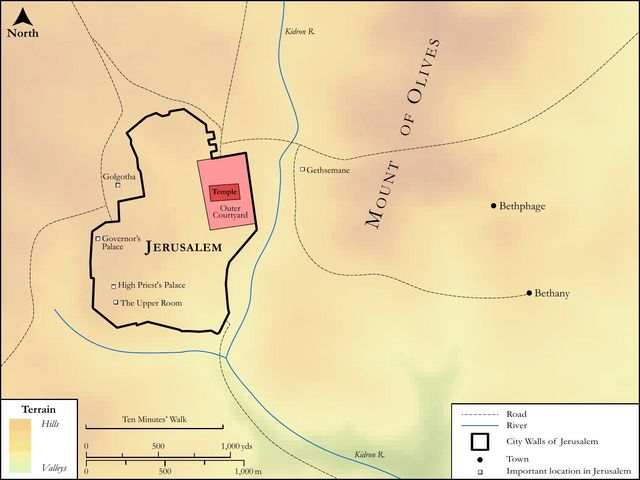
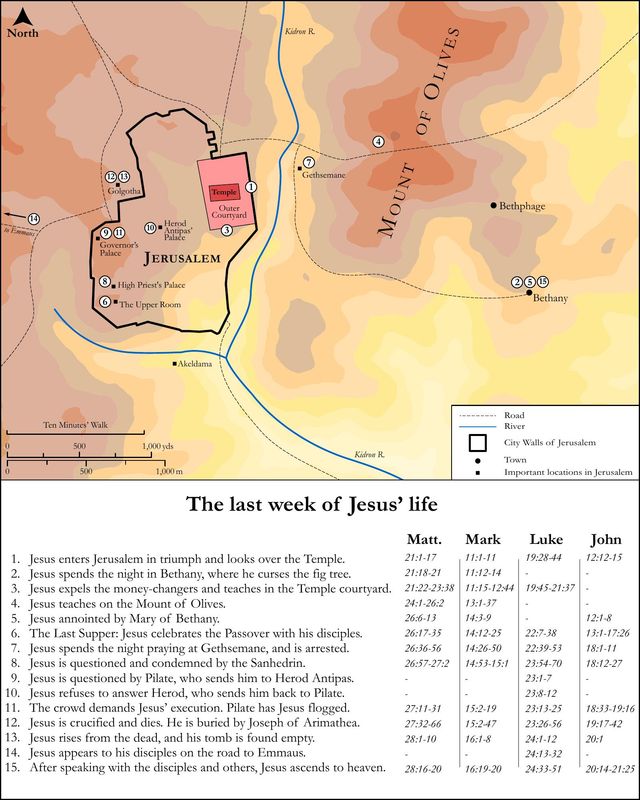
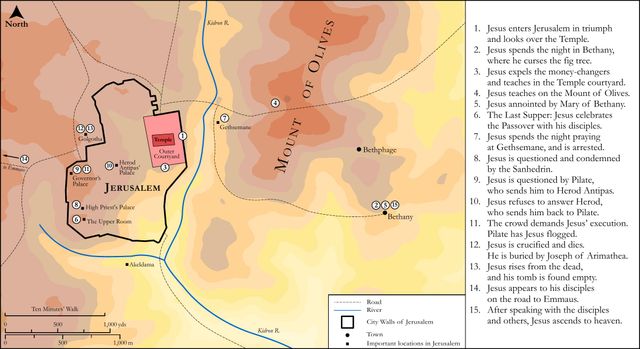
See on the biblical-era maps
Study this verse
Historical interpretation
Ten Centuries of Reception
8 surviving comments on this verse. Each one is dated, so this reads as a timeline rather than a list.
Select a marker to jump to its quote. Markers stagger vertically where authors wrote within a few decades of each other.
From this place we learn by the Saviour's example not to be allured by those things which have many voices for them, and thence seem famous, but to incline rather to those things which are spoken according to some method of reason. But we may also understand this place morally, that we ought to give some things to the body as a tribute to Cæsar, that is to say, necessaries. And such things as are congenial to our souls' nature, that is, such things as lead to virtue, those we ought to offer to God. They then who without any moderation inculcate the law of God, and command us to have no care for the things required by the body, are the Pharisees, who forbad to give tribute to Cæsar, forbidding to marry, and commanding to abstain from meats, which God hath created. (1 Tim. 4:3.) They, on the other hand, who allow too much indulgence to the body are the Herodians. But our Saviour would neither that virtue should be enfeebled by immoderate devotedness to the flesh; nor that our fleshly nature should be oppressed by our unremitting efforts after virtue. Or the prince of this world, that is, the Devil, is called Cæsar; and we cannot render to God the things that are God's, unless we have first rendered to this prince all that is his, that is, have cast off all wickedness. This moreover let us learn from this place, that to those who tempt us we should neither be totally silent, nor yet answer openly, but with caution, to cut off all occasion from those who seek occasion in us, and teach without blame the things which may save those who are willing to be saved.
For if there remain with us nothing that is Cæsar's, we shall not be bound by the condition of rendering to him the things that are his; but if we lean upon what is his, if we avail ourselves of the lawful protection of his power, we cannot complain of it as any wrong if we are required to render to Cæsar the things of Cæsar.
It behoves us also to render unto God the things that are His, namely, body, soul, and will. For Cæsar's coin is in the gold, in which His image was pourtrayed, that is, God's coin, on which the Divine image is stamped; give therefore your money to Cæsar, but preserve a conscience void of offence for God.
He stopped not, however, at the rebuke, although it was enough merely to have convicted them of their purpose, and to have put them to shame for their wickedness; but He stops not at this, but in another way closes their mouths; for, "Shew me," saith He, "the tribute money." And when they had shown it, as He ever doth, by their tongue He brings out the decision, and causes them to decide, that it is lawful; which was a clear and plain victory. So that when He asks, not from ignorance doth He ask, but because it is His will to cause them to be bound by their own answers. For when, on being asked, "Whose is the image?" they said, "Caesar's;" He saith, "Render unto Caesar the things that are Caesar's." For this is not to give but to render, and this He shows both by the image, and by the superscription.
Then that they might not say, Thou art subjecting us to men, He added, "And unto God the things that are God's." For it is possible both to fulfill to men their claims and to give unto God the things that are due to God from us. Wherefore Paul also saith, "Render unto all their dues; tribute to whom tribute is due, custom to whom custom, fear to whom fear."
But thou, when thou hearest, "Render unto Caesar the things which are Caesar's," know that He is speaking only of those things, which are no detriment to godliness; since if it be any such thing as this, such a thing is no longer Caesar's tribute, but the devil's.
When they heard these things, their mouths were stopped, and they "marvelled" at His wisdom. Ought they not then to have believed, ought they not to have been amazed. For indeed, He gave them proof of His Godhead, by revealing the secrets of their hearts, and with gentleness did He silence them.
(Hom. lxx.) They send their disciples and Herod's soldiers together, that whatever opinion the might give might be found fault with. Yet would they rather have had Him say somewhat against the Herodians; for being themselves afraid to lay hands on Him because of the populace, they sought to bring Him into danger through His liability to pay tribute.
This was a covert allusion to Herod and Cæsar.
They knew that certain had before suffered death for this very thing, as plotting a rebellion against the Romans, therefore they sought by such discourse to bring Him into the same suspicion.
But when you hear this command to render to Cæsar the things of Cæsar, know that such things only are intended which in nothing are opposed to religion; if such there be, it is no longer Cæsar's but the Devil's tribute. And moreover, that they might not say that He was subjecting them to man, He adds, And unto God the things that, are God's.
(Verse 20) And Jesus said to them, Whose image is this and superscription? Those who think that this question indicates ignorance on the part of the Savior, and not dispensation, let them learn from the present passage that Jesus could certainly know whose image was on the coin; but he asks in order to respond appropriately to their words.
Lately under Cæsar Augustus, Judæa, which was subject to the Romans, had been made tributary when the census was held of the whole world; and there was a great division among the people, some saying that tribute ought to be paid to the Romans in return for the security and quiet which their arms maintained for all. The Pharisees on the other hand, self-satisfied in their own righteousness, contended that the people of God who paid tithes and gave first-fruits, and did all the other things which are written in the Law, ought not to be subject to human laws. But Augustus had given the Jews as king, Herod, son of Antipater, a foreigner and proselyte; he was to exact the tribute, yet to be subject to the Roman dominion. The Pharisees therefore send their disciples with the Herodians, that is, with Herod's soldiers, or those whom the Pharisees in mockery called Herodians, because they paid tribute to the Romans, and were not devoted to the worship of God.
This smooth and treacherous enquiry was a kind of challenge to the answerer to fear God rather than Cæsar, and immediately they say, Tell us therefore, what thinkest Thou? Is it lawful to give tribute to Cæsar or not? Should He say tribute should not be paid, the Herodians would immediately accuse Him as a person disaffected to the Emperor.
This is the first excellence of the answerer, that He discerns the thoughts of His examiners, and calls them not disciples but tempters. A hypocrite is he who is one thing, and feigns himself another.
Wisdom does ever wisely, and so the tempters are best confuted out of their own words; therefore it follows, show me the tribute money; and they brought unto Him a denarius. This was a coin reckoned equivalent to ten sesterces, and bore the image of Cæsar. Let those who think that the Saviour asks because He is ignorant, learn from the present place that it is not so, for at all events Jesus must have known whose image was on the coin. They say unto Him, Cæsar's; not Augustus, but Tiberius, under whom also the Lord suffered. All the Roman Emperors were called Cæsar, from Caius Cæsar who first seized the chief power. Render therefore unto Cæsar the things which are Cæsar's; i. e. the coin, tribute, or money.
That is, tithes, first-fruits, oblation, and victims; as the Lord Himself rendered to Cæsar tribute, both for Himself and for Peter; and also rendered unto God the things that are God's in doing the will of His Father.
They who ought to have believed did but wonder at His great wisdom, that their craft had found no means for ensnaring Him: whence it follows, When they had heard these words, they marvelled, and left Him, and went their way, carrying away their unbelief and wonder together.
Or otherwise; Whenever God will try His Church, He enters into it that He may see the guests; and if He finds any one not having on the wedding garment, He enquires of him, How then were you made a Christian, if you neglect these works? Such a one Christ gives over to His ministers, that is, to seducing leaders, who bind his hands, that is, his works, and his feet, that is, the motions of his mind, and cast him into darkness, that is, into the errors of the Gentiles or the Jews, or into heresy. The nigher darkness is that of the Gentiles, for they have never heard the truth which they despise; the outer darkness is that of the Jews, who have heard but do not believe; the outermost is that of the heretics, who have heard and have learned.
As when one seeks to dam a stream of running water, as soon as one outlet is stopped up it makes another channel for itself; so the malevolence of the Jews, foiled on one hand, seeks itself out another course. Then went the Pharisees; went to the Herodians. Such as the plan was, such were the planners; They send unto Him their disciples with the Herodians.
This is the commonest act of hypocrites, to commend those they would ruin. Thus, these break out into praises of Him, saying, Master, we know that Thou art true. They call Him Master, that, deceived by this show of honour and respect, He might in simplicity open all His heart to them, as seeking to gain them for disciples.
He makes an answer not corresponding to the smooth tone of their address, but harsh, suitable to their cruel thoughts; for God answers men's hearts, and not their words.
He therefore calls them hypocrites, that seeing Him to be a discerner of human hearts, they might not be hardy enough to carry through their design. Observe thus how the Pharisees spoke fair that they might destroy Him, but Jesus put them to shame that He might save them; for God's wrath is more profitable to man, than man's favour.
(ord.) Who as unknown to Him, were more likely to ensnare Him, and so through them they might take Him, which they feared to do of themselves because of the populace.
(non occ.) There are three ways in which it is possible for one not to teach the truth. First, on the side of the teacher, who may either not know, or not love the truth; guarding against this, they say, We know that Thou art true. Secondly, on the side of God, there are some who, putting aside all fear of Him, do not utter honestly the truth which they know respecting Him; to exclude this they say, And teachest the way of God in truth. Thirdly, on the side of our neighbour, when through fear or affection any one withholds the truth; to exclude this they say, And carest for no man, for Thou regardest not the person of man.
Continue studying Matthew 22:20 across the web’s major study libraries — every link below opens this exact verse, chapter, or book on the destination site.
Read & Compare
 BibleGatewayThis verse in more than 200 translations and 70 languages.
 Bible.comThe YouVersion reader — hundreds of translations, reading plans, and highlights.
 ESV.orgCrossway's official English Standard Version reader.
 NET BibleThe NET translation with 60,000+ translators' notes on every rendering decision.
 STEP BibleTyndale House's free study tool — original text, vocabulary, and scholarly resources.
 BibliaLogos Bible Software's free web reader.
 USCCBThe New American Bible (Revised Edition) with the U.S. bishops' study notes.
Commentaries
 BibleHub CommentariesDozens of classic commentaries on this verse, gathered on one page.
 StudyLightMore than 100 commentary sets — the largest collection on the web.
 BibleRefPlain-English commentary on what this verse means, verse by verse.
 Enduring WordDavid Guzik's free commentary on this chapter, widely used by Bible teachers.
 Bible Study ToolsVerse commentary alongside Greek and Hebrew study aids.
Original Language & Research
- BibleHub InterlinearThe verse word by word — original language, transliteration, and English.
- BibleHub LexiconEvery word's original-language definition and Strong's entry.
 Blue Letter BibleDeep-study tools — Strong's numbers, concordance, and word studies.
 CNTR CollationThe earliest Greek manuscripts of this verse, collated letter by letter.
Sermons, Hymns & Audio


TrulyRandomVerse is not affiliated with these sites and doesn’t control their content. They’re linked because they’re genuinely useful.
Summary
In Matthew 22:20, Jesus masterfully deflects a politically charged trap by the Pharisees and Herodians concerning the lawfulness of paying taxes to Caesar. Instead of directly answering their question, He requests to see the tribute money and then poses a counter-question, "Whose is this image and superscription?" This incisive inquiry shifts the focus from a simple yes/no answer to the underlying principles of authority, ownership, and the nature of the Roman denarius itself, setting the stage for His profound teaching on rendering to Caesar what is Caesar's and to God what is God's.
Context
ShowHideLiterary Context
This verse is situated within a series of confrontations between Jesus and various Jewish religious leaders in Jerusalem during the final week of His earthly ministry, as recorded in Matthew 21-23. Following His triumphal entry and the cleansing of the temple, Jesus' authority is repeatedly challenged. In Matthew 22:15, the Pharisees, typically meticulous observers of the Law, conspire with the Herodians, a political faction loyal to Herod and Rome, to trap Jesus. Their question, "Is it lawful to give tribute unto Caesar, or not?" (Matthew 22:17), was designed to force Jesus into a dilemma: endorse Roman taxation and alienate the Jewish populace, or denounce it and face charges of sedition. Jesus, discerning their malice (Matthew 22:18), does not answer directly but instead asks for a coin, leading to the pivotal question in Matthew 22:20, which brilliantly exposes their hypocrisy and sets up His famous response in Matthew 22:21.
Historical & Cultural Context
The historical backdrop is the Roman occupation of Judea in the 1st century AD. Roman rule was enforced, and taxation was a constant source of resentment among the Jewish people, who viewed it as a symbol of their subjugation and a violation of their national and religious identity. The specific coin in question was likely the Roman denarius, a silver coin that served as a common daily wage. Crucially, this coin bore the image of Emperor Tiberius Caesar and an inscription (superscription) that often declared him "Tiberius Caesar, son of the divine Augustus" and "Pontifex Maximus" (chief priest). For devout Jews, the graven image on the coin could be seen as violating the Second Commandment (Exodus 20:4), and the imperial titles, especially claims of divinity, were blasphemous. Thus, the very act of possessing and using such a coin was a point of tension, and Jesus' question about its image and superscription directly confronted the political and religious sensitivities of His audience.
Key Themes
ShowHideMatthew 22:20 contributes significantly to several key themes within Matthew's Gospel and broader biblical theology. Firstly, it highlights Divine Wisdom and Authority, showcasing Jesus' unparalleled insight and ability to navigate complex ethical and political dilemmas, turning His adversaries' traps against them. Secondly, it addresses the theme of Authority and Ownership, specifically contrasting earthly dominion (represented by Caesar's image and inscription on the coin) with divine sovereignty. This sets the stage for the profound distinction between rendering to Caesar and rendering to God, emphasizing that ultimate allegiance belongs to God. Thirdly, the encounter exposes the Hypocrisy of Jesus' accusers; by asking them to produce the coin, Jesus reveals their own complicity in the very system they are questioning Him about. Their possession and use of the denarius demonstrate their active engagement with Roman authority, undermining their feigned piety. This passage also subtly introduces the theme of Dual Citizenship, prompting believers to consider their responsibilities to both earthly governments and the Kingdom of God, a concept further developed in passages like Romans 13:1-7.
Exposition and Analysis
ShowHideKey Word Analysis
ShowHideFrom eikō; a likeness, i.e. (literally) statue, profile, or (figuratively) representation, resemblance:--image. In this context, eikṓn refers directly to the portrait of Emperor Tiberius Caesar stamped on the denarius coin. This image was not merely a decorative feature but a powerful symbol of Caesar's authority, presence, and claim of ownership over the coin and, by extension, the realm it represented. The term carries profound theological weight elsewhere in Scripture, as humanity is created in God's eikṓn or image (Genesis 1:27).
From epigraphō; an inscription:--superscription. This term refers to the written text or legend on the coin. On the Roman denarius, this inscription typically included the emperor's name, titles, and sometimes claims of divinity (e.g., "Tiberius Caesar, son of the divine Augustus"). This inscription served as a legal and ideological declaration, asserting Caesar's identity, authority, and often his perceived divine status, which was deeply offensive to Jewish monotheistic beliefs.
A primary verb; properly, to "lay" forth, i.e. (figuratively) relate (in words (usually of systematic or set discourse; whereas epō and phēmí generally refer to an individual expression or speech respectively; while rheō is properly to break silence merely, and laléō means an extended or random harangue)); by implication, to mean:--ask, bid, boast, call, describe, give out, name, put forth, say(-ing, on), shew, speak, tell, utter. Here, légō indicates Jesus' deliberate and authoritative utterance of the question, a calculated rhetorical move designed to expose His interrogators and set forth a profound truth.
Verse Breakdown
ShowHide"And he saith unto them"
This phrase highlights Jesus' active and deliberate engagement with His adversaries. Having already perceived their malicious intent (Matthew 22:18), Jesus takes the initiative, turning the tables on them. His direct address signifies His authority and control over the conversation, refusing to be drawn into their trap on their terms.
"Whose [is] this image"
Jesus' question immediately draws attention to the visual representation on the coin. The "image" (eikṓn) of Caesar was not merely a portrait but a declaration of his dominion and ownership. By asking "Whose is this image?", Jesus forces His questioners to acknowledge the very authority they were implicitly accepting by using the coin. This question subtly introduces the concept of ownership and belonging, which is crucial for His subsequent teaching.
"and superscription?"
The addition of "and superscription" (epigraphḗ) deepens the inquiry. The inscription on the coin explicitly identified Caesar and often included blasphemous claims of divinity. This part of the question pushes beyond mere visual recognition to the proclaimed identity and authority of the one represented. It forces the Pharisees and Herodians to confront the full implications of the Roman authority they were engaging with, including its idolatrous claims. The question is designed to make them articulate the source of the coin's authority, which they would readily admit was Caesar.
Literary Devices
ShowHideJesus' question in Matthew 22:20 is rich with literary devices that amplify its impact and meaning. Firstly, it is a masterfully employed Rhetorical Question. Jesus does not ask for information He lacks; rather, He asks a question whose answer is obvious to His audience, forcing them to articulate the truth that exposes their own position. This rhetorical technique skillfully shifts the burden of proof and argument onto His adversaries, making them complicit in their own exposure. Secondly, there is profound Irony at play. The very coin that the Pharisees and Herodians use to trap Jesus becomes the instrument of their own undoing. They, who outwardly opposed Roman rule, are revealed to be actively participating in its economic system, carrying and using the coins that bear the image and blasphemous claims of the very emperor they wish to undermine. Their hypocrisy is subtly, yet powerfully, highlighted. Thirdly, the coin itself serves as a potent Symbolism. The "image" and "superscription" on the denarius symbolize Caesar's earthly authority, dominion, and even his self-proclaimed divine status. By drawing attention to these elements, Jesus uses the physical object to represent the broader concept of earthly power and ownership, contrasting it with the ultimate spiritual authority and ownership of God, which He then expounds upon in the following verse.
Theological and Thematic Connections
ShowHideMatthew 22:20 is far more than a clever retort; it lays the theological groundwork for understanding the complex relationship between earthly authority and divine sovereignty. Jesus' question about the image and superscription on the coin implicitly raises the question of whose "image" we ultimately bear and to whom our ultimate allegiance belongs. While Caesar's image signifies his claim to earthly dominion and the coin's ownership, the deeper theological truth is that humanity is created in the image of God (Genesis 1:27). Therefore, just as the coin belongs to Caesar because it bears his image, so humanity belongs to God because we bear His image. This passage thus introduces the critical distinction between our civic duties and our spiritual obligations, affirming that while we are to render to temporal authorities what is due to them, our ultimate and profoundest allegiance is reserved for God, who alone holds ultimate authority and ownership over all creation.
Reflection and Application
ShowHideMatthew 22:20, though brief, provides profound insights for believers navigating life in a complex world. Jesus' discerning approach teaches us to look beyond superficial questions and identify the underlying motives or principles at play, whether in personal interactions or broader societal issues. We are called to cultivate a Christ-like wisdom that allows us to respond not merely to the surface-level challenge, but to address the heart of the matter with truth and grace. This passage also compels us to reflect on our dual citizenship—our identity as citizens of an earthly nation and, more importantly, as citizens of God's eternal Kingdom. It reminds us that while we have legitimate responsibilities to civil authorities, our ultimate allegiance, our deepest loyalty, and our very being are stamped with the image of God. Therefore, our lives should reflect His ownership and His glory above all else. This means discerning how to live faithfully within earthly systems without compromising our devotion to God, always prioritizing His will and kingdom values.
Questions for Reflection
ShowHideFAQ
ShowHideWhy did Jesus ask to see the coin instead of just answering the question directly?
ShowHideJesus' request to see the coin, followed by His question about its "image" and "superscription," was a brilliant strategic move that served multiple purposes. Firstly, it avoided a direct "yes" or "no" answer that would have immediately trapped Him politically. If He said "yes," He would alienate the Jewish populace who resented Roman taxation. If He said "no," He would be accused of sedition against Rome. Secondly, by asking them to produce the coin, Jesus exposed the hypocrisy of His interrogators. The Pharisees, who feigned piety and concern for Jewish law, were themselves carrying and using the very Roman currency they questioned Him about. Their possession of the coin demonstrated their active participation in the Roman economic system. Thirdly, it shifted the focus from a simple legalistic question to a profound theological principle. The "image" and "superscription" on the coin were not just decorative; they represented Caesar's authority and claim of ownership. Jesus used this visual aid to set up His teaching in Matthew 22:21, distinguishing between what belongs to Caesar and what belongs to God, thereby elevating the discussion to a higher, spiritual plane.
Christ-Centered Fulfillment
ShowHideMatthew 22:20, with Jesus' incisive question about the "image" and "superscription" on the coin, powerfully foreshadows His own unique identity and ultimate authority. While the coin bore the image of Caesar, signifying his temporal dominion, Jesus Himself is revealed as the very "image of the invisible God" (Colossians 1:15), the perfect representation and embodiment of the Father's glory. The "superscription" on Caesar's coin declared his earthly titles and claims; yet, it is Jesus who possesses the true "superscription" of divine authority, having "all authority in heaven and on earth" (Matthew 28:18). His question not only exposed the hypocrisy of His adversaries but also subtly redirected their attention to the ultimate claim of ownership – that humanity, created in God's image (Genesis 1:27), belongs supremely to God. Thus, the passage moves beyond earthly taxation to the profound truth of Christ's kingship and the believer's ultimate allegiance. We are called to render to Caesar what is Caesar's, but to God what is God's, recognizing that our very lives, stamped with the divine image, are Christ's possession, bought with His precious blood (1 Peter 1:18-19). Our true fulfillment is found not in earthly allegiances, but in acknowledging and living under the supreme reign of the One who bears the true divine image and superscription.