


Ezekiel 43:23
Bible text: King James Version (1769 Blayney text) · Public domain
Bible text: Berean Standard Bible · Public domain
Bible text: American Standard Version (1901) · Public domain
Bible text: World English Bible, Messianic edition · Public domain
Bible text: Geneva Bible (1599) · Public domain
Bible text: Young's Literal Translation · Public domain
- בְּכַלּוֹתְךָbe·kha·lot·Khawhen finishing youH3615Prep-b ¦ V-Piel-Inf ¦ 2msVerb Piel Infinitive Constructבְּwhenכַלּוֹתְfinishingךָyou
- מֵחַטֵּאme·cha·Te'from cleansing [it] from sinH2398Prep-m ¦ V-Piel-InfVerb Piel Infinitive Constructמֵfromחַטֵּאcleansing [it] from sin
- תַּקְרִיבtak·Rivyou will bring nearH7126V-Hiphil-Imperf-2msVerb Hiphil Imperfect 2nd Singular Masculine
- פַּרpara young bullH6499N-msNoun Singular Masculine Absolute
- בֶּןbena young one ofH1121N-mscNoun Singular Masculine Construct
- בָּקָרba·KarcattleH1241N-csNoun Singular common gender Absolute
- תָּמִיםta·MimunblemishedH8549Adj-msAdjective Singular Masculine Absolute
- וְאַיִלve·'A·yiland a ramH352Conj-w ¦ N-msNoun Singular Masculine Absoluteוְandאַיִלa ram
- מִןminfromH4480PrepPreposition
- הַצֹּאןha·Tzonthe flockH6629Art ¦ N-csNoun Singular common gender Absoluteהַtheצֹּאןflock
- תָּמִיםta·MimunblemishedH8549Adj-msAdjective Singular Masculine Absolute
English is a literal word-by-word gloss of the Hebrew, not the KJV's wording. Why?
This is the original text the KJV's translators worked from — each Hebrew word with its own literal English meaning in this verse, prepared by scholars at Tyndale House, Cambridge. The KJV translates whole sentences, not word by word, so its wording differs: one Hebrew word can become several English words, and the KJV may choose “the LORD” where the gloss reads “Yahweh”. Both are faithful — they answer different questions. For the KJV's own rendering, switch to the KJV text.
Details
See on the biblical-era map
Study this verse
Public-domain commentary
Matthew Henry
From his Commentary on the Whole Bible. Henry comments on passages, not single verses — this entry covers Ezekiel 43:13–27. His three-level outline is real structure in the source text, so it is rendered as structure.
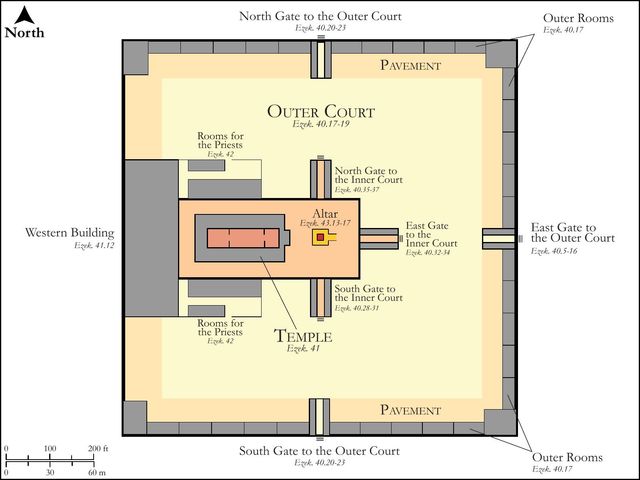
This relates to the altar in this mystical temple, and that is mystical too; for Christ is our altar. The Jews, after their return out of captivity, had an altar long before they had a temple, Ezr 3:3. But this was an altar in the temple. Now here we have,
I.The measures of the altar, Eze 43:13.
It was six yards square at the top and seven yards square at the bottom; it was four yards and a half high; it had a lower bench or shelf, here called a settle, a yard from the ground, on which some of the priests stood to minister, and another two yards above that, on which others of them stood, and these were each of them half a yard broad, and had ledges on either side, that they might stand firmly upon them. The sacrifices were killed at the table spoken of before, Eze 40:39. What was to be burnt on the altar was given up to those on the lower bench, and handed by them to those on the higher, and they laid it on the altar. Thus in the service of God we must be assistant to one another.
II.The ordinances of the altar. Directions are here given,
1.Concerning the dedication of the altar at first. Seven days were to be spent in the dedication of it, and every day sacrifices were to be offered upon it, and particularly a goat for a sin-offering (Eze 43:25), besides a young bullock for a sin-offering on the first day (Eze 43:19), which teaches us in all our religious services to have an eye to Christ the great sin-offering. Neither our persons nor our performances can be acceptable to God unless sin be taken away, and that cannot be taken away but by the blood of Christ, which both sanctifies the altar (for Christ entered by his own blood, Heb 9:12) and the gift upon the altar. There were also to be a bullock and a ram offered for a burnt-offering (Eze 43:24), which was intended purely for the glory of God, to teach us to have an eye to that in all our services; we present ourselves as living sacrifices, and our devotions as spiritual sacrifices, that we and they may be to him for a name, and for a praise, and for a glory. The dedication of the altar is here called the cleansing and purging of it, Eze 43:20, Eze 43:26. Christ, our altar, though he had no pollution to be cleansed from, yet sanctified himself (Joh 17:19); and when we consecrate the altars of our hearts to God, to have the fire of holy love always burning upon them, we must see that they be purified and cleansed from the love of the world and the lusts of the flesh. It is observable that there are several differences between the rites of dedication here and those which were appointed Ex. 29, to intimate that the ceremonial institutions were mutable things, and the changes in them were earnests of their period in Christ. Only here, according to the general law, that all the sacrifices must be seasoned with salt (Lev 2:13), particular orders are given (Eze 43:24) that the priests shall cast salt upon the sacrifices. Grace is the salt with which all our religious performances must be seasoned, Col 4:6. An everlasting covenant is called a covenant of salt, because it is incorruptible. The glory reserved for us is incorruptible and undefiled; and the grace wrought in us is the hidden man of the heart in that which is not corruptible.
2.Concerning the constant use that should be made of it, when it was dedicated: Henceforward the priests shall make their burnt-offerings and peace-offerings upon this altar (Eze 43:27), for therefore it was sanctified, that it might sanctify the gift that was offered upon it. Observe further,
(1.)Who were to serve at the altar: The priests of the seed of Zadok, Eze 43:19. That family was substituted in the room of Abiathar by Solomon, and God confirms it. His name signifies righteous, for they are the righteous seed that are priests to God, through Christ the Lord our righteousness.
(2.)How they should prepare for this service (Eze 43:26): They shall consecrate themselves, shall fill their hand with the offerings, in token of the giving up of themselves with their offerings to God and to his service. Note, Before we minister to the Lord in holy things we must consecrate ourselves by getting our hands and hearts filled with those things.
(3.)How they should speed in it (Eze 43:27): I will accept you. And if God now accept our works, if our services be pleasing to him, it is enough, we need no more. Those that give themselves to God shall be accepted of God, their persons first and then their performances, through the Mediator.
Historical interpretation
Historical reception
1 surviving comment on this verse from the historical church.
(v. 23 seqq.) 'When you have completed cleansing it, you shall offer an unblemished calf from the herd and an unblemished ram from the flock. You shall present them before the Lord, and the priests shall sprinkle salt on them and offer them as a burnt offering to the Lord. For seven days you shall make atonement for the altar and consecrate it; then the altar shall be most holy, and whatever touches the altar shall become holy.' On the eighth day and beyond, the priests shall offer your burnt offerings and peace offerings on the altar, and I will be appeased with you, says the Lord God. LXX: And when you have completed the purgation, you shall offer a calf from the herd without blemish, and a ram from the flock without blemish, and you shall offer them before the Lord, and the priests shall sprinkle salt upon them; and they shall offer them as burnt offerings to the Lord. For seven days you shall make atonement with a goat for sin daily, and a calf from the herd, and a ram from the flock without blemish shall be offered for seven days. And they shall purify the altar, and cleanse it, and fill their hands, and accomplish the days. And from the eighth day and beyond, the priests shall offer your burnt offerings upon the altar, for your salvation. And I will receive you, says the Lord God. After the altar and its measurements were shown on the top of the mountain, and the purification and consecration of it were demonstrated to the prophets, through one unblemished calf and a male goat, or two young goats, the first of which we refer to the Lord and Savior, and the two that followed to the apostles and ministers, so that in the consecration of the spiritual altar and specifically pertaining to the Church, it may not seem that the law and the prophets were excluded. Therefore, after the altar had been consecrated, an unblemished calf and a ram are taken and offered in the sight of the Lord; and the sons of Zadok, that is, the righteous priests, sprinkle salt upon their heads, so that both the law and the prophets may be seasoned with the taste of the Gospel. And there is no sacrifice (according to the command of the law and the interpretation of the Apostle, who says (Col. IV, 6): Let your speech be seasoned with salt) that is lacking in salt. Both, however, are offered as a burnt offering to the Lord, like the fat of the letter, which is signified in the Law, and the prophecy, like a cloud of fire of the Lord, that is, the Holy Spirit, of whom Paul says, fervent in spirit (Rom. XII, 11), are transformed into a spiritual and thin substance. We want to know more clearly what the calf of the unblemished herd is, and the ram with the purest fleece from the sheep, let us understand Moses and Elijah (Num. XII, III Reg. XIX); the former of whom was the gentlest among all men who dwelt on the earth; the latter was similar to Moses in fervor of faith. Hence he dared to say: I am left alone. But what is written in Hebrew as 'You shall offer a calf', in the Septuagint it is written as 'the priests shall offer', there is no question about it. And indeed Ezekiel himself, to whom these things are said, is from the number of priests, full of age and perfect; and the grace of prophecy increased the priestly rank in him. And Moses and Elijah appear on the mountain with the Lord, that is, the law and the prophets, who announced to him what he would suffer in Jerusalem. But after the altar is cleansed, for seven days a goat or a young goat is offered for sin daily, and a bull from the herd, and an unblemished ram from the flock, so that through these sacrifices the altar may be cleansed for seven days and made perfect. In seven days the Sabbath is observed, which according to the Apostle (Hebrews IV) is reserved for the people of God: in which we hope for eternal and true rest, and do no servile work of sin. However, in the goat, and the calf, and the ram, three general sins are demonstrated, to which all human beings are subject. For we sin either in thoughts, or in speech, or in action. Thoughts are referred to the ram, which is the first of all sins, and from which the other two sins arise. But the goat, or rather the male goat, is known for its eloquence or discourse, always engaging in higher-level discussions. However, it is specifically designated for agricultural work, being bound to the plow and toil and earthly labor. Therefore, we must offer these blameless things for the true Sabbath, which lasts for seven days, and cleanse the altar, so that our prayer may reach God in purity. The phrase that follows, 'And they shall cleanse it, and fill his hand,' as translated by both the Hebrew and other interpreters, signifies that the offerings for the expiation of the altar itself should also be fulfilled, just as offerings are made for the priests, the people, and the high priest, so that nothing may appear empty in the sight of the Lord. For what reason they set aside the Septuagint: both will clean it, and they will fill their hands, so that the priests may be heard, who when they are full of good works, for this reason their hands are full, after the Sabbath has passed, they may come to the eighth day of resurrection, and may say with the Apostle: We have risen with Christ (Rom. VI, Coloss. III); and beyond the eighth day, they may strive for heavenly things, and may offer burnt offerings for us, or those which are for the peace of our sins and our salvation: so that through the fire of the Holy Spirit, everything that we think, speak, and do, may be transformed into spiritual substance: and the Lord, pleased with such sacrifices, may be appeased towards us.
Continue studying Ezekiel 43:23 across the web’s major study libraries — every link below opens this exact verse, chapter, or book on the destination site.
Read & Compare
 BibleGatewayThis verse in more than 200 translations and 70 languages.
 Bible.comThe YouVersion reader — hundreds of translations, reading plans, and highlights.
 ESV.orgCrossway's official English Standard Version reader.
 NET BibleThe NET translation with 60,000+ translators' notes on every rendering decision.
 STEP BibleTyndale House's free study tool — original text, vocabulary, and scholarly resources.
 BibliaLogos Bible Software's free web reader.
 USCCBThe New American Bible (Revised Edition) with the U.S. bishops' study notes.
Commentaries
 BibleHub CommentariesDozens of classic commentaries on this verse, gathered on one page.
 StudyLightMore than 100 commentary sets — the largest collection on the web.
 BibleRefPlain-English commentary on what this verse means, verse by verse.
 Enduring WordDavid Guzik's free commentary on this chapter, widely used by Bible teachers.
 Bible Study ToolsVerse commentary alongside Greek and Hebrew study aids.
Original Language & Research
- BibleHub InterlinearThe verse word by word — original language, transliteration, and English.
- BibleHub LexiconEvery word's original-language definition and Strong's entry.
 Blue Letter BibleDeep-study tools — Strong's numbers, concordance, and word studies.
 SefariaThe Hebrew text with Rashi and centuries of Jewish commentary.
Sermons, Hymns & Audio


TrulyRandomVerse is not affiliated with these sites and doesn’t control their content. They’re linked because they’re genuinely useful.
Summary
Ezekiel 43:23 meticulously outlines the precise animal sacrifices required for the consecration of the visionary temple's altar, immediately following an intensive period of purification. This verse underscores the foundational Old Testament principle of offering unblemished sacrifices, a divine mandate that profoundly reflects God's absolute holiness and the meticulous purity essential for approaching His sacred presence. It serves as a powerful testament to God's exacting standards for worship and prophetically foreshadows the ultimate, perfect sacrifice that would fully satisfy these divine requirements.
Context
ShowHideLiterary Context
Ezekiel 43:23 is strategically positioned within the climactic section of Ezekiel's prophecy, specifically the extensive vision of the new temple, spanning chapters 40-48. This grand vision, initiated in Ezekiel 40:1, provides astonishingly detailed blueprints for the temple's architecture, its dimensions, and, crucially, its prescribed rituals and the glorious return of God's presence within it. The verses immediately preceding, Ezekiel 43:18-22, describe an intricate seven-day process dedicated to purifying and consecrating the altar itself, involving a series of specific sin offerings. Therefore, verse 23 marks the culmination of this foundational cleansing period, establishing the transition from the initial purification of the sacred space to the regular, divinely prescribed offerings that would follow, thereby emphasizing the strict order and prerequisite purity for all sacred service within God's restored dwelling.
Historical & Cultural Context
The book of Ezekiel was penned during the tumultuous period of the Babylonian exile (circa 593-571 BC), a time of profound national trauma for the Jewish people, who had lost their temple, their land, and their tangible sense of God's immediate presence. Ezekiel's elaborate temple vision served as a profound message of enduring hope, divine restoration, and God's unwavering covenant faithfulness amidst despair. It functioned not as an immediate architectural blueprint for physical reconstruction, but rather as a prophetic vision for a future, ideal state of worship and renewed communion with God. The sacrificial system delineated, while echoing foundational elements of the Mosaic Law (e.g., as detailed in Leviticus), also incorporates unique features, hinting at a renewed and profoundly purified worship in a restored Israel. The pervasive emphasis on "without blemish" was a requirement of the law from the earliest days of the tabernacle, signifying perfection, wholeness, and worthiness for divine presentation, a concept deeply ingrained in Israelite theology from the earliest days of the tabernacle.
Key Themes
ShowHideThis verse significantly contributes to several overarching themes central to Ezekiel's prophecy and the broader biblical narrative. Firstly, the theme of Purity and Consecration is paramount, as the repeated insistence on offerings being "without blemish" (Hebrew: tamim) underscores God's absolute holiness and the indispensable requirement of moral and ritual purity to approach Him. This principle is consistently woven throughout the Law, notably in the instructions for altar consecration found in Exodus 29:36-37. Secondly, the theme of Sacrifice and Atonement is implicitly but powerfully present; while not explicitly termed an atonement offering here, these sacrifices are integral to the dedication process, which inherently involves expiation for impurities and the establishment of a clean, holy space for God's dwelling. This ritualistic cleansing points forward to a future, perfect sacrifice that would truly atone. Lastly, the meticulous detail of the instructions reinforces the theme of Divine Order in Worship, emphasizing that true devotion must strictly adhere to God's prescribed ways, rather than human invention or preference, a principle consistently taught from the very construction of the tabernacle, as seen in Exodus 25:9.
Exposition and Analysis
ShowHideKey Word Analysis
ShowHideThis word (H2398) is a primitive root with a core meaning "to miss" or "to sin." However, in a causative or intensive sense, as employed in Ezekiel 43:23, it signifies "to purge," "to purify," or "to make reconciliation." Here, it specifically refers to the ritual purification of the altar, a process designed to remove its defilement and render it holy and fit for sacred use. This usage highlights the theological truth that even sacred objects require a divinely ordained process of expiation to be acceptable for divine service, thereby underscoring the pervasive nature of impurity and the absolute necessity of God's provision for its removal.
This verb (H7126) literally means "to approach" or "to bring near." In the context of sacrifices, it carries the profound meaning of "to present" or "to offer," emphasizing the deliberate act of bringing something into the immediate, sacred presence of God. The act of offering, therefore, is far more than a mere transaction; it is an act of drawing near to the divine, symbolizing access, communion, and humble submission. It implies a conscious, intentional presentation of a gift or sacrifice to God, establishing a vital connection between the worshiper and the divine.
This adjective (H8549) denotes "entire," "complete," "sound," "perfect," or "whole." When applied to sacrificial animals, it mandates physical flawlessness and absolute integrity, rendering the animal acceptable to God. This requirement was not merely an aesthetic preference but possessed profound theological significance, signifying the absolute purity and perfection demanded by a holy God. It served as a constant, tangible reminder that only what is perfect could truly represent atonement or be presented before the divine presence, setting an unattainable standard for human efforts and prophetically pointing to a future, perfect provision.
Verse Breakdown
ShowHide"When thou hast made an end of cleansing [it],"
This opening clause refers to the culmination of the seven-day consecration process for the altar, the intricate details of which are provided in the preceding verses (Ezekiel 43:18-22). The "cleansing" involved specific sin offerings designed to purify the altar from any potential defilement, thereby rendering it holy and suitable for God's presence and for receiving future offerings. This emphasizes the critical prerequisite of purification before any sacred worship or divine interaction can legitimately commence.
"thou shalt offer a young bullock without blemish,"
Following the altar's thorough purification, the first divinely prescribed offering is a "young bullock." The term "young bullock" (Hebrew: par, often combined with ben-baqar) typically refers to a male bovine in its prime, symbolizing strength, vitality, and significant value as a sacrificial animal. The crucial qualification "without blemish" (Hebrew: tamim) stipulates that the animal must be physically perfect, entirely free from any defect or imperfection that would render it unacceptable for sacrifice. This stringent requirement underscores the exceedingly high standard of purity and worthiness demanded for offerings presented to the holy God.
"and a ram out of the flock without blemish."
In addition to the bullock, a ram is also explicitly commanded to be offered. Rams (Hebrew: 'ayil) were common sacrificial animals in Israelite worship, frequently associated with burnt offerings and peace offerings. Like the bullock, this ram must also be "without blemish," reiterating and reinforcing the absolute necessity of perfection in all aspects of worship and sacrifice. The inclusion of both a bullock and a ram suggests a comprehensive and thorough set of offerings for the altar's dedication, signifying completeness and the full consecration of the sacred space.
Literary Devices
ShowHideEzekiel 43:23 masterfully employs several literary devices to convey its profound theological message and reinforce its divine authority. Repetition is prominently featured in the phrase "without blemish," which appears twice, emphatically underscoring the paramount requirement for the sacrificial animals. This reiteration serves to engrave the divine standard of perfection into the reader's mind, highlighting the absolute purity demanded for approaching God and the unblemished nature of the offerings. Symbolism is central, as the "young bullock" and "ram" transcend their animal forms to represent valuable, unblemished offerings, symbolizing the absolute best that can be given to God. They also function as Typology, serving as prophetic foreshadows of a greater, perfect sacrifice to come. The meticulous detail in the instructions, a hallmark characteristic of Ezekiel's extensive temple vision, creates a pervasive sense of Precision and Order, reinforcing the theological principle that God's worship must be conducted according to His exact, divinely revealed specifications, thereby reflecting His own orderly, holy, and sovereign nature.
Theological and Thematic Connections
ShowHideEzekiel 43:23, with its profound emphasis on unblemished sacrifices for the consecration of the altar, resonates deeply with the overarching biblical theme of God's absolute holiness and the indispensable necessity of purity for fellowship with Him. The meticulous instructions for the visionary temple, including these specific offerings, powerfully highlight God's unchanging standard for worship, which demands perfection, integrity, and utter blamelessness. This foundational Old Testament principle of offering the "best" and "purest" to God finds its ultimate and glorious culmination in the New Testament, where the need for such animal sacrifices is entirely superseded by the perfect, once-for-all sacrifice of Jesus Christ. The very concept of an unblemished offering points forward with striking clarity to the sinless nature of the Messiah, who alone possessed the moral perfection to perfectly fulfill the righteous demands of God's holy law and provide true, eternal atonement for humanity.
Reflection and Application
ShowHideWhile the physical animal sacrifices described in Ezekiel's visionary temple are not practiced by believers under the New Covenant today, the profound spiritual principles embedded within Ezekiel 43:23 remain profoundly relevant and transformative for contemporary Christian life and worship. The verse powerfully underscores the absolute necessity of purity and consecration in our approach to God. Just as the altar had to undergo a rigorous cleansing process, so too must our hearts and lives be purified before we can truly offer acceptable and meaningful worship. This spiritual purification, however, is not achieved by our own merit or ritualistic efforts, but is graciously and completely provided through faith in Jesus Christ, whose atoning work cleanses us from all sin and defilement. Our worship, therefore, should be intentional, offered with integrity, and in accordance with God's revealed will as found in His Word, not merely human preference or tradition. We are called to present ourselves as "living sacrifices," holy and pleasing to God, which is our spiritual act of worship, reflecting a life committed to spiritual blamelessness made possible solely by divine grace and the indwelling Holy Spirit.
Questions for Reflection
ShowHideFAQ
ShowHideWhy is "without blemish" so frequently emphasized in Old Testament sacrifices?
ShowHideThe emphasis on "without blemish" (Hebrew: tamim) for sacrificial animals in the Old Testament, as prominently seen in Ezekiel 43:23, is crucial for several profound theological reasons. Firstly, it directly reflects God's absolute holiness, perfection, and moral purity; only what is perfect and untainted can be offered to a perfect and holy God. Secondly, it powerfully symbolizes the purity and integrity required for true atonement. A blemished animal could not adequately represent the removal of sin or serve as a perfect, unblemished substitute for the defiled worshiper. Thirdly, it underscored the immense value and worthiness of the offering; the very best of the flock or herd was to be given to God, thereby demonstrating the worshiper's profound reverence, devotion, and commitment. This stringent requirement also served as a powerful prophetic foreshadowing, pointing to the ultimate, perfect sacrifice of Jesus Christ, who was truly without sin or blemish.
Does Ezekiel's temple vision, including these sacrifices, imply a return to animal sacrifices in the future?
ShowHideThe interpretation of Ezekiel's temple vision, including its detailed sacrificial system, is a complex and highly debated theological question with various scholarly and confessional views. Some interpret it literally, suggesting a future restoration of animal sacrifices in a millennial temple, often viewing them as memorial offerings that look back to Christ's completed work rather than as atoning ones, given the definitive finality of Christ's sacrifice (e.g., Hebrews 10:18). Others interpret the vision symbolically or spiritually, seeing it as a blueprint for an ideal, purified worship in the Messianic age, where the sacrifices represent spiritual offerings of praise, prayer, and righteous living, or that they signify the benefits and application of Christ's finished work. The New Testament consistently and unequivocally teaches that Christ's sacrifice was "once for all" (Hebrews 7:27), rendering any further animal sacrifices entirely unnecessary for the atonement of sins. Therefore, the vast majority of Christian traditions view Ezekiel's vision as primarily symbolic, highlighting timeless themes of purity, God's glorious presence, and restored worship, rather than predicting a literal re-institution of animal sacrifices for atonement.
Christ-Centered Fulfillment
ShowHideEzekiel 43:23, with its stringent requirement for unblemished sacrifices to consecrate the altar, finds its profound and ultimate fulfillment in the person and redemptive work of Jesus Christ. The "young bullock without blemish, and a ram out of the flock without blemish" served as powerful types and shadows, meticulously pointing forward to the perfect Lamb of God. Just as these animals had to be physically flawless to be acceptable for God's holy presence, so too was Jesus "without blemish and without spot" (1 Peter 1:19), utterly sinless in His life, character, and sacrificial death. The meticulous cleansing of the altar, a prerequisite for God's dwelling, perfectly foreshadows the spiritual cleansing that Christ provides for His people, making them holy and fit temples for the indwelling Holy Spirit (1 Corinthians 6:19). His "one sacrifice for sins forever" (Hebrews 10:12) perfectly accomplished what the countless Old Testament offerings could only foreshadow, purifying not merely an inanimate altar but the very hearts and consciences of believers (Hebrews 9:14). Thus, the meticulous demands of Ezekiel's vision are not abrogated but perfectly satisfied and eternally fulfilled in Christ, who is both the unblemished offering and the divine means by which we are consecrated to draw near to God with unwavering confidence and grace (Hebrews 4:16).