


Ezekiel 40:12
Bible text: King James Version (1769 Blayney text) · Public domain
Bible text: King James Version with Strong's numbers · Public domain
Bible text: Berean Standard Bible · Public domain
Bible text: American Standard Version (1901) · Public domain
Bible text: World English Bible, Messianic edition · Public domain
Bible text: Geneva Bible (1599) · Public domain
Bible text: Young's Literal Translation · Public domain
- וּגְבוּלu·ge·Vuland a barrierH1366Conj-w ¦ N-msNoun Singular Masculine Absoluteוּandגְבוּלa barrier
- לִפְנֵיlif·Nei<to> beforeH6440Prep-l ¦ N-mpcNoun Plural Masculine Constructלִ<to>פְנֵיbefore
- הַתָּאוֹתha·ta·'Otthe chambersH8372Art ¦ N-fpNoun Plural Feminine Absoluteהַtheתָּאוֹתchambers
- אַמָּה'a·Mah[was] a cubitH520N-fsNoun Singular Feminine Absolute
- אֶחָת'e·ChatoneH259Adj-fsAdjective Numerical Singular Feminine Absolute
- וְאַמָּהve·'a·mahand [was] a cubitH520Conj-w ¦ N-fsNoun Singular Feminine Absoluteוְandאַמָּה[was] a cubit
- אַחַת'a·ChatoneH259Adj-fsAdjective Numerical Singular Feminine Absolute
- גְּבוּלge·Vula barrierH1366N-msNoun Singular Masculine Absolute
- מִפֹּהmi·Pohfrom hereH6311Prep-m ¦ AdvAdverbמִfromפֹּהhere
- וְהַתָּאve·ha·Ta'and the chamberH8372Conj-w ¦ Art ¦ N-msNoun Singular Masculine Absoluteוְandהַtheתָּאchamber
- שֵׁשׁshesh[was] sixH8337Adj-cscAdjective Numerical Singular common gender Construct
- אַמּוֹת'a·MotcubitsH520N-fpNoun Plural Feminine Absolute
- מִפּוֹmi·Pofrom hereH6311Prep-m ¦ AdvAdverbמִfromפּוֹhere
- וְשֵׁשׁve·Sheshand sixH8337Conj-w ¦ Adj-cscAdjective Numerical Singular common gender Constructוְandשֵׁשׁsix
- אַמּוֹת'a·MotcubitsH520N-fpNoun Plural Feminine Absolute
- מִפּוֹmi·Pofrom hereH6311Prep-m ¦ AdvAdverbמִfromפּוֹhere
English is a literal word-by-word gloss of the Hebrew, not the KJV's wording. Why?
This is the original text the KJV's translators worked from — each Hebrew word with its own literal English meaning in this verse, prepared by scholars at Tyndale House, Cambridge. The KJV translates whole sentences, not word by word, so its wording differs: one Hebrew word can become several English words, and the KJV may choose “the LORD” where the gloss reads “Yahweh”. Both are faithful — they answer different questions. For the KJV's own rendering, switch to the KJV text.
Details
See on the biblical-era map
Study this verse
Public-domain commentary
Matthew Henry
From his Commentary on the Whole Bible. Henry comments on passages, not single verses — this entry covers Ezekiel 40:5–26. His three-level outline is real structure in the source text, so it is rendered as structure.
The measuring-reed which was in the hand of the surveyor-general was mentioned before, Eze 40:3. Here we are told (Eze 40:5) what was the exact length of it, which must be observed, because the house was measured by it. It was six cubits long, reckoning, not by the common cubit, but the cubit of the sanctuary, the sacred cubit, by which it was fit that this holy house should be measured, and that was a hand-breadth (that it, four inches) longer than the common cubit: the common cubit was eighteen inches, this twenty-two, see Eze 43:13. Yet some of the critics contend that this measuring-reed was but six common cubits in length, and one handbreadth added to the whole. The former seems more probable. Here is an account,
I.Of the outer wall of the house, which encompassed it round, which was three yards thick and three yards high, which denotes the separation between the church and the world on every side and the divine protection which the church is under. If a wall of this vast thickness will not secure it, God himself will be a wall of fire round about it; whoever attack it will do so at their peril.
II.Of the several gates with the chambers adjoining to them.
Here is no mention of the outer court of all, which was called the court of the Gentiles, some think because in gospel-times there should be such a vast confluence of Gentiles to the church that their court should be left unmeasured, to signify that the worshippers in that court should be unnumbered, Rev 7:9, Rev 7:11, Rev 7:12.
1.He begins with the east gate, because that was the usual way of entering into the lower end of the temple, the holy of holies being at the west end, in opposition to the idolatrous heathen that worshipped towards the east. Now, in the account of this gate, observe,
(1.)That he went up to it by stairs (Eze 40:6), for the gospel-church was exalted above that of the Old Testament, and when we go to worship God we must ascend; so is the call, Rev 4:1. Come up hither. Sursum corda - Up with your hearts.
(2.)That the chambers adjoining to the gates were but little chambers, about ten feet square, Eze 40:7. These were for those to lodge in who attended the service of the house. And it becomes such as are made spiritual priests to God to content themselves with little chambers and not to seek great things to themselves; so that we may but have a place within the verge of God's court we have reason to be thankful though it be in a little chamber, a mean apartment, though we be but door-keepers there.
(3.)The chambers, as they were each of them four-square, denoting their stability and due proportion and their exact agreement with the rule (for they were each of them one reed long and one reed broad), so they were all of one measure, that there might be an equality among the attendants on the service of the house.
(4.)The chambers were very many; for in our Father's house there are many mansions (Joh 14:2), in his house above, and in that here on earth. In the secret of his tabernacle shall those be hid, and in a safe pavilion, whose desire is to dwell in the house of the Lord all the days of their life, Psa 27:4, Psa 27:5. Some make these chambers to represent the particular congregations of believers, which are parts of the great temple, the universal church, which are, and must be, framed by the scripture-line and rule, and which Jesus Christ takes the measure of, that is, takes cognizance of, for he walks in the midst of the seven golden candle-sticks.
(5.)It is said (Eze 40:14), He made also the posts. He that now measured them was the same that made them; for Christ is the builder of his church and therefore is best able to give us the knowledge of it. And his reducing them to the rule and standard is called his making them, for no account is made of them further than they agree with that. To the law and to the testimony.
(6.)Here are posts of sixty cubits, which, some think, was literally fulfilled when Cyrus, in his edict for rebuilding the temple at Jerusalem, ordered that the height thereof should be sixty cubits, that is, thirty yards and more, Ezr 6:3.
(7.)Here were windows to the little chambers, and windows to the posts and arches (that is, to the cloisters below), and windows round about (Eze 40:16), to signify the light from heaven with which the church is illuminated; divine revelation is let into it for instruction, direction, and comfort, to those that dwell in God's house, light to work by, light to walk by, light to see themselves and one another by. There were lights to the little chambers; even the least, and least considerable, parts and members of the church, shall have light afforded them. All thy children shall be taught of the Lord. But they are narrow windows, as those in the temple, Kg1 6:4. The discoveries made to the church on earth are but narrow and scanty compared with what shall be in the future state, when we shall no longer see through a glass darkly.
(8.)Divers courts are here spoken of, an outermost of all, then an outer court, then an inner, and then the innermost of all, into which the priests only entered, which (some think) may put us in mind "of the diversities of gifts, and graces, and offices, in the several members of Christ's mystical body here, as also of the several degrees of glory in the courts and mansions of heaven, as there are stars in several spheres and stars of several magnitudes in the fixed firmament." English Annotations. Some draw nearer to God than others and have a more intimate acquaintance with divine things; but to a child of God a day in any of his courts is better than a thousand elsewhere. These courts had porches, or piazzas, round them, for the shelter of those that attended in them from wind and weather; for when we are in the way of our duty to God we may believe ourselves to be under his special protection, that he will graciously provide for us, nay, that he will himself be to us a covert from the storm and tempest, Isa 4:5, Isa 4:6.
(9.)On the posts were palm-trees engraven (Eze 40:16), to signify that the righteous shall flourish like the palm-tree in the courts of God's house, Psa 92:12. The more they are depressed with the burden of affliction the more strongly do they grow, as they say of the palm-trees. It likewise intimates the saints' victory and triumph over their spiritual enemies; they have palms in their hands (Rev 7:9); but lest they should drop these, or have them snatched out of their hands, they are here engraven upon the posts of the temple as perpetual monuments of their honour. Thanks be to God, who always causes us to triumph. Nay, believers shall themselves be made pillars in the temple of our God, and shall go no more out, and shall have his name engraven on them, which will be their brightest ornament and honour, Rev 3:12.
(10.)Notice is here taken of the pavement of the court, Eze 40:17, Eze 40:18. The word intimates that the pavement was made of porphyry-stone, which was of the colour of burning coals; for the brightest and most sparkling glories of this world should be put and kept under our feet when we draw near to God and are attending upon him. The stars are, as it were, the burning coals, or stones of a fiery colour, with which the pavement of God's celestial temple is laid; and, if the pavement of the court be so bright and glittering, how glorious must we conclude the mansions of that house to be!
2.The gates that looked towards the north (Eze 40:20) and towards the south (Eze 40:24), with their appurtenances, are much the same with that towards the east, after the measure of the first gate, Eze 40:21. But the description is repeated very particularly. And thus largely was the structure of the tabernacle related in Exodus, and of the temple in the books of Kings and Chronicles, to signify the special notice God does take, and his ministers should take, of all that belong to his church. His delight is in them; his eye is upon them. He knows all that are his, all his living temples and all that belongs to them. Observe,
(1.)This temple had not only a gate towards the east, to let into it the children of the east, that were famous for their wealth and wisdom, but it had a gate to the north, and another to the south, for the admission of the poorer and less civilized nations. The new Jerusalem has twelve gates, three towards each quarter of the world (Rev 21:13); for many shall come from all parts to sit down there, Mat 8:11.
(2.)To those gates they went up by steps, seven steps (Eze 40:22-26), which, as some observe, may remind us of the necessity of advancing in grace and holiness, adding one grace to another, going from step to step, from strength to strength, still pressing forward towards perfection - upward, upward, towards heaven, the temple above.
Historical interpretation
Two Centuries of Reception
3 surviving comments on this verse. Each one is dated, so this reads as a timeline rather than a list.
Select a marker to jump to its quote. Markers stagger vertically where authors wrote within a few decades of each other.
(Verse 5 and following) And behold, there was a wall surrounding the house on all sides, and in the hand of the man was a measuring reed of six cubits and a handbreadth, and he measured the width of the building with the reed, one reed wide, and the height with the reed, one reed high. And he came to the gate that faced the eastern road, and he went up its steps, and he measured the threshold of the gate with the reed, one reed wide, that is, one reed wide, and the vestibule one reed long, and one reed wide, and between the vestibules five cubits, and the threshold of the gate next to the entrance of the gate inside, one reed wide. And the vestibule of the gate was eight cubits, and the front of it two cubits: but the gate itself was inward. And the chambers of the gate towards the east, three on this side, and three on that side; they measured one against another: and the fronts of the gate on both sides were of one measure. And he measured the length of the porch of the gate, ten cubits: and the breadth of the gate, thirteen cubits. And there was also a space before the chambers, one cubit on this side, and one cubit on that side: and the chambers six cubits on this side, and six cubits on that side. And he measured the gate from the roof of the chamber to its roof, a width of twenty-five cubits, door against door. Seventy: And behold, a wall on the outside of the house all around, and in the man's hand a measuring reed of six cubits and a handbreadth. So he measured the thickness of the wall, one reed; and the height, one reed. Then he went inside the gateway which faced toward the east, went up its stairs and measured the threshold of the gateway, which was one reed wide, and the other threshold was one reed wide. Each gate chamber was one reed long and one reed wide; between the gate chambers were five cubits. The threshold of the gateway by the vestibule of the inside gate was one reed. And three equal in width for the stem, and equal in length for the stem, and one gate next to the gate of eight cubits, and one of two cubits, and one gate on the inside, and three gates on each side, and one measurement: one measurement for the gate on both sides. The width of the entrance of the gate was ten cubits, and the width of the gate was thirteen cubits, and one cubit was equivalent to the sight of one finger, and the end of one cubit on both sides, and three cubits here, and three cubits there. And the gate was measured from wall to wall, a width of twenty-five cubits. This gate is opposite the gate.» When I was a boy in Rome, and was being educated in the liberal arts, I used to go with others of the same age and purpose, on Sundays, to visit the tombs of the apostles and martyrs; and I would often enter the crypts, which are dug deep in the earth, and on both sides of those who enter, the bodies of the buried are held in the walls, and everything is so dark that almost the prophetic saying is fulfilled: 'Let the living descend into hell' (Psalm 55:16): and rarely is light admitted from above to temper the horror of the darkness, so that you would think it is not a window, but a hole of light descending: and again, one approaches slowly, and in the blind night that Virgilian phrase is set forth (Aeneid, Book II):
Everywhere horror seizes the souls, and the very silence terrifies. Let this statement be for me, so that the wise reader may understand the sentiment I have concerning the explanation of the temple of God in Ezekiel, about which it is written: Clouds and darkness are under His feet (Ps. 96:2). And again: Darkness is His hiding place (Ps. 18:12): Hence Moses also entered into a cloud and darkness, so that he could contemplate the mysteries of the Lord, which the people, being far away and remaining below, could not see (Exod. 24 and 34). After forty days, the common people were unable to see the face of Moses because it was glorified, or as it is written in Hebrew, Moses had horns on his face. Similarly, while reading the description of the mystical temple (which the Jews believe should be built literally upon the coming of their own Christ, whom we believe to be the Antichrist, but we refer to the Church of Christ, which we see being built daily in his saints), whenever the eye of the heart opens, it happens to me that I think I see and possess the bridegroom and joyfully say: 'I have found him whom my soul loves; I will hold him, and not let him go.' (Song of Solomon 3:4). Then again, the divine word deserts me, the bridegroom flees from my hands, and my eyes are blinded by darkness, so that I am compelled to say: 'O the depth of the riches and wisdom and knowledge of God!' How inscrutable are His judgments, and His ways past finding out! (Rom. 11:33) And what is written elsewhere: The judgments of the Lord are a great abyss. (Ps. 36:7) And: Out of the depths I have cried to You, O Lord; Lord, hear my voice. (Ps. 129:1) And that of Elisha, who followed with his eyes his master being taken up, saying: My father, my father, the chariot of Israel and its horsemen! (2 Kings 2:12) Therefore, it must be simply confessed that the temple of the blessed Ezekiel, which all ages have been silent about, I do not wish to discuss rashly, but to demonstrate the conjecture of my mind to the readers with faith and fear of God; so that if I should offer in the tabernacle of God the skins of goats and hairs, by which the thorns and thistles of sins may be protected, and rains and storms may be kept out: let another, who is rich, according to the quality of his merits, offer iron, or bronze, or silver, and gold and precious stones, and not despise our offerings, because they are lesser, but rejoice in his own wealth. For if the lower parts are not present, the upper parts cannot exist. And in order for the greater things to be praised, they increase in comparison to the smaller things. Let us therefore see what Ezekiel, upon entering the building of the city facing south, first saw and then heard: 'And behold,' he says, 'there was a wall on the outside surrounding the house on all sides.' Regarding the wall, which Aquila and Theodotion interpreted as 'περίβολον', Symmachus and the Seventy translated it as 'περίβολος'. Therefore, the wall, or 'περίβολος', surrounded the house, that is, the temple of the Lord on all sides, and it had a man whose appearance was like the appearance of bronze, who not only held a geometric string and a mason's trowel, but also held a measuring rod in his hand, the measurement of which is not explicitly stated, but is now given as six cubits and a palm, which is more accurately called 'παλαιστή' in Greek and is the sixth part of a cubit. Moreover, the word 'spithamen' is used to mean 'palm,' as some use 'palm' to distinguish it. Furthermore, they are accustomed to call a wrestler a 'palm'. Therefore, with a measuring rod, he measured the width and height of the wall, and both, that is, the width and height, were six cubits and one palm. And since there were many gates, he did not want to enter through the other gates, but through the one that faced the eastern region. And because the place was not level, and the wall went around, and the house of God itself was built on higher ground, therefore he entered, or rather, ascended through steps. These are referred to as 'LXX seven' alone, when in Hebrew and in other translations we read only the word 'steps' without a number. Having entered the gate, he immediately measured the threshold of the gate, which the Greeks call LXX θεὸς: for which it is written in Hebrew Seph. And I think the diligent and studious reader should be reminded: if, however, he is led by the knowledge of the Scriptures and not by the empty declamations of orators, so that he knows nearly all the Hebrew words and names, which have been greatly corrupted by age in the Greek and Latin translations, distorted by the fault of the scribes, and while they are written about in their uncorrected form, made even more uncorrected, having turned into Sarmatian instead of Hebrew, nay of no nation at all, since they have ceased to be Hebrew and have not yet begun to be foreign. The LXX also translated the word aelam (αἰλὰμ) as itself, which Symmachus interpreted as anteliminare in the following passages. There were two bedchambers, or cubicles, and παραστάδαs which were five cubits long, and another threshold of the gate next to the vestibule on the inside with a single reed. The third vestibule of the gate also had eight cubits, and in front of it, or on its borders, two cubits. In order to prevent anyone from confusing this vestibule with the previous one, he added: This vestibule is the inner vestibule of the gate, for which the LXX translated first, second, and third vestibule. But the chambers, that is, the bedrooms, which were built after the Eastern gate in the vestibules, faced the Eastern road. And so that we may know how many chambers there were, it is joined, three on this side and three on that: namely, facing North and South, and facing the Eastern road: and the measurements of the fronts were the same on both sides. Also, the measurement of the width of the gate threshold was taken, and it was found to be ten cubits, and in length thirteen cubits, and the ends of the chambers were narrowed down to one cubit, or as Symmachus translated, "παραστάδων", and each front had one cubit. But the chambers, or παραστάδες, and as the LXX have rendered it θεηλὰθ, had on each side six cubits. And he measured the door of the chamber, or παραστάδος, from the roof of the one chamber to the roof of the other, and it was twenty-five cubits wide. So there was only space from the door to the door, or from the gate to the gate. This we have briefly spoken to suggest more the divine presence than to explain, desiring to outline the picture according to the obscure and almost unseen letter. Furthermore, we will set down a few things that we can suspect narrowly and with doubts. The Apostle Paul, desiring the Ephesians to understand more sacred things, prays that they may be filled with the wisdom and love of the Lord, so that rooted and founded, they may be able to know and comprehend the breadth, and length, and depth, and height, and the profound riches of Him. And he speaks to them: Therefore, you are by no means strangers but fellow citizens of the saints and domestics of God, built upon the foundation of the apostles and prophets, with Jesus Christ Himself as the cornerstone, in whom the whole structure grows together to form a holy temple in the Lord. In Him, you also are built together to be a dwelling place of God in the Holy Spirit. Peter the Apostle also speaks in almost the same words, because of the same spirit, in his Epistle: For if you have believed that the Lord is good, approaching him as to a living stone, rejected indeed by men but chosen, and honorable before God, and be yourselves built up as living stones into a spiritual house, a holy priesthood, offering up spiritual sacrifices acceptable to God through Jesus Christ (1 Peter 2, 3-5). From this it is clear that the Lord and Savior, who is the true architect, tests the stones that can be placed in the foundations of the temple, both in the middle and in the higher places, and whether they are of a less solid strength in the wall and whether they can be placed outside the temple in the circuit of the enclosure. For it is not of little strength or of minimal firmness to support the stones placed on top. Hence the Apostle writes to the believers: Bear one another's burdens (Galatians 6:2). And in another place it is written: we should not take on a burden that we cannot bear. But the reed of measurement, which had six cubits and one palm, signifies our conversation with God, which is contained in the six days in which the world was made, and signifies the reason for each work, so that one thing belongs to the work, another to the mind. Hence, the width is equal to the height: the width refers to the works, as we said; the height refers to the soul, which hastens to lofty things. But let it suffice to have warned once: to know me by name, and to be called by a neutral gender, but for the sake of simplicity and ease of understanding, and the common usage, to use the masculine gender. For our concern is not to avoid grammatical errors, but to explain the obscurity of the Holy Scripture with whatever words. Therefore, a man enters, whose name is East, through the Eastern gate, to enlighten those whom he finds in the first part of the entrance hall, whether in the entrance itself: not through one, but through several steps, whose number is kept silent, so that the difficulty of ascent may be apparent, and for whatever number of steps you propose, you may know that it is less than the doubt that is left behind. I consider this to be the gate, of which it is sung in the Psalms: This is the gate of the Lord, the righteous shall enter through it (Ps. 118:20). And the threshold of the gate is measured, so that we may know that all the knowledge of God is open. This threshold is said to be one reed in width, and it is silent about height and length. For it is both the way and the entrance, and through it one must proceed to the inner parts (although in this place the Septuagint unnecessarily speaks of length, or, as is contained in most manuscripts, height); but the chambers, that is, the bedrooms and alcoves, have individual reeds in both length and width, but there are five cubits between each chamber, so that the inner chambers have the full measure of a reed, that is, six cubits and one palm, as the works and calculations agree. Those things which are external, that is, between chamber and chamber, are five cubits; for the secrets of Christ have not yet been penetrated, and they cannot say: The king has brought me into his chamber (Song of Songs 1:3). And elsewhere: All the glory of the king's daughter is within (Psalm 44:14). But while the disciples were staying at home with Christ, they could not hear his mysteries, and they desired to go outside to hear the word of God; and therefore a measurement of five cubits is placed in them, so that they may be taught to refer everything to the five senses. The threshold of the other gate, as it is contained in the Septuagint, of the second vestibule and third, is of the same size as one reed. After this vestibule, that is, the threshold of the gate, eight cubits are placed at the entrance, so that the inner parts of the vestibule do not hold a number of seven, but of eight, which pertain to the sacrament of the resurrection and the Lord's Day. And in front, he says, of the same vestibule, there were two cubits, which pertain either to both Testaments, or to the letter and the spirit, or to the mystery of the pair of tongs, which is included in Isaiah about the altar of coal, and is brought to cleanse the lips of the prophet. And so that we may know what this vestibule is, which is terminated by eight and two cubits, he explains it more clearly: The vestibule of the gate was inside, through which we came to the temple of God. There were also chambers and rooms which were on the way to the eastern gate, for which the Septuagint write 'Elau', there were three on one side and three on the other, each measuring one, that is, a reed which had six cubits and one palm, as mentioned above: And one reed for length, and one reed for width, and between the chambers five cubits. Therefore, we should not think that there are only two bedchambers, but rather six on each side, to indicate the number six, which is also shown in the water pots of the Gospel (John 2), in which water was turned into wine, and the Jewish water is daily turned into wine, which gladdens the heart of man, and becomes sweeter with the blood of Christ. He also measured the width of the threshold of the ten-cubit gate, which is a perfect number and is contained either in the Decalogue or in the sacraments of the four Gospels. Whoever begins with one, reaches four in such a way as to fill the number ten. Its length was thirteen cubits: for which the width is again placed at seventy, which seems to me to have been corrupted by the carelessness of scribes. For the Scripture would not have said the width in one place and again the width of ten or thirteen cubits. However, it can be understood as the gate of the threshold, in which the number of the Old and New Testament is consecrated, or the Lord himself, who says: I am the gate (John 10:9); or certainly all the saints through whom we enter into the knowledge of God, to whom the Apostle Paul spoke: My mouth is open to you, Corinthians; and: Enlarge yourselves also (2 Corinthians 6:11). But thirteen cubits after the number eighteen, they contain the sacrament of the books of Moses, which are also shown in the five loaves (Matthew 14), and in the Samaritan woman of the Gospel (John 4), who is accused of having had five husbands, and the sixth one she thought she had, she did not have: and yet the number eight, and the number five, is completed by one cubit, that is, the fourteenth ((or thirteenth)): because in Christ all things are recapitulated. It is said: 'And one cubit at each end: for the old and new Testaments together make up one measurement of Christ, and one cubit contains the height of the ark of Noah, which is thirty cubits. However, the rooms, as the Septuagint has it, either as 'thau' or 'thee', changing and altering the names in each place as they wished, were six cubits on either side, which is called 'here and there', and they did not have a span or additional measure placed on top, which would have signified the present life leading to future blessedness, but only six cubits.' And it is measured from the roof of the chamber to the roof or wall of it, and it is found to be twenty-five cubits in width; which number, though multiplied four times, still relates to sense. For if you arrange five cubits against it five times, you will produce the number twenty-five, which is between the roof of the chambers and the roof; and yet both, when placed opposite each other, have a doorway facing the doorway. Let these things not seem frivolous to the reader, although they may displease even myself who speak, feeling like I am knocking on a closed door; but they are to be read with permission: otherwise, I could simply confess my ignorance and remove every desire of the students. For just as we are far from perfect knowledge, we consider a minor fault at least somewhat lighter than saying absolutely nothing.
The chambers having been mentioned above, the prophet adds that the chambers were six cubits on this side and on that side. In this matter a great question arises for us: why did he say above that the chamber was measured by one reed, which reed he declared to have six cubits and a handbreadth, yet below he says the chambers are measured by only six cubits? For if they are measured not by the reed but by six cubits, the handbreadth is missing, which above was said to be present in the measure of the reed. But if the chambers are the senses and thoughts of the faithful, in which chaste souls are joined to their Creator in love, and through the six cubits perfect work is expressed, while through the handbreadth the beginning of contemplation is expressed, we ought to observe the members of the holy universal Church, and we quickly discover that in her there are chambers measured by one reed, and there are others measured by only six cubits. For certain faithful in her love almighty God in such a way that they are both perfect in work and lifted up in contemplation. These indeed have the reed in their measure, because they possess both the six cubits of work and the handbreadth of contemplation. But certain others indeed love almighty God and are perfectly exercised in good works, yet they do not know how to contemplate His greatness with subtler understanding. They love, indeed, but they do not know how to search out the joys of His brightness. These therefore have six cubits and do not have the handbreadth, because they are already joined to Him through love, but separated from contemplation. Yet these chambers are reported to be on this side and on that side after the mention of one cubit, because clearly faithful souls have come together in the love of our Author and Redeemer both from the Jewish people and from the Gentiles.
Hence also our same Redeemer, when, sitting upon an ass, He was heading toward Jerusalem, as the evangelist testifies, many spread their garments in the way; but others cut branches from the trees and spread them in the way; and those who went before and those who followed cried out, saying: Hosanna, blessed is He who comes in the name of the Lord. For our Savior, sitting upon an ass, heads toward Jerusalem when, governing the soul of each faithful one, namely His beast of burden, He leads it to the vision of inward peace. He also sits upon a beast of burden when He universally presides over holy Church and kindles it with desire for heavenly peace. But many spread their garments in the way because they tame their bodies through abstinence, so that they might prepare a path for Him to their mind, or provide good examples to those who follow. But others cut branches or fronds from trees and spread them in the way because in the teaching of truth they pluck words and sentences of the fathers from their eloquence, and submit these in the way of God to the soul of the hearer coming through humble preaching. Which we also, though unworthy, are now doing. For when we take up the sentences of the fathers in a sermon of exhortation, we cut fronds from trees so that we may spread them in the way of almighty God. But those who went before and those who followed cried out: Hosanna. For the Jewish people went before, and the Gentile followed. And because all the elect, whether those who were able to be in Judea or those who now exist in the Church, believed and believe in the Mediator of God and men, those who go before and those who follow cry out Hosanna. But Hosanna in the Latin tongue is said to mean "save us." For from Him both the earlier ones sought salvation and those present seek it; and they confess blessed is He who comes in the name of the Lord, since there is one hope, one faith of the peoples who precede and follow. For just as they were healed by His awaited passion and resurrection, so we are saved by His past passion and resurrection continuing through the ages. For He whom our forebears from the Jewish people believed and loved as coming, we both believe has come and love, and we are kindled with desire for Him, that we may contemplate Him face to face. Therefore His chambers are on this side and on that, because the hearts of those who love embrace the faith that is in Him both from the earlier part of the age and from the last.
And a border before the chambers of one cubit. And one cubit the border on each side.
As we have often said, the chambers are the hearts of the elect, burning with love for almighty God. What then is expressed by the border before the chambers, if not faith? Because unless this is first held, one can by no means attain to spiritual love. For charity does not precede faith, but faith precedes charity. For no one can love what he has not believed. Therefore the border is before the chambers, faith before the ardor of charity, because, as has been said, unless you believe what you hear, you will in no way be inflamed with love for what you have heard. But the border before the chambers is of one cubit, because faith joins the hearts of hearers to God in love when it is not divided through errors and schisms, but endures in unity, so that evidently a border of one cubit may lead the soul of the hearer to the chamber, because the beauty of the heavenly bridegroom which it proclaims here it afterward displays in the heavens. Where it is also well added: And one cubit the border on each side.
On both sides, however, is said as if it were said "to both," namely to the threshold and to the gate. For we have said that the Old and New Testament are designated by the width of the threshold and the length of the gate. At the end, moreover, it is added that one cubit is the boundary on both sides, because indeed both the Old Testament announced to us one Mediator of God and men, and the New Testament announces to us that the same one will come in eternal glory, whom we have already known to have become incarnate for us. Therefore one cubit is the boundary of both, because both he whom the law foretold appeared in the flesh, and he himself of whom the New Testament now speaks will appear in the glory of majesty. And then will be the end of both, when, having been seen in the power of his divinity, he will have fulfilled all things that were foretold. For it is written: "Christ is the end of the law for righteousness to everyone who believes." The end, that is, not one who destroys, but one who perfects. For he perfected the law when, as the law had foretold, he appeared incarnate. But the New Testament still speaks many things about his judgment, still narrates many things about his kingdom, which we do not yet see fulfilled. Behold, the Gospel is read daily, the life to come is preached. Therefore there will also be an end of the New Testament when the Lord will have fulfilled the things he promised concerning himself.
The new testament will indeed come to an end, because it will be perfected. For when He of whom it speaks shall have been seen, the words of that same testament will cease. Hence also to holy Church, awaiting the day of true light as if it were springtime, it is said through the voice of the Bridegroom: "Arise, make haste, my love, my dove, my beautiful one, and come. For now the winter has passed, the rain has departed and gone away, flowers have appeared on the earth." For whether it be holy Church or each elect soul, she is the beloved of the heavenly Bridegroom through love, a dove through the Spirit, beautiful through the beauty of her conduct. When she is now led forth from the corruption of the flesh, the winter without doubt passes for her, because the torpor of the present life departs. The rain also departs and recedes, because when she is led forth to contemplate almighty God in His own substance, drops of words will no longer be necessary, so that the rain of preaching need not be poured forth. For what she was less able to hear, she will more fully see. Then flowers appear on the earth, because when the soul has begun to taste beforehand certain first-fruits of sweetness from the life of eternal blessedness, as if already going out she smells the fragrance in the flowers, what she will have more abundantly in fruit after she has departed. Hence it is also added there: "The time of pruning has arrived." In pruning, indeed, barren branches are cut away, so that those which prevail may bear fruit more abundantly. Therefore the time of our pruning arrives when we abandon the unfruitful and harmful corruption of the flesh, so that we may be able to attain the fruit of the soul. This fruit will be most abundant for us: the vision of the One. Therefore there is one cubit at the end on each side, because He is the one who said: "I am alone until I pass over." He who alone with the Father and the Holy Spirit presides in heaven, like a solitary sparrow in a building. Just as He fulfilled the law through the mystery of His incarnation and perfect humanity, so He will fulfill the promises of the new testament through the revealed glory of His brightness.
This one cubit the measure of the ark has also declared to us. For the ark, which was commanded to be made three hundred cubits in length, sixty in width, and thirty in height, was completed in one cubit. For what is figured by the ark except the holy Church, which is broad below and narrow above? Which is gathered from three hundred, sixty, and thirty cubits to one cubit, because from that breadth which the holy Church has in its still weak members, being gradually narrowed and advancing upward, it tends toward one. For reason itself demands that we believe that in that breadth of the ark all beasts, all quadrupeds and reptiles were in the lower parts, while humans and birds were certainly in the upper parts. For near the upper part there was a window in the side, from which the man released the raven and the dove, so that he might know whether the waters of the flood had now passed. And because that same ark was completed in one cubit, humans and birds were near the cubit. Rightly therefore by the ark the universal Church is designated, which is still broad in its many carnal members, narrow in its few spiritual ones. And because it is gathered to one man, who is without sin, it is completed, as it were, in one cubit.
For we see many within the bosom of this same holy Church lifted up in pride, dissolved in carnal pleasure, gaping after the acquisition of earthly things, crossing seas at the command of avarice, enslaving themselves to wrath, giving themselves to quarrels, and injuring their neighbors whenever they can. But because the holy Church still tolerates them so that they may be converted, the beasts, as it were, dwell below in the breadth of the ark. We see others who now seek not what belongs to others, bear injury inflicted upon them with equanimity, are content with their own possessions, and live humbly. But because these are now few, the ark grows narrow. Moreover, we behold others who even abandon what they possess, give no attention to earthly things, love their enemies, subdue the flesh from all pleasures, suppress all impulses under the judgment of reason, and are lifted up by the wing of contemplation through heavenly desire. But because such persons are exceedingly rare, the ark is now brought to a cubit, where men and birds are contained. Yet let it be asked whether anyone among them can be without sin, and none is found. Who therefore is without sin, except He who was not conceived in sins? Therefore the ark is completed in one cubit, because the one Author and Redeemer of the holy Church is without sin, to whom and through whom all advance who know themselves to be sinners. Let it therefore be said of the threshold and the gate: "And one cubit, the end on both sides," because when the one Mediator of God and men, the man Christ Jesus, shall appear in His majesty, He will fulfill all things of both testaments that have been foretold and promised.
If indeed in this place he mentions both the border and the chambers, neither does this disagree with this meaning, because when the majesty of our Redeemer shall have been shown to us, faith comes to an end, since man will then have begun to see what he believed. And the chambers reach their end, because the hearts of the faithful are perfected in love of Him incomparably far beyond what they are now. Therefore one cubit is the end on each side, because the vision of the one Lord and Savior in His elect brings faith to an end and perfects charity.
It is pleasing to consider who we are who treat these matters. Certainly we came from the Gentiles, certainly our parents were worshippers of wood and stone. Whence then is this for us, that we search out such profound mysteries of the prophet Ezekiel which the Hebrews do not know even now? Let us therefore give thanks to the One who fulfilled by deed all the things that were written about Him in sacred Scripture, so that what could not be understood when heard might be revealed when seen. For there His incarnation is contained, there His passion, there His death, there His resurrection, there His ascension. But who among us would have believed these things when heard, unless he had known them when accomplished? Therefore the sealed book, as is read in the Apocalypse of John, which no one could open and read, the lion of the tribe of Judah opened, because He revealed to us all His mysteries in His passion and resurrection. And through the fact that He bore the evils of our weakness, He showed us the good things of His power and glory.
For he was made flesh, that he might make us spiritual; he graciously stooped down, that he might lift us up; he went out, that he might bring us in; he appeared visible, that he might show forth invisible things; he endured scourges, that he might heal; he bore reproaches and mockings, that he might free us from eternal reproach; he died, that he might give life. Let us therefore give thanks to him who gives life and who died, and all the more for giving life, because he died. Whence Isaiah, contemplating our salvation and his passion, well says: "That he might do his work, his strange work; that he might perform his work, his work is alien to him." For the work of God is to gather the souls which he created, and to call them back to the joys of eternal light. But to be scourged and covered with spittle, to be crucified, to die, and to be buried—this is not the work of God in his own substance, but the work of sinful man, who merited all these things through sin. But he himself bore our sins in his body upon the tree. And he who in his own nature remains always incomprehensible, in our nature deigned to be apprehended and scourged, because unless he had taken upon himself the things that belonged to our weakness, he would never have raised us up to the power of his strength. Therefore, that he might do his work, his strange work; and that he might perform his work, his work is alien to him, because God incarnate, that he might gather us to his righteousness, deigned to be beaten for us as if he were a sinful man. And he did a strange work that he might do his own, because through this, that in weakness he bore our evils, he brought us who are his creatures to the glory of his strength, in which he lives and reigns with God the Father in the unity of the Holy Spirit, God, through all ages of ages. Amen.
Continue studying Ezekiel 40:12 across the web’s major study libraries — every link below opens this exact verse, chapter, or book on the destination site.
Read & Compare
 BibleGatewayThis verse in more than 200 translations and 70 languages.
 Bible.comThe YouVersion reader — hundreds of translations, reading plans, and highlights.
 ESV.orgCrossway's official English Standard Version reader.
 NET BibleThe NET translation with 60,000+ translators' notes on every rendering decision.
 STEP BibleTyndale House's free study tool — original text, vocabulary, and scholarly resources.
 BibliaLogos Bible Software's free web reader.
 USCCBThe New American Bible (Revised Edition) with the U.S. bishops' study notes.
Commentaries
 BibleHub CommentariesDozens of classic commentaries on this verse, gathered on one page.
 StudyLightMore than 100 commentary sets — the largest collection on the web.
 BibleRefPlain-English commentary on what this verse means, verse by verse.
 Enduring WordDavid Guzik's free commentary on this chapter, widely used by Bible teachers.
 Bible Study ToolsVerse commentary alongside Greek and Hebrew study aids.
Original Language & Research
- BibleHub InterlinearThe verse word by word — original language, transliteration, and English.
- BibleHub LexiconEvery word's original-language definition and Strong's entry.
 Blue Letter BibleDeep-study tools — Strong's numbers, concordance, and word studies.
 SefariaThe Hebrew text with Rashi and centuries of Jewish commentary.
Sermons, Hymns & Audio


TrulyRandomVerse is not affiliated with these sites and doesn’t control their content. They’re linked because they’re genuinely useful.
Summary
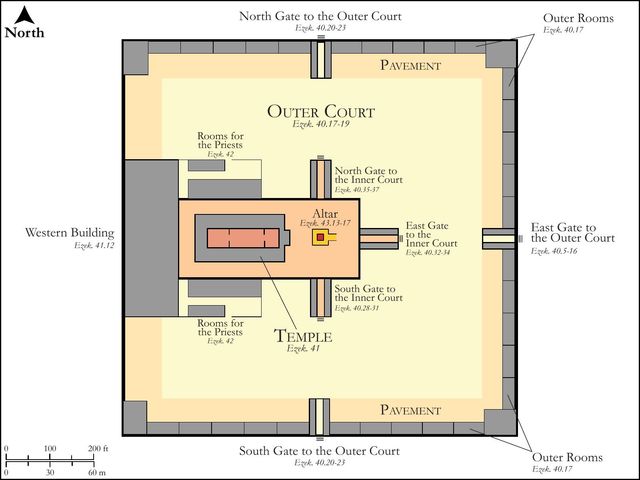
Ezekiel 40:12 provides intricate architectural specifications for the visionary temple, detailing the precise dimensions of the spaces and the "little chambers" within the gate structures. This verse highlights the meticulous and symmetrical design of the divine blueprint for God's future dwelling place, underscoring the profound order, holiness, and intentionality inherent in God's plans for restoration and renewed worship.
Context
ShowHideLiterary Context
Ezekiel 40 marks a pivotal transition in the book of Ezekiel, shifting dramatically from prophecies of judgment and destruction (chapters 1-39) to a vivid, detailed vision of restoration and a new temple (chapters 40-48). Given to Ezekiel during the Babylonian exile, approximately 14 years after the destruction of the first temple in Jerusalem (586 BC), this vision offered a profound message of hope and divine faithfulness to a despondent people. Chapters 40-42 meticulously outline the temple's elaborate layout, encompassing its outer and inner courts, various chambers, and magnificent gate complexes. Ezekiel 40:12 is specifically situated within the extensive description of the East Gate, providing granular measurements for the guardrooms and the intervening passages. This level of architectural precision not only emphasizes the divine origin and importance of the vision but also sets the stage for the glorious return of God's presence to the temple, a climactic event described in Ezekiel 43.
Historical & Cultural Context
The vision of the temple was received by Ezekiel around 573 BC, a time when the Jewish people were in deep despair, having lost their land, their king, and most significantly, their temple—the physical nexus of God's presence and worship. In Israel, the temple was not merely a building but the house of the LORD, built after the pattern He gave, reflecting His order and serving as His dwelling place. Gate complexes, such as those elaborately detailed in Ezekiel's vision, were far more than simple entrances; they were significant architectural and social hubs that often incorporated guardrooms, administrative offices, and spaces for legal proceedings and public assembly. The "cubit" utilized in this text, as explicitly defined in Ezekiel 40:5, was the "long cubit" (approximately 20.6 inches or 52.3 cm), which was a handbreadth longer than the common cubit. This specific, elevated standard of measurement underscores the sacred, extraordinary, and divinely ordained nature of this visionary structure, distinguishing it from ordinary human constructions.
Key Themes
ShowHideThis verse, embedded within the sweeping temple vision, powerfully contributes to several overarching themes central to the book of Ezekiel. Firstly, it profoundly illustrates Divine Precision and Order. The painstaking measurements and symmetrical design evident throughout chapters 40-48, including the specific dimensions articulated in this verse, highlight God's absolute sovereignty, His meticulous attention to detail, and the perfect order inherent in His divine plans. Every single dimension is purposeful, reflecting a holy and purposeful design that leaves nothing to chance. Secondly, the detailed architectural layout, with its various courts, gates, and chambers, emphatically speaks to Holiness and Separation. The precise boundaries and defined spaces serve to delineate and protect the sanctity of God's dwelling place, emphasizing the absolute necessity of purity and separation in approaching Him. Finally, the entire temple vision, including these specific architectural details, delivers a potent message of Future Hope and Restoration to a people in profound despair. It serves as a divine promise that God had not abandoned His covenant people and that His glorious presence would once again dwell among them in a restored land and a purified worship, echoing the profound promise of God's dwelling among His people found in Ezekiel 37:27.
Exposition and Analysis
ShowHideKey Word Analysis
ShowHideProperly meaning "a cord (as twisted)," this term implies a defined boundary or limit. By extension, it refers to the territory enclosed or a precisely delineated area. In Ezekiel 40:12, gᵉbûwl denotes the specific, measured intervals or boundaries situated before and between the "little chambers." Its use here emphasizes the meticulous delineation of every part of the temple complex, highlighting the concept of ordered space where every dimension is intentionally set and strictly adhered to.
This word refers to a room or a circumscribed space. In the context of the elaborate temple gates described in Ezekiel 40-42, these tâʼ are consistently understood as guardrooms or gatehouses. Their inclusion and specific dimensions within the visionary blueprint indicate not only a functional purpose for security but also potentially for housing temple personnel, storing sacred items, or facilitating specific administrative functions related to the gate's operation, all within the meticulously planned structure.
This is a foundational unit of linear measurement, derived from the length of the human forearm (from the elbow to the tip of the middle finger). As explicitly specified in Ezekiel 40:5, the cubit employed for this divine temple vision was a "long cubit," which was a handbreadth longer than the common cubit. This distinction is crucial, as it signifies a divine standard of measurement that transcends ordinary human measures, reinforcing the extraordinary, sacred, and divinely ordained nature of this temple.
Verse Breakdown
ShowHide"The space also before the little chambers [was] one cubit [on this side],"
This initial clause precisely defines the dimension of the open area or boundary immediately preceding the gate's guardrooms. The "one cubit" (understood as the long cubit) indicates a narrow, precise passageway or boundary, emphasizing controlled access and the meticulous planning of the sacred space. The phrase "on this side" implies a symmetrical architectural design, with corresponding measurements on the opposite side of the gate structure.
"and the space [was] one cubit on that side:"
This clause continues the description of the symmetrical "space" or boundary, confirming that the identical one-cubit dimension was maintained on the corresponding side of the gate complex. This repetition powerfully reinforces the exactness, balance, and uniformity of the architectural design, which is critically important for a structure intended to house the very glory of God.
"and the little chambers [were] six cubits on this side,"
This clause shifts focus to specify the dimensions of the guardrooms themselves. Each "little chamber" (or tâʼ) measured six cubits in width or depth on one side. This larger dimension for the chambers suggests their functional purpose, whether for housing guards, providing storage, or facilitating other temple-related activities, all meticulously integrated within the overarching gate structure.
"and six cubits on that side."
Concluding the verse, this final clause reiterates the symmetrical measurement of the chambers, confirming that the six-cubit dimension was consistently applied to both sides of the gate. The repeated "six cubits" profoundly underscores the uniformity and precision that characterize the entire temple vision, reflecting a divine blueprint where every single detail is perfectly balanced, ordered, and purposeful.
Literary Devices
ShowHideThe most prominent literary device employed in Ezekiel 40:12, and indeed throughout the comprehensive architectural vision presented in chapters 40-42, is Precision and Detail. The text functions as an exhaustive blueprint, providing exact measurements for every single component, down to the cubit. This overwhelming level of detail serves to emphatically underscore the divine origin of the vision and to highlight the absolute order, holiness, and perfect design of God's future dwelling place. Another significant device is Repetition, evident in phrases such as "one cubit on this side, and... one cubit on that side" and "six cubits on this side, and six cubits on that side." This repetition powerfully reinforces the inherent symmetry and exactness of the divine design, leaving no room for ambiguity in the sacred instructions. Furthermore, the entire passage functions as an Architectural Vision, a highly symbolic and meticulously detailed description of a structure that transcends mere physical building, pointing to profound deeper theological truths about God's presence, His holiness, and His ultimate plan for restoration.
Theological and Thematic Connections
ShowHideEzekiel 40:12, with its unwavering focus on precise measurements and symmetrical design, offers profound insights into the very nature of God and His interaction with humanity. The meticulous detail underscores God's absolute sovereignty, His profound care for order, and His unwavering commitment to holiness. This divine precision, embedded within the temple's blueprint, reflects the perfect wisdom and intentionality with which God orchestrates all things, from the grand sweep of redemptive history to the minute details of His sacred dwelling. It teaches us that God is a God of design, purpose, and exactness, and that His holy presence demands a structured, reverent, and pure environment. This divine attention to detail implies that all worship and service rendered to God are not arbitrary but are to be conducted with profound reverence, perfect order, and in strict accordance with His revealed will, mirroring the divine blueprint for His eternal kingdom.
Reflection and Application
ShowHideThe seemingly tedious meticulous measurements of Ezekiel 40:12 carry profound spiritual weight, offering a powerful reminder that God is a God of order, precision, and intentionality. Just as every cubit, every space, and every chamber in His visionary temple was perfectly designed according to a divine blueprint, so too is His sovereign plan for our individual lives and for the grand unfolding of His kingdom. This verse challenges us to deeply consider the "measurements" and "dimensions" of our own spiritual lives: Are we living with intentionality and order, striving to reflect God's perfect design for us? Do we approach our walk with God, our worship, and our service with the same reverence, attention to detail, and commitment to purity that He demonstrates in His divine blueprints? It profoundly encourages us to trust that even in the seemingly small or mundane details of our existence, God has a magnificent purpose, and His ultimate plan is one of perfect beauty, holiness, and divine order.
Questions for Reflection
ShowHideFAQ
ShowHideWhat is the significance of the "cubit" measurement in Ezekiel 40:12?
ShowHideThe "cubit" is a traditional unit of measurement, typically based on the length of a human forearm. However, in Ezekiel's visionary temple, as explicitly specified in Ezekiel 40:5, it is the "long cubit," which was a handbreadth longer than the common cubit. This distinction is profoundly significant because it implies a divine, elevated standard of measurement for this sacred temple, setting it apart from ordinary human constructions. It underscores the extraordinary, holy, and divinely ordained nature of God's dwelling place, emphasizing that it adheres to a transcendent, rather than human, scale of perfection and precision.
Why are there so many precise measurements in Ezekiel's temple vision?
ShowHideThe abundance of precise measurements throughout Ezekiel's temple vision, including those in Ezekiel 40:12, serves several crucial theological and pastoral purposes. Firstly, it emphatically highlights God's meticulous nature and His absolute sovereignty over all creation. Every detail is purposeful and divinely ordained, reflecting perfect order and design. Secondly, for the exiled Israelites, these highly detailed plans offered a tangible, concrete message of enduring hope and unwavering assurance that God's glorious presence would indeed return and dwell among them in a restored, purified, and holy manner. The exactness underscored the certainty and reliability of God's promises. Thirdly, the precision powerfully emphasizes the holiness and sacredness of the temple, indicating that approaching God requires adherence to His specific, divine standards, thereby fostering profound reverence and awe in His presence.
Christ-Centered Fulfillment
ShowHideEzekiel 40:12, with its meticulous architectural specifications for the visionary temple, finds its ultimate and profound fulfillment not in a physical edifice, but in the person and work of Jesus Christ. While Ezekiel's temple vision may hold literal or symbolic interpretations regarding a future earthly temple, its deepest spiritual reality points to Christ as the true and ultimate temple of God. Jesus Himself declared, "Destroy this temple, and in three days I will raise it up," speaking prophetically of the temple of His own body (John 2:21). The divine precision and perfect order seen in Ezekiel's blueprint powerfully foreshadow the divine perfection of God's redemptive plan, meticulously executed through Christ's sinless life, sacrificial death, and glorious resurrection. The "spaces" and "chambers" of the visionary temple, designed to control access and facilitate holy worship, are entirely superseded by Christ, who is the "way, the truth, and the life," providing direct, unhindered access to God the Father. The holiness and separation so emphatically emphasized by the temple's intricate design are perfectly fulfilled in Christ's once-for-all sacrifice, which sanctifies believers and makes them a "holy temple in the Lord" and a "dwelling place for God by the Spirit. Ultimately, the profound vision of God dwelling intimately among His people, hinted at in the temple's design, culminates gloriously in the New Covenant through Christ, where believers collectively form the spiritual temple of God (1 Corinthians 3:16), and will be perfectly realized in the New Jerusalem, where God's presence is directly and eternally with humanity, for "the Lord God Almighty and the Lamb are its temple."