


Acts 5:8
Bible text: King James Version (1769 Blayney text) · Public domain
Bible text: Berean Standard Bible · Public domain
Bible text: American Standard Version (1901) · Public domain
Bible text: World English Bible, Messianic edition · Public domain
Bible text: Geneva Bible (1599) · Public domain
Bible text: Young's Literal Translation · Public domain
- ἀπεκρίθηapekrithēRepliedG611V-ADI-3SVerb Aorist Middle Deponent Indicative 3rd Singular
- δὲdethenG1161CONJConjunction
- αὐτὴνautēnherG846P-ASFPersonal pronoun Accusative Singular Feminine
- ὁho<the>G3588T-NSMDefinite article Nominative Singular Masculine
- Πέτρος·PetrosPeterG4074N-NSM-PNoun Nominative Singular Masculine Individual
- εἰπέeipedo tellG2036V-2AAM-2SVerb 2nd Aorist Active Imperative 2nd Singular
- μοιmoimeG3165P-1DSPersonal pronoun Dative 1st Singular
- εἰeiifG1487CONDConjunction
- τοσούτουtosoutoufor so muchG5118K-GSNCorrelative pronoun Genitive Singular Neuter
- τὸtotheG3588T-ASNDefinite article Accusative Singular Neuter
- χωρίονchōrionlandG5564N-ASNNoun Accusative Singular Neuter
- ἀπέδοσθε;apedostheyou sold?G591V-2AMI-2PVerb 2nd Aorist Middle Indicative 2nd Plural
- ἡhē<the>G3588T-NSFDefinite article Nominative Singular Feminine
- δὲdeAndG1161CONJConjunction
- εἶπεν·eipenshe saidG2036V-2AAI-3SVerb 2nd Aorist Active Indicative 3rd Singular
- ναὶnaiYesG3483PRTParticle or Disjunctive
- τοσούτουtosoutoufor so muchG5118K-GSNCorrelative pronoun Genitive Singular Neuter
English is a literal word-by-word gloss of the Greek, not the KJV's wording. Why?
This is the original text the KJV's translators worked from — each Greek word with its own literal English meaning in this verse, prepared by scholars at Tyndale House, Cambridge. The KJV translates whole sentences, not word by word, so its wording differs: one Greek word can become several English words, and the KJV may choose “charity” where the gloss reads “love”. Both are faithful — they answer different questions. For the KJV's own rendering, switch to the KJV text.
Details
See on the biblical-era map
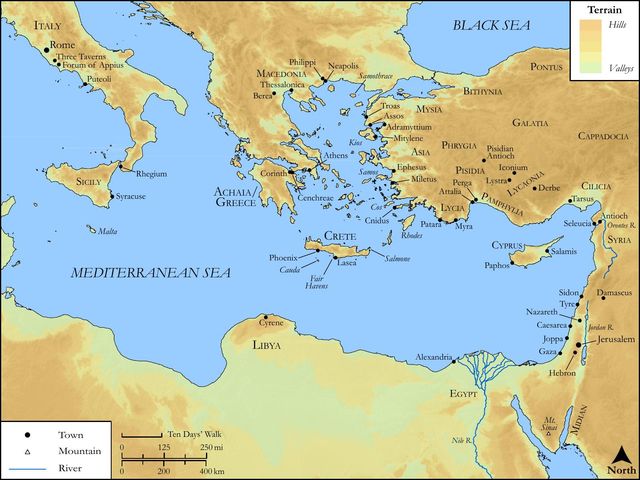
Study this verse
Public-domain commentary
Matthew Henry
From his Commentary on the Whole Bible. Henry comments on passages, not single verses — this entry covers Acts 5:1–11. His four-level outline is real structure in the source text, so it is rendered as structure.
The chapter begins with a melancholy but, which puts a stop to the pleasant and agreeable prospect of things which we had in the foregoing chapters; as every man, so every church, in its best state has its but. 1. The disciples were very holy, and heavenly, and seemed to be all exceedingly good; but there were hypocrites among them, whose hearts were not right in the sight of God, who, when they were baptized, and took upon them the form of godliness, denied the power of godliness, and stopped short of that. There is a mixture of bad with good in the best societies on this side heaven; tares will grow among the wheat until the harvest. 2. It was the praise of the disciples that they came up to that perfection which Christ recommended to the rich young man - they sold what they had, and gave to the poor; but even that proved a cloak and cover of hypocrisy which was thought the greatest proof and evidence of sincerity. 3. The signs and wonders which the apostles wrought were hitherto miracles of mercy; but now comes in a miracle of judgment, and here is an instance of severity following the instances of goodness, that God may be both loved and feared. Observe here,
I.The sin of Ananias and Sapphira his wife.
It is good to see husband and wife joining together in that which is good, but to be confederate in evil is to be like Adam and Eve, when they agreed to eat the forbidden fruit, and were one in their disobedience. Now their sin was,
1.That they were ambitious of being thought eminent disciples, and of the first rank, when really they were not true disciples; they would pass for some of the most fruitful trees in Christ's vineyard, when really the root of the matter was not found in them. They sold a possession, and brought the money (as Barnabas did) to the apostles' feet, that they might not seem to be behind the very chief of believers, but might be applauded and cried up, and stand so much the fairer for preferment in the church, which perhaps they thought would shortly shine in secular pomp and grandeur. Note, It is possible that hypocrites may deny themselves in one thing, but then it is to serve themselves in another; they may forego their secular advantage in one instance, with a prospect of finding their account in something else. Ananias and Sapphira would take upon them a profession of Christianity, and make a fair show in the flesh with it, and so would mock God, and deceive others, when they knew they could not go through with the Christian profession. It was commendable, and so far it was right, in that rich young man, that he would not pretend to follow Christ, when, if it should come to a pinch, he knew he could not come up to his terms, but he went away sorrowful. Ananias and Sapphira pretended they could come up to the terms, that they might have the credit of being disciples, when really they could not, and so were a discredit to discipleship. Note, It is often of fatal consequence for people to go a greater length in profession than their inward principle will admit of.
2.That they were covetous of the wealth of the world, and distrustful of God and his providence: They sold their land, and perhaps then, in a pang of zeal, designed no other than to dedicate the whole of the purchase-money to pious uses, and made a vow, or at least conceived a full purpose, to do so; but, when the money was received, their heart failed them, and they kept back part of the price, (Act 5:2), because they loved the money, and thought it was too much to part with at once, and to trust in the apostles' hands, and because they knew not but they might want it themselves; though now all things were common, yet it would not be so long, and what should they do in a time of need, if they should leave themselves nothing to take to? They could not take God's word that they should be provided for, but thought they would play a wiser part than the rest had done, and lay up for a rainy day. Thus they thought to serve both God and mammon - God, by bringing part of the money to the apostles' feet, and mammon, by keeping the other part in their own pockets; as if there were not an all-sufficiency in God to make up the whole to them, except they retained some in their own hands by way of caution-money. Their hearts were divided, so they were found faulty, Hos 10:2. They halted between two; if they had been thorough-paced worldlings, they would not have sold their possession; and, if they had been thorough-paced Christians, they would not have detained part of the price.
3.That they thought to deceive the apostles, and make them believe they brought the whole purchase-money, when really it was but a part. They came with as good an assurance, and as great a show of piety and devotion, as any of them, and laid the money at the apostles' feet, as if it were their all. They dissembled with God and his Spirit, with Christ and his church and ministers; and this was their sin.
II.The indictment of Ananias, which proved both his condemnation and execution for this sin.
When he brought the money, and expected to be commended and encouraged, as others were, Peter took him to task about it, He, without any enquiry or examination of witnesses concerning it, charges him peremptorily with the crime, and aggravates it, and lays a load upon him for it, showing it to him in its own colour, Act 5:3, Act 5:4. The Spirit of God in Peter not only discovered the fact without any information (when perhaps no man in the world knew it but the man and his wife themselves), but likewise discerned the principle of reigning infidelity in the heart of Ananias, which was at the bottom of it, and therefore proceeded against him so suddenly. Had it been a sin of infirmity, through the surprise of a temptation, Peter would have taken Ananias aside, and have bidden him go home, and fetch the rest of the money, and repent of his folly in attempting to put this cheat upon them; but he knew that his heart was fully set in him to do this evil, and therefore allowed him not space to repent. He here showed him,
1.The origin of his sin: Satan filled his heart; he not only suggested it to him, and put it into his head, but hurried him on with resolution to do it. Whatever is contrary to the good Spirit proceeds from the evil spirit, and those hearts are filled by Satan in which worldliness reigns, and has the ascendant. Some think that Ananias was one of those that had received the Holy Ghost, and was filled with his gifts, but, having provoked the Spirit to withdraw from him, now Satan filled his heart; as, when the Spirit of the Lord departed from Saul, an evil spirit from God troubled him. Satan is a lying spirit; he was so in the mouth of Ahab's prophets, and so he was in the mouth of Ananias, and by this made it appear that he filled his heart.
2.The sin itself: He lied to the Holy Ghost; a sin of such a heinous nature that he could not have been guilty of it if Satan had not filled his heart.
(1.)The phrase which we render lying to the Holy Ghost, pseusasthai se to pneuma to hagion, some read, to belie the Holy Ghost, which may be taken two ways:
[1.]That he belied the Holy Ghost in himself; so Dr. Lightfoot takes it, and supposes that Ananias was not an ordinary believer, but a minister, and one that had received the gift of the Holy Ghost with the hundred and twenty (for mention is made of him immediately after Barnabas); yet he durst thus, by dissembling, belie and shame that gift. Or thus; Those who had sold their estates, and laid the money at the apostles' feet, did it by the special impulse of the Holy Ghost, enabling them to do an act so very great and generous; and Ananias pretended that he was moved by the Holy Ghost to do what he did, as others were; whereas it appeared by his baseness that he was not under the influence of the good Spirit at all; for, had it been his work, it would have been perfect.
[2.]That he belied the Holy Ghost in the apostles, to whom he brought the money; he misrepresented the Spirit they were actuated by, either by a suspicion that they would not faithfully distribute what they were entrusted with (which was a base suggestion, as if they were false to the trust reposed in them), or by an assurance that they could not discover the fraud. He belied the Holy Ghost when by what he did he would have it thought that those who are endued with the gifts of the Holy Ghost might as easily be imposed upon as other men; like Gehazi, whom his master convicted of his error by that word, Went not my heart with thee? Kg2 5:26. It is charged upon the house of Israel and Judah, when, like Ananias here, they dealt very treacherously, that they belied the Lord, saying, It is not he, Jer 5:11, Jer 5:12. Thus Ananias thought the apostles were altogether such as himself, and this was belying the Holy Ghost in them, as if he were not in them a discerner of spirits, whereas they had all the gifts of the Spirit in them, which to others were divided severally. See Co1 12:8-11. Those that pretend to an inspiration of the Spirit, in imposing upon the church their own fancies, either in opinion or practice - that say they are moved from above when they are carried on by their pride, covetousness, or affectation of dominion, belie the Holy Ghost.
(2.)But we read it, to lie unto the Holy Ghost, which reading is countenanced by Act 5:4, Thou hast not lied unto men, but unto God.
[1.]Ananias told a lie, a deliberate lie, and with a purpose to deceive; he told Peter that he had sold a possession (house or lands) and this was the purchase-money. Perhaps he expressed himself in words that were capable of a double meaning, used some equivocations about it, which he thought might palliate the matter a little, and save him from the guilt of a downright lie: or perhaps he said nothing; but it was all one, he did as the rest did who brought the whole price, and would be thought to do so, and expected the praise those had that did so, and the same privilege and access to the common stock as they had; and therefore it was an implicit protestation that he brought the whole price, as they did; and this was a lie, for he kept back part. Note, Many are brought to gross lying by reigning pride, and affectation of the applause of men, particularly in works of charity to the poor. That therefore we may not be found boasting of a false gift given to us, or given by us (Pro 25:14), we must not boast even of a true gift, which is the meaning of our Saviour's caution in works of charity, Let not thy left hand know what thy right hand doeth. Those that boast of good works they never did, or promise good works they never do, or make the good works they do more or better than really they are, come under the guilt of Ananias's lie, which it concerns us all to dread the thought of.
[2.]He told this lie to the Holy Ghost. It was not so much to the apostles as to the Holy Ghost in them that the money was brought, and that was said which was said, Act 5:4, Thou hast not lied unto men (not to men only, not to men chiefly, though the apostles be but men), but thou hast lied unto God. Hence it is justly inferred that the Holy Ghost is God; for he that lieth to the Holy Ghost lieth to God. "Those that lied to the apostles, actuated and acting by the Spirit of God, are said to lie to God, because the apostles acted by the power and authority of God, whence it follows (as Dr. Whitby well observes) that the power and authority of the Spirit must be the power and authority of God." And, as he further argues, "Ananias is said to lie to God, because he lied to that Spirit in the apostles which enabled them to discern the secrets of men's hearts and actions, which being the property of God alone, he that lies to him must therefore lie to God, because he lies to one who has the incommunicable property of God, and consequently the divine essence."
3.The aggravations of the sin (Act 5:4): While it remained, was it not thine own? And, after it was sold, was it not in thine own power? Which may be understood two ways: - (1.) "Thou wast under no temptation to keep back part of the price; before it was sold it was thy own, and not mortgaged nor encumbered, nor any way engaged for debt; and when it was sold it was in thy own power to dispose of the money at thy pleasure; so that thou mightest as well have brought the whole as a part. Thou hadst no debts to pay, perhaps no children to provide for; so that thou wast not under the influence of any particular inducement to keep back part of the price. Thou was a transgressor without a cause." Or, (2.) "Thou wast under no necessity of selling thy land at all, nor bringing any of the money to the apostles' feet. Thou mightest have kept the money, if thou hadst pleased, and the land too, and never have pretended to this piece of perfection." This rule of charity the apostle gives, that people be not pressed, and that it be not urged as of necessity, because God loves a cheerful giver (Co2 9:7), and Philemon must do a good work, not as it were of necessity, but willingly, Plm 1:14. As it is better not to vow than to vow and not to pay, so better had it been for him not to have sold his land at all than thus to keep back part of the price; not to have pretended to do the good work than thus to do it by the halves. "When it was sold, it was in thine own power; but it was not so when it was vowed: thou hadst then opened thy mouth to the Lord, and couldst not go back." Thus, in giving our hearts to God, we are not admitted to divide them. Satan, like the mother whose own the child was not, would take up with a half; but God will have all or none.
4.All this guilt, thus aggravated, is charged upon him: Why hast thou conceived this thing in thine heart? Observe, Though Satan filled his heart to do it, yet he is said to have conceived it in his own heart, which shows that we cannot extenuate our sins by laying the fault of them upon the devil; he tempts, but he cannot force; it is of our own lusts that we are drawn away and enticed. The evil thing, whatever it is, that is said or done, the sinner has conceived it in his own heart; and therefore, if thou scornest, thou alone shalt bear it. The close of the charge is very high, but very just: Thou hast not lied unto men, but unto God. What emphasis does the prophet lay upon that of Ahaz, not wearying men only, but wearying my God also! Isa 7:13. And Moses upon that of Israel, Your murmurings are not against us, but against the Lord! Exo 16:8. So here, Thou mightest have imposed upon us, who are men like thyself; but, be not deceived, God is not mocked. If we think to put a cheat upon God, we shall prove in the end to have put a fatal cheat upon our own souls.
III.The death and burial of Ananias, Act 5:5, Act 5:6.
1.He died upon the spot: Ananias, hearing these words, was speechless, in the same sense that he was who was charged with intruding into the wedding feast without a wedding garment: he had nothing to say for himself; but this was not all: he was struck speechless with a witness, for he was struck dead: He fell down, and gave up the ghost. It does not appear whether Peter designed and expected that this would follow upon what he said to him; it is probable that he did, for to Sapphira his wife Peter particularly spoke death, Act 5:9. Some think that an angel struck him, that he died, as Herod, Act 12:23. Or, his own conscience smote him with such horror and amazement at the sense of his guilt, that he sunk and died away under the load of it. And perhaps, when he was convicted of lying to the Holy Ghost, he remembered the unpardonableness of the blasphemy against the Holy Ghost, which struck him like a dagger to the heart. See the power of the word of God in the mouth of the apostles. As it was to some a savour of life unto life, so it was to others a savour of death unto death. As there are those whom the gospel justifies, so there are those whom it condemns. This punishment of Ananias may seem severe, but we are sure it was just.
(1.)It was designed to maintain the honour of the Holy Ghost as now lately poured out upon the apostles, in order to the setting up of the gospel kingdom. It was a great affront which Ananias put upon the Holy Ghost, as if he could be imposed upon: and it had a direct tendency to invalidate the apostles' testimony; for, if they could not by the Spirit discover this fraud, how could they by this Spirit discover the deep things of God, which they were to reveal to the children of men? It was therefore necessary that the credit of the apostles' gifts and powers should be supported, though it was at this expense.
(2.)It was designed to deter others from the like presumptions, now at the beginning of this dispensation. Simon Magus afterwards was not thus punished, nor Elymas; but Ananias was made an example now at first, that, with the sensible proofs given what a comfortable thing it is to receive the Spirit, there might be also sensible proofs given what a dangerous thing it is to resist the Spirit, and do despite to him. How severely was the worshipping of the golden calf punished, and the gathering of sticks on the sabbath-day, when the laws of the second and fourth commandments were now newly given! So was the offering of strange fire by Nadab and Abihu, and the mutiny of Korah and his company, when the fire from heaven was now newly given, and the authority of Moses and Aaron now newly established. The doing of this by the ministry of Peter, who himself with a lie denied his Master but a little while ago, intimates that it was not the resentment of a wrong done to himself; for then he, who had himself been faulty, would have had charity for those that offended; and he, who himself had repented and been forgiven, would have forgiven this affront, and endeavoured to bring this offender to repentance; but it was the act of the Spirit of God in Peter: to him the indignity was done, and by him the punishment was inflicted.
2.He was buried immediately, for this was the manner of the Jews (Act 5:6): The young men, who it is probable were appointed to that office in the church of burying the dead, as among the Romans the libitinarii and polinctores; or the young men that attended the apostles, and waited on them, they wound up the dead body in grave-clothes, carried it out of the city, and buried it decently, though he died in sin, and by an immediate stroke of divine vengeance.
IV.The reckoning with Sapphira, the wife of Ananias, who perhaps was first in the transgression, and tempted her husband to eat this forbidden fruit. She came in to the place where the apostles were, which, as it should seem, was Solomon's porch, for there we find them (Act 5:12), a part of the temple where Christ used to walk, Joh 10:23. She came in about three hours after, expecting to share in the thanks of the house for her coming in, and consenting to the sale of the land, of which perhaps she was entitled to her dower or thirds; for she knew not what had been done. It was strange that nobody ran to tell her of the sudden death of her husband, that she might keep away; perhaps some one did, and she was not at home; and so when she came to present herself before the apostles, as a benefactor to the fund she met with a breach instead of a blessing.
1.She was found guilty of sharing with her husband in his sin, by a question that Peter asked her (Act 5:8): Tell me whether you sold the land for so much? naming the sum which Ananias had brought and laid at the apostles' feet. "Was this all you received for the sale of the land, and had you no more for it?" "No," saith she, "we had no more, but that was every farthing we received." Ananias and his wife agreed to tell the same story, and the bargain being private, and by consent kept to themselves, nobody could disprove them, and therefore they thought they might safely stand in the lie, and should gain credit to it. It is sad to see those relations who should quicken one another to that which is good harden one another in that which is evil.
2.Sentence was passed upon her, that she should partake in her husband's doom, Act 5:9.
(1.)Her sin is opened: How is it that you have agreed together to tempt the Spirit of the Lord? Before he passes sentence, he makes her to know her abominations, and shows her the evil of her sin. Observe,
[1.]That they tempted the Spirit of the Lord; as Israel tempted God in the desert, when they said, Is the Lord among us, or is he not? after they had seen so many miraculous proofs of his power; and not only his presence, but his presidency, when they said, Can God furnish a table? So here, "Can the Spirit in the apostles discover this fraud? Can they discern that this is but a part of the price, when we tell them it is the whole?" Can he judge through this dark cloud? Job 22:13. They saw that the apostles had the gift of tongues; but had they the gift of discerning spirits? Those that presume upon security and impunity in sin tempt the Spirit of God; they tempt God as if he were altogether such a one as themselves.
[2.]That they agreed together to do it, making the bond of their relation to each other (which by the divine institution is a sacred tie) to become a bond of iniquity. It is hard to say which is worse between yoke-fellows and other relations - a discord in good or concord in evil. It seems to intimate that their agreeing together to do it was a further tempting of the Spirit; as if, when they had engaged to keep one another's counsel in this matter, even the Spirit of the Lord himself could not discover them. Thus they digged deep to hide their counsel from the Lord, but were made to know it is in vain. "How is it that you are thus infatuated? What strange stupidity has seized you, that you would venture to make trial of that which is past dispute? How is it that you, who are baptized Christians, do not understand yourselves better? How durst you run so great a risk?"
(2.)Her doom is read: Behold, the feet of those who have buried thy husband are at the door (perhaps he heard them coming, or knew that they could not be long): and they shall carry thee out. As Adam and Eve, who agreed to eat the forbidden fruit, were turned together out of paradise, so Ananias and Sapphira, who agreed to tempt the Spirit of the Lord, were together chased out of the world.
3.The sentence executed itself. There needed no executioner, a killing power went along with Peter's word, as sometimes a healing power did; for the God in whose name he spoke kills and makes alive; and out of his mouth (and Peter was now his mouth) both evil and good proceed (Act 5:10): Then fell she down straightway at his feet. Some sinners God makes quick work with, while others he bears long with; for which difference, doubtless, there are good reasons; but he is not accountable to us for them. She heard not till now that her husband was dead, the notice of which, with the discovery of her sin, and the sentence of death passed upon her, struck her as a thunderbolt and took her away as with a whirlwind. And many instances there are of sudden deaths which are not to be looked upon as the punishment of some gross sin, like this. We must not think that all who die suddenly are sinners above others; perhaps it is in favour to them, that they have a quick passage: however, it is forewarning to all to be always ready. But here it is plain that it was in judgment. Some put the question concerning the eternal state of Ananias and Sapphira, and incline to think that the destruction of the flesh was that the spirit might be saved in the day of the Lord Jesus. And I should go in with that charitable opinion if there had been any space given them to repent, as there was to the incestuous Corinthian. But secret things belong not to us. It is said, She fell down at Peter's feet; there, where she should have laid the whole price and did not, she was herself laid, as it were to make up the deficiency. The young men that had the care of funerals coming in found her dead; and it is not said, They wound her up, as they did Ananias, but, They carried her out as she was, and buried her by her husband; and probably an inscription was set over their graves, intimating that they were joint-monuments of divine wrath against those that lie to the Holy Ghost. Some ask whether the apostles kept the money which they did bring, and concerning which they lied? I am apt to think they did; they had not the superstition of those who said, It is not lawful for us to put it into the treasury: for unto the pure all things are pure. What they brought was not polluted to those to whom they brought it; but what they kept back was polluted to those that kept it back. Use was made of the censers of Korah's mutineers.
V.The impression that this made upon the people.
Notice is taken of this in the midst of the story (Act 5:5): Great fear came upon all that heard these things, that heard what Peter said, and saw what followed; or upon all that heard the story of it; for, no doubt, it was all the talk of the city. And again (Act 5:11), Great fear came upon all the church, and upon as many as heard these things.
1.Those that had joined themselves to the church were thereby struck with an awe of God and of his judgments, and with a greater veneration for this dispensation of the Spirit which they were now under. It was not a damp or check to their holy joy, but it taught them to be serious in it, and to rejoice with trembling. All that laid their money at the apostles' feet after this were afraid of keeping back any part of the price.
2.All that heard it were put into a consternation by it, and were ready to say, Who is able to stand before this holy Lord God and his Spirit in the apostles? As Sa1 6:20.
Historical interpretation
Historical reception
2 surviving comments on this verse. Each one is dated, so this reads as a timeline rather than a list.
Select a marker to jump to its quote. Markers stagger vertically where authors wrote within a few decades of each other.
"You shall not steal:" [Exodus 20:15] for Achan, when he had stolen in Israel at Jericho, was stoned to death; [Joshua 7:1] and Gehazi, who stole, and told a lie, inherited the leprosy of Naaman; [2 Kings 5:27] and Judas, who stole the poor's money, betrayed the Lord of glory to the Jews, [John 12:6] and repented, and hanged himself, and burst asunder in the midst, and all his bowels gushed out; [Matthew 27:5; Acts 1:18] and Ananias, and Sapphira his wife, who stole their own goods, and "tempted the Spirit of the Lord," were immediately, at the sentence of Peter our fellow-apostle, struck dead. [Acts 5:1-11]
"And the young men arose, and wound him up, and carried him out, and buried him. And it was about the space of three hours after, when his wife, not knowing what was done, came in. And Peter answered unto her, Tell me whether ye sold the land for so much?"
The woman he would fain save, for the man had been the author of the sin: therefore he gives her time to clear herself, and opportunity for repentance, saying, "Tell me whether ye sold the land for so much?"
But observe how Peter, instead of sending for her, waited till she entered; and how none of the others durst carry out the intelligence. Such the teacher's awfulness, such the disciples' reverence, such the obedience! "An interval of three hours," and yet the woman did not hear of it, and none of those present reported it, although there was time enough for it to be noised abroad; but they were afraid. This circumstance the Evangelist relates with wonder even, when he says, "Not knowing what was done, came in." "And Peter answered unto her," etc. And yet she might have perceived even from this that Peter knew the secret. For why, having questioned none other, does he question you? Was it not clear that he asked because he knew? But so great was her hardness, it would not let her attempt to evade the guilt; and with great confidence she replied; for she thought she was speaking only to a man.
Continue studying Acts 5:8 across the web’s major study libraries — every link below opens this exact verse, chapter, or book on the destination site.
Read & Compare
 BibleGatewayThis verse in more than 200 translations and 70 languages.
 Bible.comThe YouVersion reader — hundreds of translations, reading plans, and highlights.
 ESV.orgCrossway's official English Standard Version reader.
 NET BibleThe NET translation with 60,000+ translators' notes on every rendering decision.
 STEP BibleTyndale House's free study tool — original text, vocabulary, and scholarly resources.
 BibliaLogos Bible Software's free web reader.
 USCCBThe New American Bible (Revised Edition) with the U.S. bishops' study notes.
Commentaries
 BibleHub CommentariesDozens of classic commentaries on this verse, gathered on one page.
 StudyLightMore than 100 commentary sets — the largest collection on the web.
 BibleRefPlain-English commentary on what this verse means, verse by verse.
 Enduring WordDavid Guzik's free commentary on this chapter, widely used by Bible teachers.
 Bible Study ToolsVerse commentary alongside Greek and Hebrew study aids.
Original Language & Research
- BibleHub InterlinearThe verse word by word — original language, transliteration, and English.
- BibleHub LexiconEvery word's original-language definition and Strong's entry.
 Blue Letter BibleDeep-study tools — Strong's numbers, concordance, and word studies.
 CNTR CollationThe earliest Greek manuscripts of this verse, collated letter by letter.
Sermons, Hymns & Audio


TrulyRandomVerse is not affiliated with these sites and doesn’t control their content. They’re linked because they’re genuinely useful.
Summary
Acts 5:8 captures the climactic moment of Sapphira's confrontation with Peter, just hours after her husband Ananias's death for deceit. Peter's direct question, "Tell me whether ye sold the land for so much?", offers Sapphira a final, clear opportunity to confess the truth about their fraudulent transaction. Her subsequent affirmation, "Yea, for so much," seals her fate, revealing a shared complicity in lying to the Holy Spirit and underscoring the early church's profound commitment to purity, truth, and the severe consequences of hypocrisy within the nascent community.
Context
ShowHideLiterary Context
Acts 5:8 is the pivotal point in the tragic narrative of Ananias and Sapphira, which begins in Acts 5:1. The preceding verses detail Ananias's deception regarding the sale of a property, his confrontation by Peter, and his immediate death upon lying to the Holy Spirit. Peter's question to Sapphira in Acts 5:8 occurs three hours after Ananias's demise, with Sapphira entering unaware of her husband's fate. This moment serves as a direct parallel and a final test, setting up the swift and equally severe judgment that follows in Acts 5:9-10. The entire episode is framed by the early church's communal living practices described in Acts 4:32-37, highlighting the stark contrast between genuine generosity and deceitful performance.
Historical & Cultural Context
The early Christian community, as depicted in Acts, was characterized by radical generosity and a profound sense of unity, often involving the voluntary sharing of possessions, as seen in Acts 2:44-45. While not mandatory, selling property and donating proceeds to the apostles for distribution to the needy was a significant act of devotion. In this context, Ananias and Sapphira's sin was not merely withholding money, but rather the pretense of full devotion while secretly retaining a portion. This act of deception was particularly egregious within a community founded on truth and the indwelling Holy Spirit, echoing Old Testament covenant violations that brought severe consequences, such as Achan's sin in Joshua 7. The public nature of their judgment served as a powerful deterrent, establishing the sanctity and integrity required within the new covenant community.
Key Themes
ShowHideThis verse powerfully contributes to several overarching themes in Acts. Firstly, it underscores the holiness and sovereignty of the Holy Spirit, emphasizing that lying to the community leaders was tantamount to lying directly to God, as Peter clarifies in Acts 5:3-4. Secondly, it highlights the theme of divine judgment against hypocrisy and deceit within the church, demonstrating God's zero tolerance for spiritual corruption at its foundational stage. Thirdly, the narrative showcases apostolic authority and discernment, as Peter, empowered by the Spirit, possesses supernatural knowledge of their deception, reinforcing the apostles' role as God's chosen instruments for guiding the nascent church, a theme consistently seen throughout the book of Acts. Finally, it emphasizes the importance of integrity and truthfulness as core virtues for believers, setting a precedent for the ethical standards expected within the body of Christ.
Exposition and Analysis
ShowHideKey Word Analysis
ShowHideThis word, G611, means "to conclude for oneself, i.e. (by implication) to respond; by Hebraism (compare עָנָה) to begin to speak (where an address is expected)." In this context, Peter's "answer" is not a reply to a question from Sapphira, but rather a solemn, authoritative declaration and interrogation, initiating a critical exchange. It signifies a decisive, Spirit-led move to bring the hidden truth to light.
Meaning "to give away, i.e. up, over, back, etc. (in various applications)... sell, yield." This term precisely describes the act of selling the land, which was the basis of their deception. Peter's use of this word directly references the transaction they had claimed to have fully given to the church, making his question a direct challenge to their honesty regarding the entire proceeds.
A "primary particle of strong affirmation; yes:--even so, surely, truth, verily, yea, yes." Sapphira's single-word response "Yea" is a definitive and emphatic affirmation. It is not a hesitant or ambiguous reply but a strong, deliberate confirmation of the lie, demonstrating her full complicity and conscious choice to deceive, even when presented with a clear opportunity to repent.
Verse Breakdown
ShowHide"And Peter answered unto her,"
This phrase introduces Peter's direct engagement with Sapphira. The "answered" (G611, apokrínomai) here implies a solemn, authoritative response to the unfolding situation, rather than a reply to a question from Sapphira. It signifies Peter, empowered by the Holy Spirit, taking the initiative to confront the hidden sin.
"Tell me whether ye sold the land for so much?"
This is Peter's penetrating question, designed to elicit the truth. The phrase "Tell me" (G2036, épō) is a command, demanding a direct answer. "Whether" (G1487, ei) introduces a conditional clause, presenting Sapphira with a clear choice: affirm the truth or perpetuate the lie. The crucial element is "for so much" (G5118, tosoûtos), which implies a specific, known amount—the amount they had claimed to have given. Peter is not asking what the amount was, but if the amount they had declared was the entire sum.
"And she said, Yea, for so much."
Sapphira's response is concise and damning. Her "Yea" (G3483, naí) is a strong affirmation, indicating a conscious and deliberate choice to confirm the lie. The repetition of "for so much" (G5118, tosoûtos) mirrors Peter's question, confirming that she understood the precise nature of his inquiry and chose to double down on the deception, sealing her fate.
Literary Devices
ShowHideThe passage employs several potent literary devices. Dramatic Irony is central, as Sapphira enters unaware of her husband's death and the reason for it, while the reader (and Peter) knows the full truth, making her confident lie all the more tragic. Peter's question is a direct Interrogation, a precise and pointed inquiry that leaves no room for ambiguity, forcing Sapphira to make an explicit choice. The Repetition of the phrase "for so much" (G5118, tosoûtos) in both Peter's question and Sapphira's answer highlights the specific point of contention—the exact amount declared versus the actual sale price—and underscores the deliberate nature of her deception. This repetition also builds narrative tension, leading directly to the inevitable judgment.
Theological and Thematic Connections
ShowHideActs 5:8 serves as a stark reminder of God's holiness and the gravity with which He views integrity within His covenant community. The immediate and severe judgment on Ananias and Sapphira, initiated by Peter's Spirit-led confrontation, underscores that the early church was not merely a social club but a divine institution where truth and purity were paramount. This event established a terrifying precedent, instilling a healthy fear and reverence for God among believers and outsiders alike, ensuring the church's foundation was built on genuine faith rather than outward show. It teaches that deception, especially concerning spiritual matters or contributions to God's work, is not merely a human failing but an offense against the Holy Spirit Himself.
Reflection and Application
ShowHideActs 5:8 challenges believers to examine the depth of their sincerity and transparency before God and the community. In an age where outward appearances often overshadow inner reality, this passage calls us to radical integrity. It reminds us that God sees beyond our public declarations and our visible contributions, penetrating to the motives of our hearts. Are we truly living lives of truth, or are we, like Ananias and Sapphira, holding back portions of ourselves—our full devotion, our honest intentions, our complete surrender—while presenting a facade of piety? This narrative urges us to cultivate a profound reverence for God's holiness and to understand that our relationship with Him demands unvarnished honesty. While divine judgment may not manifest in the same immediate, physical way today, the spiritual consequences of deception and hypocrisy remain severe, hindering our fellowship with God and undermining the integrity of the church. This passage serves as a powerful call to live authentically, recognizing that our lies are ultimately against the Holy Spirit who indwells us and empowers the church.
Questions for Reflection
ShowHideFAQ
ShowHideWhy was the punishment for Ananias and Sapphira so severe?
ShowHideThe severity of the judgment on Ananias and Sapphira in Acts 5 is often understood in the context of the early church's foundational period. Their sin was not merely withholding money, but "lying to the Holy Spirit" (Acts 5:3) and "testing the Spirit of the Lord" (Acts 5:9). This act of deliberate deceit and hypocrisy, aimed at gaining prestige while defrauding God, posed a grave threat to the nascent church's spiritual health and witness. The immediate and public judgment served as a powerful deterrent, instilling a healthy fear of God and establishing a clear precedent for the holiness required within the body of Christ, ensuring that the church's foundation was built on truth and sincerity.
Christ-Centered Fulfillment
ShowHideWhile Acts 5:8 and the subsequent judgment highlight God's righteous wrath against sin and hypocrisy, the ultimate fulfillment of God's response to human deceit is found in Jesus Christ. The immediate and physical judgment on Ananias and Sapphira serves as a stark Old Testament-like warning, demonstrating God's intolerance for sin within His holy community. However, in the New Covenant, God's justice is perfectly met in the person of Jesus. He is the one who, though perfectly truthful and without sin, bore the full weight of humanity's deception and sin on the cross, becoming the ultimate sacrifice for our lies and hypocrisy (2 Corinthians 5:21). Through His atoning work, the severity of God's judgment, which Sapphira experienced, is now satisfied for those who believe. Rather than immediate death for our lies, we are offered forgiveness and the indwelling Holy Spirit, who convicts us of sin and guides us into all truth (John 16:8 and John 16:13). Thus, while Acts 5:8 shows the consequence of rejecting truth in the Spirit's presence, Christ offers the path to genuine truthfulness and reconciliation, transforming hearts from deceit to integrity through His grace (Ephesians 4:25).